Two equal charges $q$ are placed at a distance of $2a$ and a third charge $ - 2q$ is placed at the midpoint. The potential energy of the system is
Medium


Download our appand get started for free
Experience the future of education. Simply download our apps or reach out to us for more information. Let's shape the future of learning together!No signup needed.*
Similar Questions
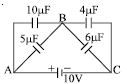
- 1View SolutionIn the circuit shown in figure, four capacitors are connected to a battery. A capacitor is connected to a battery. The force of attraction between the plates when the separation between them is halved
- 2What is the potential energy of the equal positive point charges of $1\,\mu C$ each held $1\, m$ apart in airView Solution
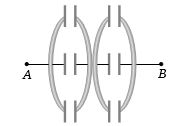
- 3All six capacitors shown are identical, Each can withstand maximum $200\, volts$ between its terminals. The maximum voltage that can be safely applied between $A$ and $B$ is.....$V$View Solution
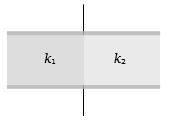
- 4A parallel plate condenser is filled with two dielectrics as shown. Area of each plate is $A\;metr{e^2}$ and the separation is $t$ $metre$. The dielectric constants are ${k_1}$ and ${k_2}$ respectively. Its capacitance in farad will beView Solution
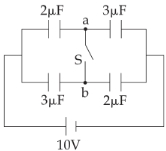
- 5In figure a system of four capacitors connected across a $10\, V$ battery is shown. Charge that will flow from switch $S$ when it is closed isView Solution
- 6Electric potential in a region is varying according to the relation $V=\frac{3 x^2}{2}-\frac{y^2}{4}$, where $x$ and $y$ are in metre and $V$ is in volt. Electric field intensity (in $N/C$) at a point $(1 \,m , 2 \,m$ ) is ......View Solution
- 7A parallel plate capacitor has capacitance $C$ . If charges of the plates are $Q$ and $-3Q$ , find the potential difference between the platesView Solution
- 8View SolutionA capacitor is charged by using a battery which is then disconnected. A dielectric slab is introduced between the plates which results in
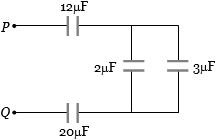
- 9In the circuit diagram shown in the adjoining figure, the resultant capacitance between $P$ and $Q$ is........$\mu F$View Solution
- 10While working on a physics project at school physics lab, you require a $4 \,\mu F$ capacitor in a circuit across a potential difference of $1 \,kV$. Unfortunately, $4 \,\mu F$ capacitors are out of stock in your lab but $2 \,\mu F$ capacitors which can withstand a potential difference of $400 \,V$ are available in plenty. If you decide to use the $2 \,\mu F$ capacitors in place of $4 \,\mu F$ capacitor, minimum number of capacitors required areView Solution