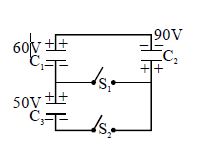
Three charged capacitors, $C_1$ = $17\ μF$, $C_2$ = $34\ μF$, $C_3$ = $41\ μF$and two open switches, $S_1$ and $S_2$ are assembled into a network with initial voltages and polarities, as shown. Final status of the network is attained when the two switches, $S_1$ and $S_2$ are closed. In the figure, the final charge on capacitor $C_3$ in $mC$, is closet to:
Diffcult


Download our appand get started for free
Experience the future of education. Simply download our apps or reach out to us for more information. Let's shape the future of learning together!No signup needed.*
Similar Questions
- 1If identical charges $( - q)$ are placed at each corner of a cube of side $b$, then electric potential energy of charge $( + q)$ which is placed at centre of the cube will beView Solution
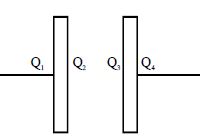
- 2In an insulated parallel-plate capacitor of capacitance $C$, the four surfaces have charges $Q_1, Q_2, Q_3$ and $Q_4$ as shown. The potential difference between the plate isView Solution
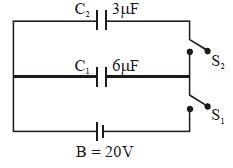
- 3In the circuit shown here $C_1 = 6\,\mu F, C_2 = 3 \,\mu F$ and battery $B = 20\,V$. The switch $S_1$ is first closed. It is then opened and afterwards $S_2$ is closed. What is the charge (in $\mu F$)finally on $C_2$ ?View Solution
- 4Two metal spheres of capacitance ${C_1}$ and ${C_2}$ carry some charges. They are put in contact and then separated. The final charges ${Q_1}$ and ${Q_2}$ on them will satisfyView Solution
- 5Two condensers of capacities $1\,\mu F$ and $2\,\mu F$ are connected in series and the system is charged to $120\;volts$. Then the $P.D.$ on $1\,\mu F$ capacitor (in $volts$) will beView Solution
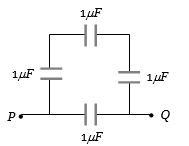
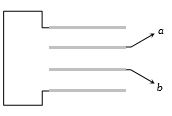
- 6Four metallic plates each with a surface area of one side $A$ are placed at a distance $d$ from each other. The plates are connected as shown in the circuit diagram. Then the capacitance of the system between $a$ and $b$ isView Solution
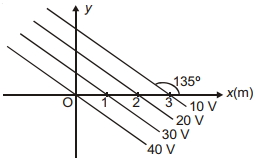
- 7View SolutionFigure shows a set of equipotential surfaces. The magnitude and direction of electric field that exists in the region is .........
- 8The distance between the circular plates of a parallel plate condenser $40\,mm$ in diameter, in order to have same capacity as a sphere of radius $1\;metre$ is....$mm$View Solution
- 9A capacitor of capacitance $C$ is charged to potential difference $V_0$. Now this capacitor is connected to an ideal inductor. When $25\%$ of energy of capacitor is transferred to inductor then at that time what will be potential difference across capacitorView Solution
- 10Four capacitors are connected as shown in the equivalent capacitance between the points $P$ and $Q$ is.......$\mu F$View Solution