A point P (-2, 3) is reflected in line x = 2 to point P’. Find the coordinates of P’.
Exercise 12 (B) | Q 6 | Page 170
Download our app for free and get started
The line x = 2 is a line parallel to y-axis and at a distance of 2 units from it.
Mark point P (-2, 3).
From P, draw a straight line perpendicular to line CD and produce. On this line mark a point P’ which is at the same distance to the right of CD as P is to the left of it.
The co-ordinates of P’ are (6, 3).
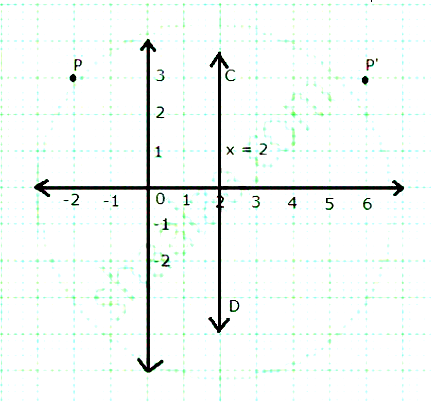
Mark point P (-2, 3).
From P, draw a straight line perpendicular to line CD and produce. On this line mark a point P’ which is at the same distance to the right of CD as P is to the left of it.
The co-ordinates of P’ are (6, 3).

Download our appand get started for free
Experience the future of education. Simply download our apps or reach out to us for more information. Let's shape the future of learning together!No signup needed.*
Similar Questions
- 1View SolutionThe points P (4, 1) and Q (-2, 4) are reflected in line y = 3. Find the co-ordinates of P’, the image of P and Q’, the image of Q.
- 2View Solution(i) Plot the points A (3, 5) and B (-2, -4). Use 1 cm = 1 unit on both the axes.
(ii) A’ is the image of A when reflected in the x-axis. Write down the co-ordinates of A’ and plot it on the graph paper.
(iii) B’ is the image of B when reflected in the y-axis, followed by reflection in the origin. Write down the co-ordinates of B’ and plot it on the graph paper.
(iv) Write down the geometrical name of the figure AA’BB’.
(v) Name the invariant points under reflection in the x-axis.
- 3View SolutionA (1, 1), B (5, 1), C (4, 2) and D (2, 2) are vertices of a quadrilateral. Name the quadrilateral ABCD. A, B, C, and D are reflected in the origin on to A’, B’, C’ and D’ respectively. Locate A’, B’, C’ and D’ on the graph sheet and write their co-ordinates .
Are D, A, A’ and D’ collinear?
- 4View Solution
Use a graph paper for this question: (Take 2cm = 1 unit on both x and y axes) (i) Plot the following points: A(0,4), B(2,3), C(1,1) and D(2,0).
(ii) Reflect points B, C, D on the y-axis and write down their coordinates. Name the images as B', C', D' respectively.
(iii) Join the points A, B, C, D, D', C', B' and A in order, so as to form a closed figure. Write down the equation to the line about which if this closed figure obtained is folded, the two parts of the figure exactly coincide.
- 5View SolutionA point P (a, b) is reflected in the x-axis to P’ (2, -3). Write down the values of a and b. P” is the image of P, reflected in the y-axis. Write down the co-ordinates of P”. Find the co-ordinates of P”’, when P is reflected in the line, parallel to y-axis, such that x = 4.
- 6View SolutionThe point P (3, 4) is reflected to P’ in the x-axis; and O’ is the image of O (the origin) when reflected in the line PP’.
Write:
(i) the co-ordinates of P’ and O’.
(ii) the length of the segments PP’ and OO’.
(iii) the perimeter of the quadrilateral POP’O’.
(iv) the geometrical name of the figure POP’O’.
- 7View Solution
Use graph paper for this question.
(Take 2 cm = 1 unit along both side x-axis and y-axis.)
Plot the points O(0,0), A(-4, 4), B(-3, 0) and C(0, -3).
- Reflect points A and B on the y-axis and name them A' and B' respectively. Write down their co-ordinates.
- Name the figure OABCB'A'.
- iii. State the line of symmetry of this figure. [Now symmetry is not in course]
- 8View SolutionUsing a graph paper, plot the point A (6, 4) and B (0, 4).
(a) Reflect A and B in the origin to get the image A’ and B’.
(b) Write the co-ordinates of A’ and B’.
(c) Sate the geometrical name for the figure ABA’B’.
(d) Find its perimeter.
- 9The point $P (5, 3)$ was reflected in the origin to get the image $P’.(a)$ Write down the co-ordinates of P’.View Solution
(b) If M is the foot if the perpendicular from P to the x-axis, find the co-ordinates of M.
(c) If N is the foot if the perpendicular from P’ to the x-axis, find the co-ordinates of N.
(d) Name the figure PMP’N.
(e) Find the area of the figure PMP’N. - 10The triangle $A B C$, where $A$ is $(2,6), B$ is $(-3,5)$ and $C$ is $(4,7)$, is reflected in the $y$-axis to triangle $A^{\prime} B^{\prime} C^{\prime}$. Triangle $A^{\prime} B^{\prime} C^{\prime}$ is then reflected in the origin to triangle $A^{\prime \prime} B^{\prime \prime} C^{\prime \prime}$.View Solution
i. Write down the co-ordinates of $A ^{\prime \prime}, B ^{\prime \prime}$ and $C ^{\prime \prime}$.
ii. Write down a single transformation that maps triangle $A B C$ onto triangle $A^{\prime \prime} B^{\prime \prime} C^{\prime \prime}$.