Question
Define root mean square velocity. How is the temperature of an ideal gas explained by the kinetic theory of gases?
Answer

SELF

Need a full question paper?

Generate a complete, print-ready paper with questions like this in minutes — across 16+ boards, with answer keys.

Start Generating Free

Similar questions

A body performs simple harmonic motion according to the following equation :
$
x=6 \sin \left(3 \pi t+\frac{\pi}{3}\right)
$
Find out : (i) amplitude (ii) period (iii) initial art (iv) displacement, velocity and acceleration at time $t = 2$.
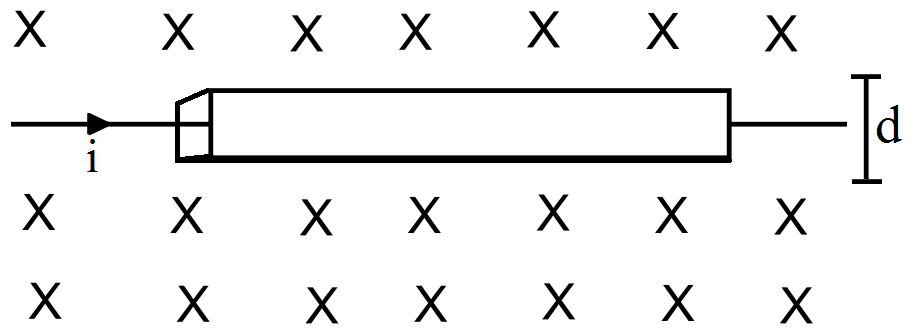
A current i is passed through a silver strip of width d and area of cross-section A. The number of free electrons per unit volume is n.
  1. Find the drift velocity v of the electrons.
  2. If a magnetic field B exists in the region, as shown in the figure, what is the average magnetic force on the free electrons?
  3. Due to the magnetic force, the free electrons get accumulated on one side of the conductor along its length. This produces a transverse electric field in the conductor, which opposes the magnetic force on the electrons. Find the magnitude of the electric field which will stop further accumulation of electrons.
  4. What will be the potential difference developed across the width of the conductor due to the electron-accumulation? The appearance of a transverse emf, when a current-carrying wire is placed in a magnetic field, is called Hall effect.
An LR circuit has L = 1.0H and $\text{R}=20\Omega.$ It is connected across an emf of 2.0V at t = 0. Find $\frac{\text{di}}{\text{dt}}$ at:
  1. t = 100ms
  2. t = 200ms
  3. t = 1.0s
Check the accuracy of following formulas:
(i) $F =\frac{m v^2}{r}$
(ii) $T =\frac{\text { hrgd }}{2}$
(iii) $T =2 \pi \sqrt{\frac{l}{g}}$
(iv) $Y =\frac{ MgL }{\pi r^2 l}$ Here, Y is Young's modulus.
(v) $S =u t+\frac{1}{2} a t^2$
(vi) $\frac{1}{2} m v^2=m g h$
(vii) $v^2=u^2+2 a s$ where $v$ and $u$ are final and initial velociteis respectively. a is acceleration and $s$ is the distance covered.
(viii) $n=\frac{1}{2 l} \sqrt{\frac{T}{m}}$, Here $n$ is frequency, T is tension force, $l$ is length and $m$ is mass of unit length.
A hot air balloon is a sphere of radius 8 m . The air inside is at a temperature of $60^{\circ} \mathrm{C}$. How large a mass can the balloon lift when the outside temperature is $20^{\circ} \mathrm{C}$ ? (Assume air is an ideal gas, $\mathrm{R}=8.314 \mathrm{~J} \mathrm{~mole}^{-1} \mathrm{~K}^{-1}, 1 \mathrm{~atm} .=1.013 \times$ $10^5$ Pa the membrane tension is $5 \mathrm{~N} \mathrm{~m}^{-1}$)
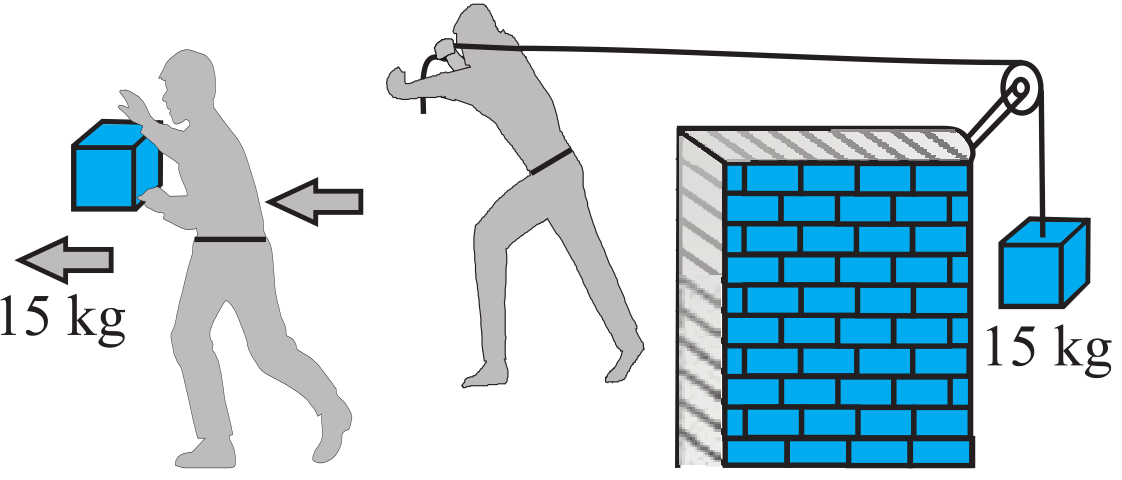
Answer the following: In the man walks $2m$ carrying a mass of $15kg$ on his hands. In he walks the same distance pulling the rope behind him. The rope goes over a pulley, and a mass of $15kg$ hangs at its other end. In which case is the work done greater?
A piano wire A vibrates at a fundamental frequency of 600Hz. A second identical wire B produces 6 beats per second with it when the tension in A is slightly increased. Find the ratio of the tension in A to the tension in B.
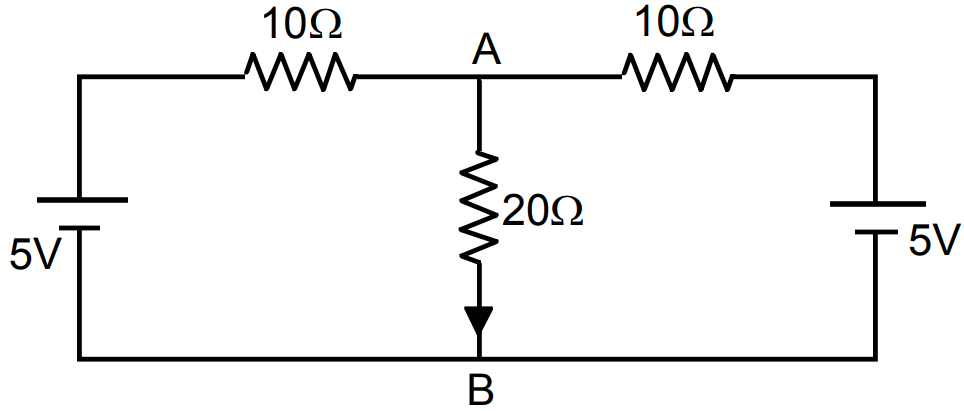
(a) Find the current in the $20\Omega$ resistor shown in the figure. (b) If a capacitor of capacitance $4\mu\text{F}$ is joined between the points A and B, what would be the electrostatic energy stored in it in steady state?
A capacitor having a capacitance of $100\mu\text{F}$ is charged to a potential difference of $50V$.
  1. What is the magnitude of the charge on each plate?
  2. The charging battery is disconnected and a dielectric of dielectric constant $2.5$ is inserted. Calculate the new potential difference between the plates.
  3. What charge would have produced this potential difference in absence of the dielectric slab.
  4. Find the charge induced at a surface of the dielectric slab.
A uniform chain of length L and mass M overhangs a horizontal table with its two third part on the table. The friction coefficient between the table and the chain is $\mu.$ Find the work done by the friction during the period the chain slips off the table.