Question
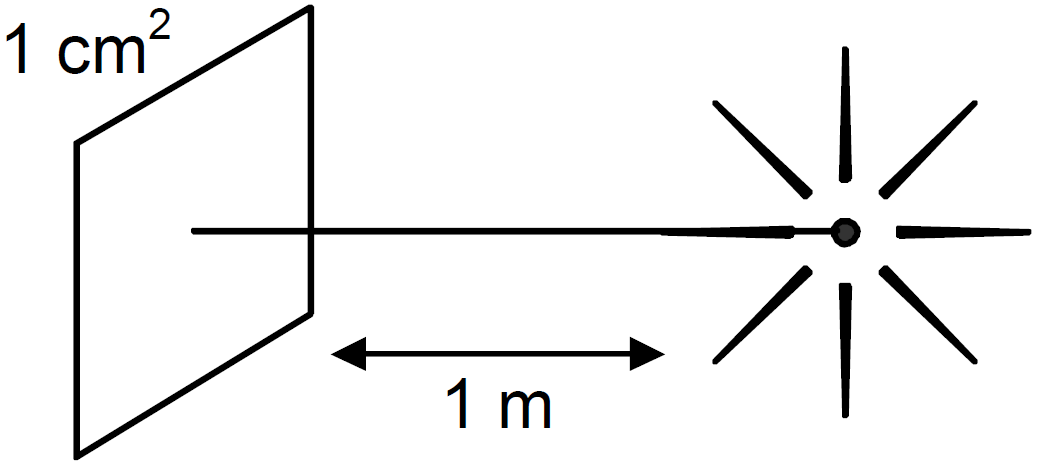
A point source emitting alpha particles is placed at a distance of $1m$ from a counter which records any alpha particle falling on its $1\ cm^2$ window. If the source contains $6.0 \times 10^{16}$ active nuclei and the counter records a rate of $50000$ counts/ second, find the decay constant. Assume that the source emits alpha particles uniformly in all directions and the alpha particles fall nearly normally on the window.
Answer

Counts received per $cm^2 = 50000$ Counts/sec.
$N = N_3o$ of active nucleic $= 6 \times 10^{16}$
Total counts radiated from the source $=$ Total surface area $\times\ 50000$ counts/$cm^2$
$= 4 \times 3.14 \times 1 \times 10^4 \times 5 \times 10^4 = 6.28 \times 10^9$
$\text{Counts}=\frac{\text{dN}}{\text{dt}}$
We know, $\frac{\text{dN}}{\text{dt}}=\lambda\text{N}$
$\lambda=\frac{6.28\times10^9}{6\times10^{16}}=1.0467\times10^{-7}=1.05\times10^{-7}\text{s}^{-1}$

Need a full question paper?

Generate a complete, print-ready paper with questions like this in minutes — across 16+ boards, with answer keys.

Start Generating Free

Similar questions

Do permeability and relative permeability have the same dimensions?
A charged particle is accelerated through a potential difference of $12kV$ and acquires a speed of $1.0 \times 10^6m s^{−1}$. It is then injected perpendicularly into a magnetic field of strength $0.2T.$ Find the radius of the circle described by it.
A tightly-wound solenoid of radius a and length l has n turns per unit length. It carries an electric current i. Consider a length dx of the solenoid at a distance x from one end. This contains n(dx) turns and may be approximated as a circular current in (dx).
  1. Write the magnetic field at the centre of the solenoid due to this circular current. Integrate this expression under proper limits to find the magnetic field at the centre of the solenoid.
  2. Verify that if a >> l, the field tends to $\text{B}=\frac{\mu_0\text{nil}}{2\text{a}}.$ Interpret these results.
Consider a neutron and an electron bound to each other due to gravitational force. Assuming Bohr's quantization rule for angular momentum to be valid in this case, derive an expression for the energy of the neutron-electron system.
A circular disc made of iron is rotated about its axis at a constant velocity to $\omega$. Calculate the percentage change in the linear speed of a particle of the rim as the disc is slowly heated from $20^\circ C$ to $50^\circ C$ keeping the angular velocity constant. Coefficient of linear expansion of iron $= 1.2 \times 10^{-5^\circ} C^{-1}$.
Answer the following questions:
(a) Are the equations of nuclear reactions (such as those given in Section 13.7) 'balanced' in the sense a chemical equation (e.g., $2 H _2+ O _2 \rightarrow 2 H _2 O$ ) is? If not, in what sense are they balanced on both sides?
(b) If both the number of protons and the number of neutrons are conserved in each nuclear reaction, in what way is mass converted into energy (or vice-versa) in a nuclear reaction?
(c) A general impression exists that mass-energy interconversion takes place only in nuclear reaction and never in chemical reaction. This is strictly speaking, incorrect. Explain.
  1. Estimate the speed with which electrons emitted from a heated emitter of an evacuated tube impinge on the collector maintained at a potential difference of $500 V$ with respect to the emitter. Ignore the small initial speeds of the electrons. The specific charge of the electron, i.e., its $e/m$ is given to be $1.76 \times 10^{11} C \ kg^{–1}.$
  2. Use the same formula you employ in $(a)$ to obtain electron speed for an collector potential of $10 MV.$ Do you see what is wrong? In what way is the formula to be modified?
Find the centre of mass of a uniform plate having semicircular inner and outer boundaries of radii $R_1$ and $R_2.$
An optical instrument used for angular magnification has a $25D$ objective and a $20D$ eyepiece. The tube length is $25\ cm$ when the eye is least strained.
  1. Whether it is a microscope or a telescope?
  2. What is the angular magnification produced?
The intensity of the sunlight reaching Earth is $1380Wm^{-2}.$ Assume this light to be a plane, monochromatic wave. Find the amplitudes of electric and magnetic fields in this wave.