Question
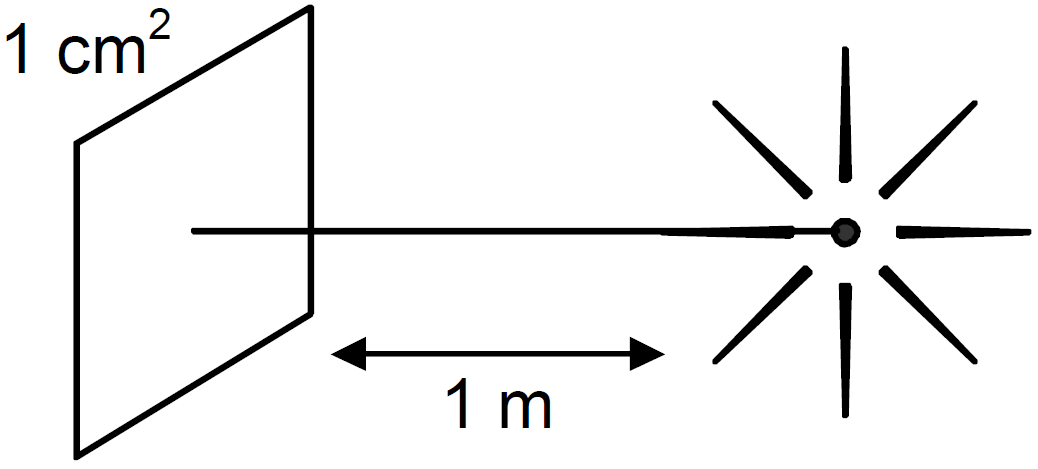
A point source emitting alpha particles is placed at a distance of $1$ m from a counter which records any alpha particle falling on its $1 cm^2$ window. If the source contains $6.0 \times 10^{16}$ active nuclei and the counter records a rate of $50000$ counts/ second, find the decay constant. Assume that the source emits alpha particles uniformly in all directions and the alpha particles fall nearly normally on the window.
Answer

Counts received per $cm^2 = 50000$ Counts/sec. $N = N_3o$ of active nucleic $= 6 \times 10^{16}$ Total counts radiated from the source = Total surface area $\times 50000 \ counts/cm^2 = 4 \times 3.14 \times 1 \times 10^4 \times 5 \times 10^4 = 6.28 \times 10^9$ $\text{Counts}=\frac{\text{dN}}{\text{dt}}$ We know, $\frac{\text{dN}}{\text{dt}}=\lambda\text{N}$$\lambda=\frac{6.28\times10^9}{6\times10^{16}}=1.0467\times10^{-7}=1.05\times10^{-7}\text{s}^{-1}$

Need a full question paper?

Generate a complete, print-ready paper with questions like this in minutes — across 16+ boards, with answer keys.

Start Generating Free

Similar questions

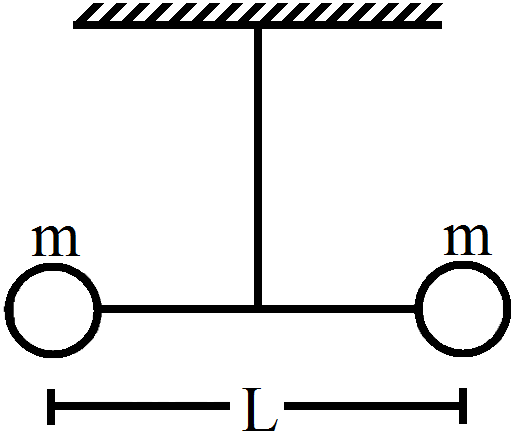
Two small balls, each of mass m are connected by a light rigid rod of length L. The system is suspended from its centre by a thin wire of torsional constant k. The rod is rotated about the wire through an angle $\theta_0$ and released. Find the tension in the rod' as the system passes through the mean position.
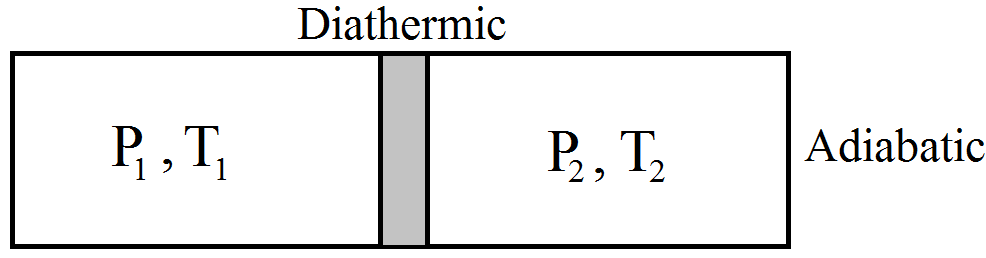
Figure. shows a cylindrical tube of volume V with adiabatic walls containing an ideal gas. The internal energy of this ideal gas is given by 1.5nRT. The tube is divided into two equal parts by a fixed diathermic wall. Initially, the pressure and the temperature are $P_1, T_1$ on the left and $p_2, T_2$ on the right. The system is left for sufficient time so that the temperature becomes equal on the two sides.
  1. How much work has been done by the gas on the left part?
  2. Find the final pressures on the two sides.
  3. Find the final equilibrium temperature.
  4. How much heat has flown from the gas on the right to the gas on theleft?
A narrow sound pulse (for example, a short pip by a whistle) is sent across a medium.
(a) Does the pulse have a definite,
  1. frequency,
  2. wavelength,
  3. speed of propagation?
(b) If the pulse rate is 1 after every 20s, (that is the whistle is blown for a split of second after every 20s), is the frequency of the note produced by the whistle equal to 1/20 or 0.05Hz?
Calculate the temperature at which r.m.s. velocity of a gas molecule is the same as that of a molecule of another gas at 27°C. Molecular weight of first and second gases are 64 and 32 respectively.
A $10kW$ drilling machine is used to drill a bore in a small aluminium block of mass $8.0\ kg$. How much is the rise in temperature of the block in $2.5$ minutes,assuming $50\%$ of power is used up in heating the machine itself or lost to the surroundings. Specific heat of aluminium $= 0.91J g^{–1} K^{–1}.$
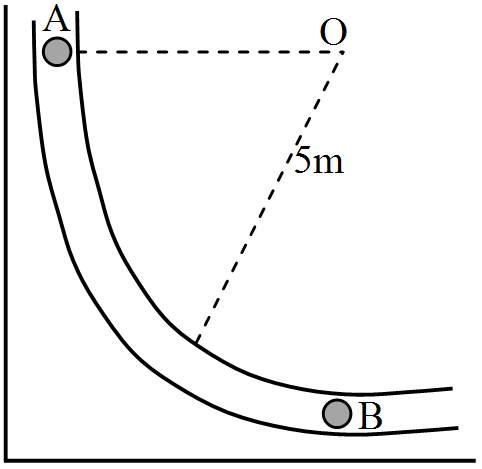
A ball moves along a curved path of radius 5m as shown in figure. It starts from point A and reaches point B. If there is no force of friction between the ball and surface of the path, then find the normal force that acts on the ball at the bottom (B) of the curved path.
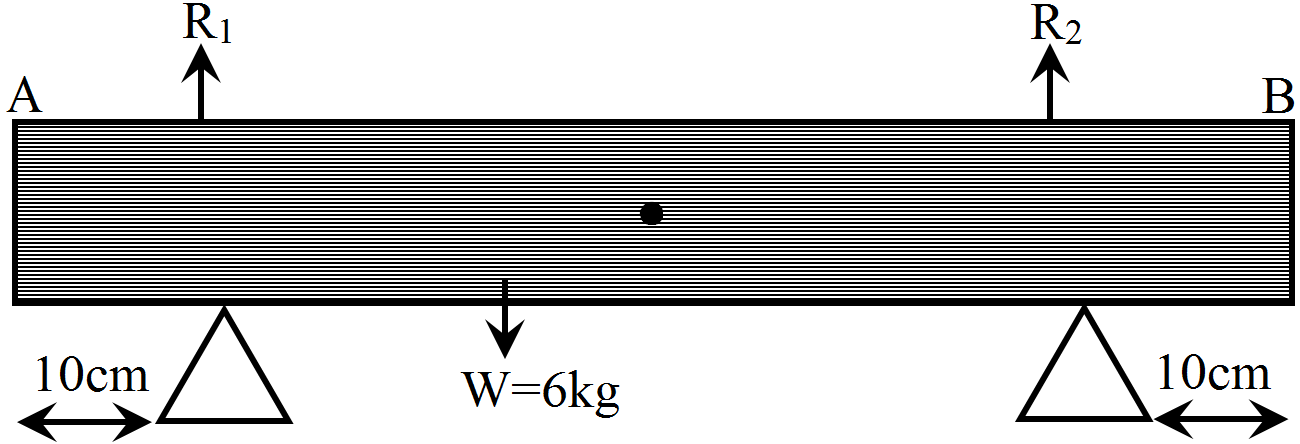
What is Mechanical Advantage (M.A.) in the principle of moments for a lever? Find the reactions forces at knife edge as shown in the figure:

Where AB is a metal bar of $70cm$ length having mass $4kg$ and a $6kg$ load is suspended from $30cm$ from the end A.
Differentiate the following:
  1. Wave velocity and particle velocity.
  2. Harmonics and overtones.
Consider that an ideal gas ( $n$ moles) is expanding in a process given by $P=f(V)$, which passes through a point $\left(V_0\right.$, $\left.P_0\right)$. Show that the gas is absorbing heat at $\left(P_0, V_0\right)$ if the slope of the curve $P=f(V)$ is larger than the slope of the adiabat passing through $\left(\mathrm{P}_0, \mathrm{~V}_0\right)$.
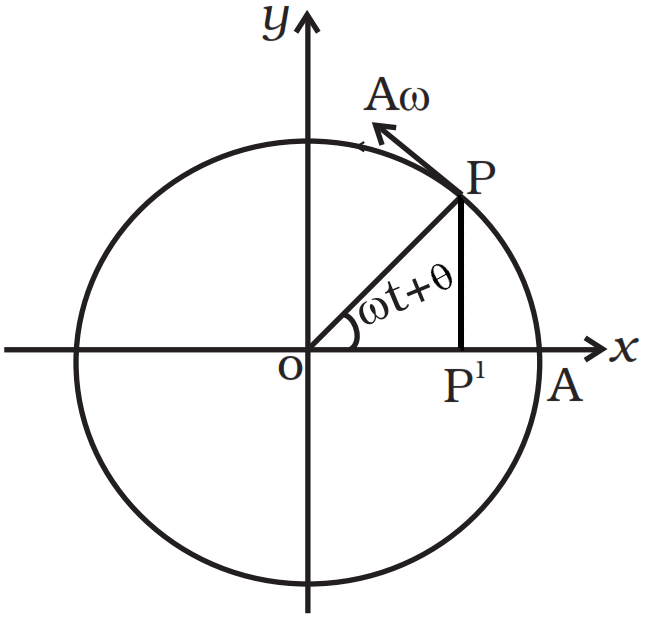
In Fig. 14.9, what will be the sign of the velocity of the point, which is the projection of the velocity of the P′ reference particle P .P is moving in a circle of radius R in anticlockwise direction.