What is Mechanical Advantage (M.A.) in the principle of moments for a lever? Find the reactions forces at knife edge as shown in the figure:
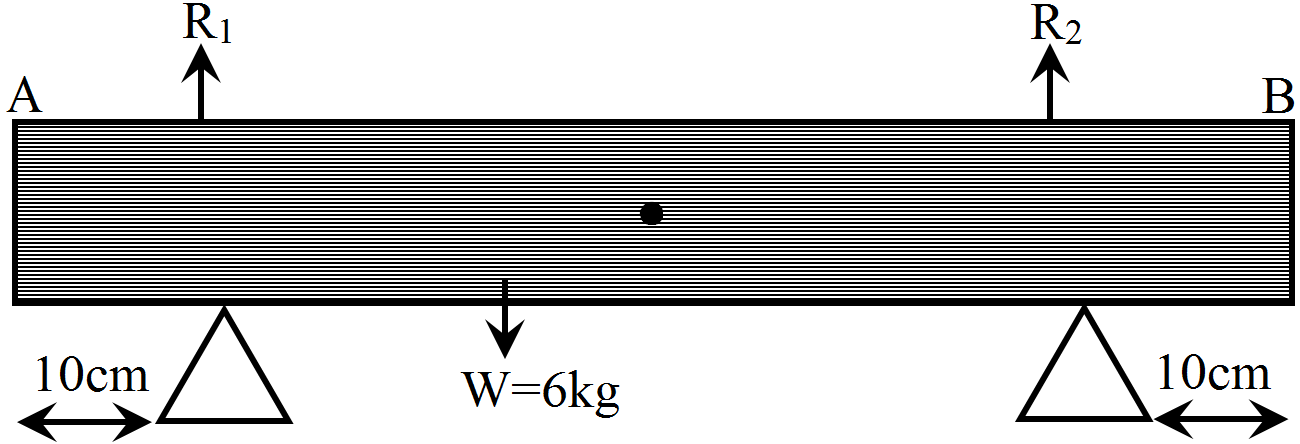
Where AB is a metal bar of $70cm$ length having mass $4kg$ and a $6kg$ load is suspended from $30cm$ from the end A.
Where AB is a metal bar of $70cm$ length having mass $4kg$ and a $6kg$ load is suspended from $30cm$ from the end A.
Download our app for free and get started
Mechanical Advantage (M.A.) in the principle of moments $\frac{\text{Load}}{\text{Effort}}=\frac{\text{Effort arm}}{\text{Load arm}}$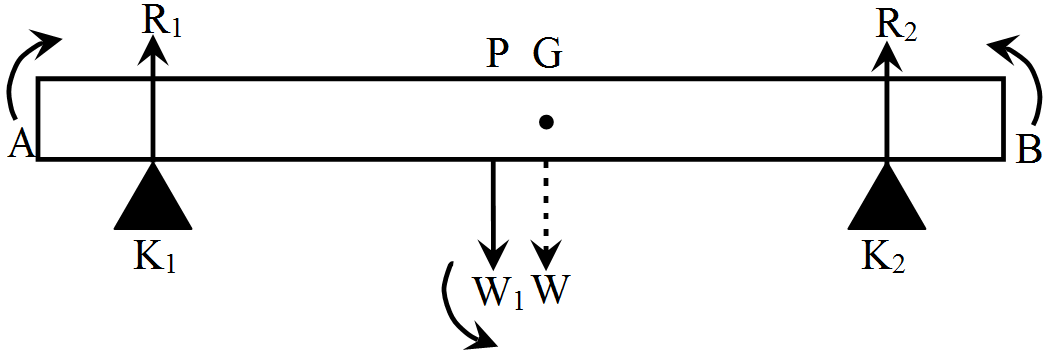
Figure shows the rod AB, the positions of the knife edges $K_1$ and $K_2$ the centre of gravity of the rod at G and the subtended weight at P. Note the weight of the rod W acts at its centre of gravity G. The rod is uniform in cross-section and homogeneous; hence G is at the centre of the rod;AB = 70cm, AG = 35cm, AP = 30cm, PG = 5cm,
$AK_1, = BK_2 = 10cm$ and $K, G = K_1G = 25cm$
Also, W = Weight of the rod = 4gN and W, + S (Suspended weight) = gN. $R_1$, and $R_2$, are the normal reactions of the support at the knife edges.
For translational equilibrium of the rod.
$R_1, + R_2 - W_1- W = 0$
$\Rightarrow R_1, + R_2 - 4g - 6g = 0$
or $R_1, + R_2 = 98N ...(1)$
$W_1$, and W act vertically down and $R_1$, and $R_2$, act vertically up.
For considering rotational equilibrium, we take moments of the forces. A convenient point to take moments about is G. The moments of $R_2$ and $W_1$ are anticlockwise (+ve), whereas the moment of $R_1$ is clockwise (-ve).
For rotational equilibrium,
$-R_1(K_1G) + W_1(PG) + R_2(K_2G) = 0 ...(2)$
Given, $W = 4gN$ and$ W_1 = 6gN$, where g = acceleration
due to gravity. We take $g = 9.8ms^{-2}$
From (2) $- 0.25R, + 0.05W_1 + 0.25R_2 = 0$
$\Rightarrow R_1 - R_2 = 1.2gN = 11.76N ...(3)$
From (1) and (3), $R_1 = 54.88N, R_2 = 43.12N$ Thus the reactions of the support are about 55N at $K_1$ and 43N at $K_2$.
Figure shows the rod AB, the positions of the knife edges $K_1$ and $K_2$ the centre of gravity of the rod at G and the subtended weight at P. Note the weight of the rod W acts at its centre of gravity G. The rod is uniform in cross-section and homogeneous; hence G is at the centre of the rod;AB = 70cm, AG = 35cm, AP = 30cm, PG = 5cm,
$AK_1, = BK_2 = 10cm$ and $K, G = K_1G = 25cm$
Also, W = Weight of the rod = 4gN and W, + S (Suspended weight) = gN. $R_1$, and $R_2$, are the normal reactions of the support at the knife edges.
For translational equilibrium of the rod.
$R_1, + R_2 - W_1- W = 0$
$\Rightarrow R_1, + R_2 - 4g - 6g = 0$
or $R_1, + R_2 = 98N ...(1)$
$W_1$, and W act vertically down and $R_1$, and $R_2$, act vertically up.
For considering rotational equilibrium, we take moments of the forces. A convenient point to take moments about is G. The moments of $R_2$ and $W_1$ are anticlockwise (+ve), whereas the moment of $R_1$ is clockwise (-ve).
For rotational equilibrium,
$-R_1(K_1G) + W_1(PG) + R_2(K_2G) = 0 ...(2)$
Given, $W = 4gN$ and$ W_1 = 6gN$, where g = acceleration
due to gravity. We take $g = 9.8ms^{-2}$
From (2) $- 0.25R, + 0.05W_1 + 0.25R_2 = 0$
$\Rightarrow R_1 - R_2 = 1.2gN = 11.76N ...(3)$
From (1) and (3), $R_1 = 54.88N, R_2 = 43.12N$ Thus the reactions of the support are about 55N at $K_1$ and 43N at $K_2$.

Download our appand get started for free
Experience the future of education. Simply download our apps or reach out to us for more information. Let's shape the future of learning together!No signup needed.*
Similar Questions
- 1Two cylindrical hollow drums of radii R and 2R, and of a common height h, are rotating with angular velocities $\omega$ (anti-clockwise) and $\omega$ (clockwise), respectively. Their axes, fixed are parallel and in a horizontal plane separated by $(3\text{R}+\delta).$ They are now brought in contact $(\delta\rightarrow0){:}$View Solution
- Show the frictional forces just after contact.
- Identify forces and torques external to the system just after contact.
- What would be the ratio of final angular velocities when friction ceases?
- 2View SolutionThe door of an almirah is 6ft high, 1.5ft wide and weighs 8kg. The door is supported by two hinges situated at a distance of 1ft from the ends. If the magnitudes of the forces exerted by the hinges on the door are equal, find this magnitude.
- 3View SolutionDiscuss the rolling motion of a cylinder on an inclined plane.
- 4View SolutionA hoop of radius 2m weighs 100kg. It rolls along a horizontal floor so that its centre of mass has a speed of 20cm/s. How much work has to be done to stop it?
- 5Two discs of moments of inertia $I_1$ and $I_2$ about their respective axes (normal to the disc and passing through the centre), and rotating with angular speeds $\omega_1$ and $\omega_2$ are brought into contact face to face with their axes of rotation coincident.View Solution
- What is the angular speed of the two-disc system?
- Show that the kinetic energy of the combined system is less than the sum of the initial kinetic energies of the two discs. How do you account for this loss in energy? Take $\omega_1\neq\omega_2$
- 6View SolutionA solid sphere rolls down two different inclined planes of the same heights but different angles of inclination.
- Will it reach the bottom with the same speed in each case?
- Will it take longer to roll down one plane than the other?
- If so, which one and why?
- 7View SolutionA solid cylinder of mass M and radius R has a light flexible rope wound around it. The rope carries a mass m at its free end. The mass is rest at a height h above the floor. Find the angular velocity of the cylinder at the instant the mass m, after release, strikes the floor. Assume friction to be absent and the cylinder to rotate about its own axis.
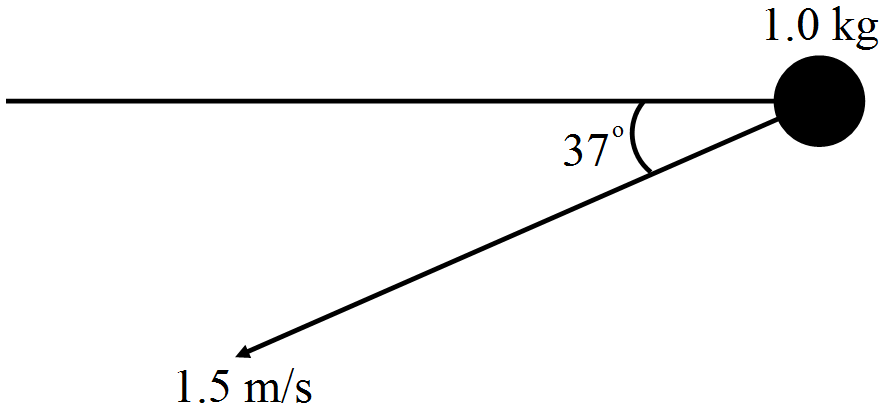
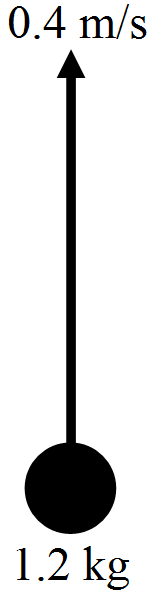
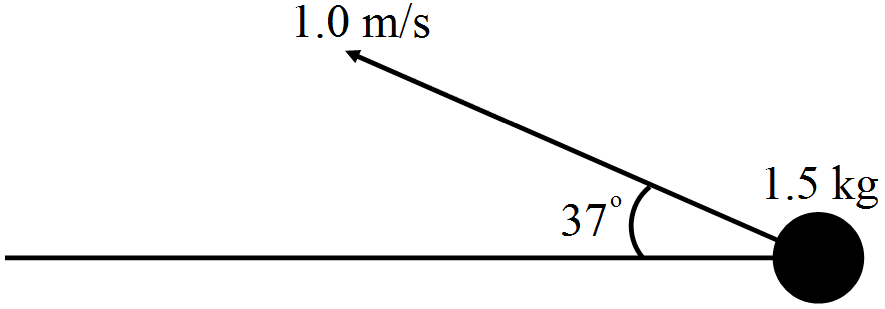
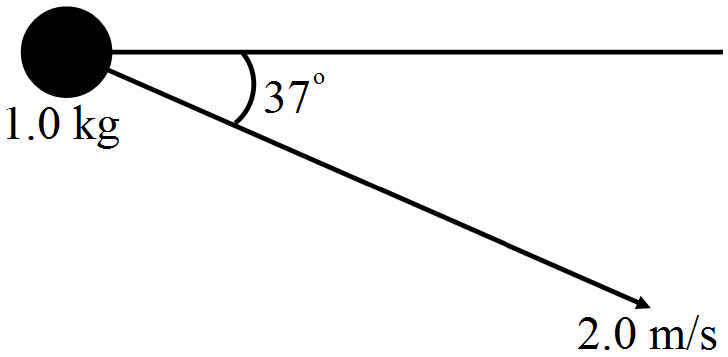
- 8View SolutionCalculate the velocity of the centre of mass of the system of particles shown in figure.

- 9A disc of mass $5kg$ and radius $50cm$ rolls on the ground at the rate of $10ms^{-1}$. Calculate the K.E. of the disc. $\Big(\text{Given}:\text{I}=\frac{1}{2}\text{MR}^2\Big)$View Solution
- 10Locate the centre of mass of a system of particles of mass $m_1 = 1kg, m_2 = 2kg$ and $m_3 = 3kg$, situated at the corners of an equilateral triangle of side 1.0 metre.View Solution