Question
A point source emitting light uniformly in all directions is placed 60cm above a table-top. The illuminance at a point on the table-top, directly below the source, is 15 lux. Find the illuminance at a point on the table-top 80cm away from the first point.

Answer


given that $\text{E}_\text{a}=15\text{ lux}=\frac{\text{l}_0}{60^2}$

$\Rightarrow\text{l}_0=15\times(0.6)^2=5.4\text{ candela}$

 So, $\text{E}_\text{B}=\frac{\text{l}_0\cos\theta}{(\text{OB})^2}=\frac{5.4\times\Big(\frac{3}{5}\Big)}{1^2}=3.24\text{ lux}$

Need a full question paper?

Generate a complete, print-ready paper with questions like this in minutes — across 16+ boards, with answer keys.

Start Generating Free

Similar questions

Suppose, one wishes to construct a 1.0 farad capacitor using circular discs. If the separation between the discs be kept at 1.0mm, what would be the radius of the discs?
Explain why
The angle of contact of mercury with glass is obtuse, while that of water with glass is acute.
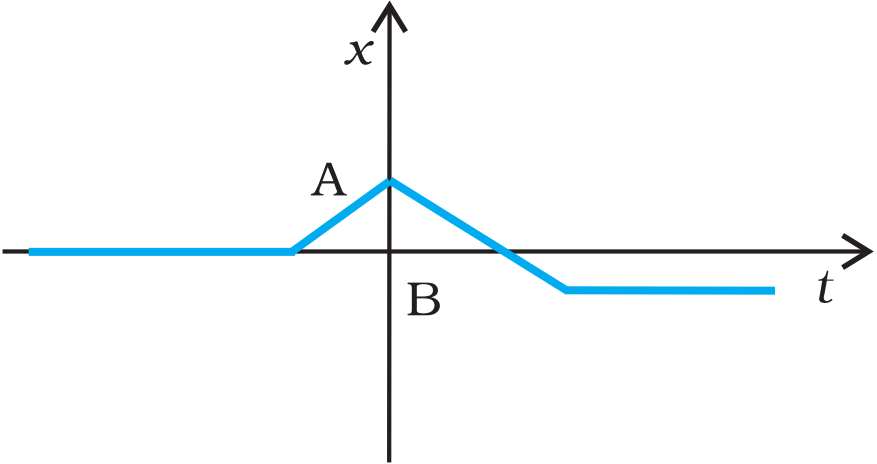
Suggest a suitable physical situation for of the following graphs.

A spy report about a suspected car reads as follows. "The car moved 2.00km towards east, made a perpendicular left turn, ran for 500m, made a perpendicular right turn, ran for 4.00km and stopped". Find the displacement of the car.
A satellite is revolving around the earth, close to the surface of earth with a kinetic energy E. How much kinetic energy should be given to it so that it escapes from the surface of earth?
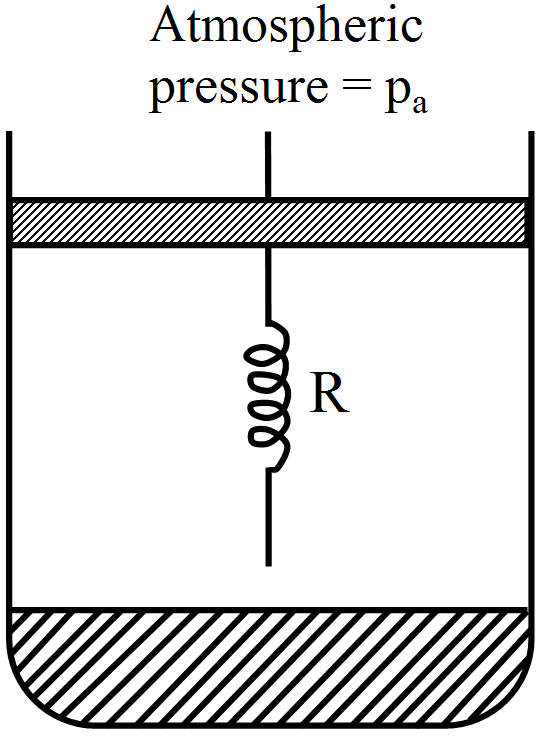
Consider one mole of perfect gas in a cylinder of unit cross-section with a piston attached (figure). A spring (spring constant k) is attached (unstretched length L) to the piston and to the bottom of the cylinder. Initially, the spring is unstretched and the gas is in equilibrium.
A certain amount of heat Q is supplied to the gas causing an increase of volume from V0 to V1.
  1. What is the initial pressure of the system?
  2. What is the final pressure of the system?
  3. Using the first law of thermodynamics, write down a relation between Q, Pa, V, V0, and k.
​​​​​​​
A perfect Carnot engine utilizes an ideal gas. The source temperature is 500K and sink temperature is 375K. If the engine takes 600K cal per cycle from the source, compute:
  1. The efficiency of the engine.
  2. Work done per cycle.
  3. Heat rejected to the sink per cycle.
Find the acceleration of the moon with respect to the earth from the following data:
Distance between the earth and the moon = 3.85 × 105km and the time taken by the moon to complete one revolution around the earth = 27.3 days.
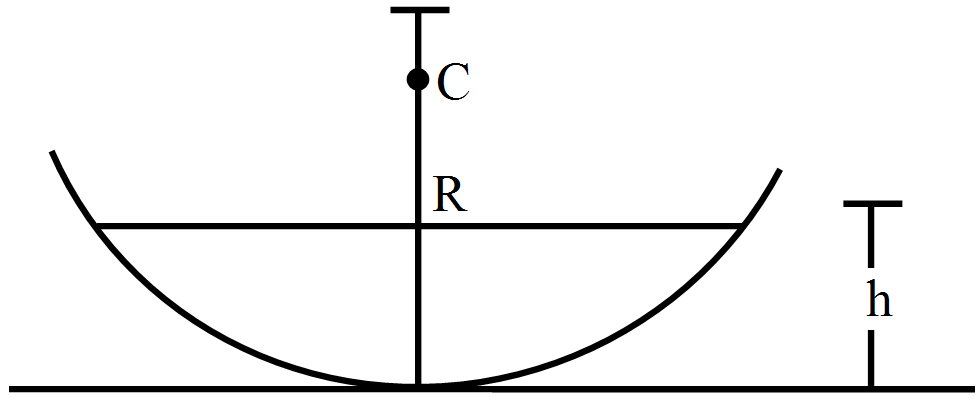
A concave mirror of radius R is kept on a horizontal. Water $\big($refractive index $=\mu\big)$ is poured into it upto a height h. Where should an object be placed so that its image is formed on itself?

A simple pendulum in a stationary lift has time period T. What would be the effect on the time period when the left
  1. Moves up with uniform velocity v.
  2. Moves down with uniform velocity v.
  3. Moves up with uniform acceleration a.
  4. Moves down with uniform acceleration a.
  5. Beings to fall freely under gravity?