Question
A perfect Carnot engine utilizes an ideal gas. The source temperature is 500K and sink temperature is 375K. If the engine takes 600K cal per cycle from the source, compute:
  1. The efficiency of the engine.
  2. Work done per cycle.
  3. Heat rejected to the sink per cycle.

Answer

Here T1 = 500K

T2 = 375K

Q1 = Heat absorbed per cycle = 600 kcal

  1.  

$\therefore$ Using the relation,

$\eta=1-\frac{\text{T}_2}{\text{T}_1},$ we get

$\eta=\frac{\text{T}_1-\text{T}_2}{\text{T}_1}$

$=\frac{500-375}{500}$

$=\frac{125}{500}=0.25$

$\eta\%=0.25\times100$

$=25\%$

  1. Let W = work done per cycle

$\therefore$ Using the relation

$\eta=\frac{\text{W}}{\text{Q}_1},$ we get

$\text{W}=\eta\text{Q}_1=0.25\times600\text{ kcal}=150\text{ kcal}$

$=150\times10^3\times4.2\text{J}$

$=6.3\times10^5\text{J}$

  1. Let Q2 = Heat rejected to the sink

$\therefore$ Using the relation

$\text{W}=\text{Q}_1-\text{Q}_2,$ we get

$\text{Q}_2=\text{Q}_1-\text{W}$

$=600-150=450\text{ kcal}$

Need a full question paper?

Generate a complete, print-ready paper with questions like this in minutes — across 16+ boards, with answer keys.

Start Generating Free

Similar questions

A particle is released from the top of an incline of height h. Does the kinetic energy of the particle at the bottom of the incline depend on the angle of incline? Do you need any more information to answer this question in Yes or No?
A circular loop of radius 20cm carries a current of 10A. An electron crosses the plane of the loop with a speed of 2.0 × 10⁶m/s. The direction of motion makes an angle of 30° with the axis of the circle and passes through its centre. Find the magnitude of the magnetic force on the electron at the instant it crosses the plane.
Distinguish clearly between the three modes of heat transmission.
A thin spherical shell lying on a rough horizontal surface is hit by a cue in such a way that the line of action passes through the centre of the shell. As a result, the shell starts moving with a linear speed v without any initial angular velocity. Find the linear speed of the shell after it starts pure rolling on the surface.
A uniform chain of mass m and length l overhangs a table with its two third part on the table. Find the work to be done by a person to put the hanging part back on the table.
A travelling harmonic wave on a string is described by
$\text{y}(\text{x, t})=7.5\sin\Big(0.0050\text{x}+12\text{t}+\frac{\pi}{4}\Big)$
Locate the points of the string which have the same transverse displacements and velocity as the x = 1cm point at t = 2s, 5s and 11s.
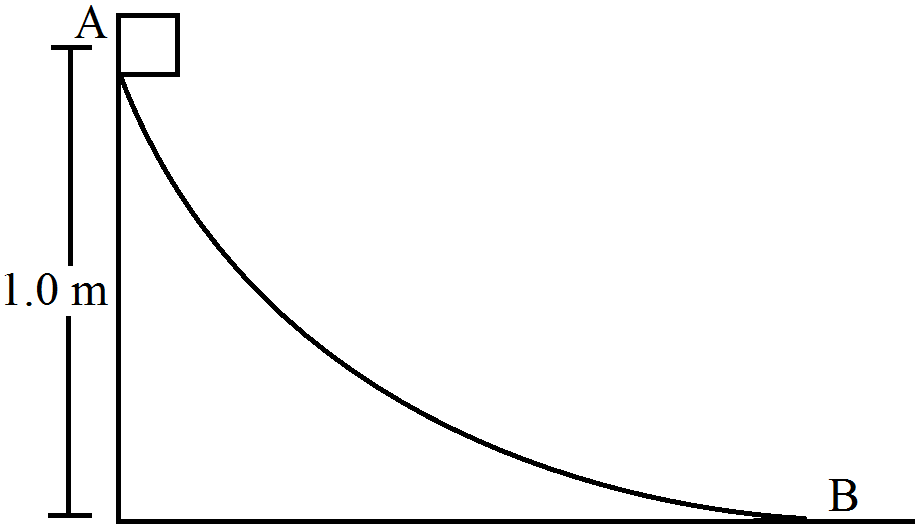
A block weighing 10N travels down a smooth curved track AB joined to a rough horizontal surface (figure). The rough surface has a friction coefficient of 0.20 with the block. If the block starts slipping on the track from a point 1.0m above the horizontal surface, how far will it move on the rough surface?

The equation of trajectory of an oblique projectile is,
$\text{y}=\sqrt{3}\text{x}-\frac{\text{gx}^2}{2}$
What is the initial velocity and the angle of projection of the projectile?
Find the ratio of the lengths of an iron rod and an aluminium rod for which the difference in the lengths is independent of temperature. Coefficients of linear expansion of iron and aluminium are 12 × 10-6 °C-1 and 23 × 10-6 °C-1 respectively.
Write the dimensional formula for the following:
  1. Wein’s constant.
  2. Planck's constant.
  3. Specific heat.
  4. Latent heat.
  5. Rydberg's constant.