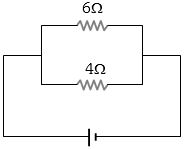
A potentiometer has uniform potential gradient. The specific resistance of the material of the potentiometer wire is $10^{-7} \, ohm-meter$ and the current passing through it is $0.1\, ampere$; cross-section of the wire is $10^{-6}\, m^2$. The potential gradient along the potentiometer wire is
AIPMT 2001, Medium
Download our app for free and get started
Potential gradient $(x)$ $ = \frac{{i\rho }}{A}$ $ = \frac{{0.1 \times {{10}^{ - 7}}}}{{{{10}^{ - 6}}}} = {10^{ - 2}}\,V/m$

Download our appand get started for free
Experience the future of education. Simply download our apps or reach out to us for more information. Let's shape the future of learning together!No signup needed.*
Similar Questions
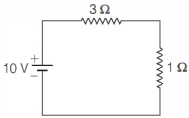
- 1In the following circuit, $1 \,\Omega$ resistor dissipates power $P$. If the resistor is replaced by $9 \,\Omega$, the power dissipated in it isView Solution
- 2$A$ uniform copper wire carries a current $i$ amperes and has $p$ carriers per meter$^3$. The length of the wire is $\lambda$ meters and its cross-section area is $s$ meter $^2$. If the charge on a carrier is $q$ coulombs, the drift velocity in $ms^{-1}$ is given byView Solution
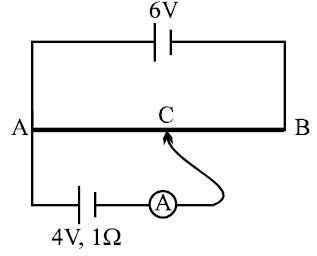
- 3$A \,6 \,V$ battery of negligible internal resistance is connected across a uniform wire of length $1\, m$. The positive terminal of another battery of emf $4\,V$ and internal resistance $1\, \Omega$ is joined to the point $A$ as shown in figure. The ammeter shows zero deflection when the jockey touches the wire at the point $C$. The $AC$ is equal toView Solution
- 4View SolutionThe resistance of a discharge tube is
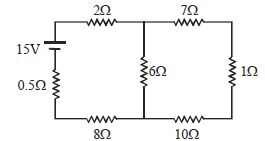
- 5The current from the battery in the given circuit is ................ $A$View Solution
- 6View SolutionTo draw maximum current from a combination of cells, how should the cells be grouped
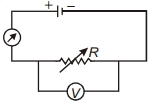
- 7A voltmeter is connected in parallel with a variable resistance $R$ which is in series with an ammeter and a cell as shown in the figure. For one value of $R$, the meters read $0.3 \,A$ and $0.9 \,V$. For another value of $R$ the readings are $0.25 \,A$ and $1.0 \,V$. What is the internal resistance of the cell is ......... $\Omega$View Solution
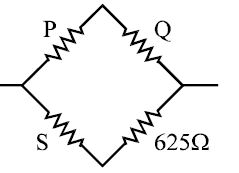
- 8$A$ Wheatstone's bridge is balanced with a resistance of $625\, \Omega$ in the third arm, where $P, Q$ and $S$ are in the $1^{st}, 2^{nd}$ and $4^{th}$ arm respectively. If $P$ and $Q$ are interchanged, the resistance in the third arm has to be increased by $51\,\Omega$ to secure balance. The unknown resistance in the fourth arm is ............. $\Omega$View Solution
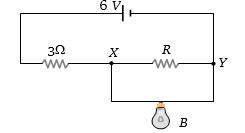
- 9In the following circuit, bulb rated as $1.5\, V$, $0.45\, W$. If bulbs glows with full intensity then what will be the equivalent resistance between $X$ and $Y$ ............. $\Omega$View Solution
- 10In the circuit shown below, the power developed in the $6$ $\Omega$ resistor is $6\, watt$. The power in watts developed in the $4$ $ \Omega$ resistor isView Solution