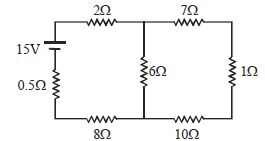
The current from the battery in the given circuit is ................ $A$
Medium
Download our app for free and get started
According to figure,
Applying Kirchhoffs law in mash $(I)$
$2 i_1+6 i_1-6 i_2+8 i_1+0.5 i_1-15=0$
$16.5 i_1-6 i_2=15 \ldots . \text { (I) }$
Applying Kirchhoff's law in mash $(II)$
$7 i _2+ i _2+10 i _2+6 i _2-6 i _1=0$
$24 i _2-6 i _1=0$
$4 i _2- i _1=0$
$i _1=4 i _2 \ldots \ldots \text { (II) }$
After solving of equation $(I)$ and $(II)$
Then,
$16.5 \times 4 i _2-6 i _2=15$
$66 i _2-6 i _2=15$
$60 i _2=15$
$i _2=\frac{1}{4} A$
Now put the value of $i_2$ in equation $(I)$
$i_1=4 i_2$
$i_1=4 \times \frac{1}{4}$
$i_1=1\,\,A$
Now, the current from the battery in the circuit is $1\,\,A$.

Download our appand get started for free
Experience the future of education. Simply download our apps or reach out to us for more information. Let's shape the future of learning together!No signup needed.*
Similar Questions
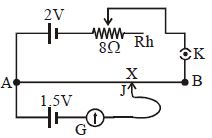
- 1In a potentiometer experiment shown here, for the position $X$ of the jockey $J,$ there occurs a null deflection in the galvanometer. Then the potential difference between points $A$ and $X$ is ................ $V$View Solution
- 2A current of $2\,A$ flows through a wire of crosssectional area $25.0\,mm ^2$. The number of free electrons in a cubic meter are $2.0 \times 10^{28}$. The drift velocity of the electrons is $...............\times 10^{-6}\,ms ^{-1}$ (given, charge on electron $=1.6 \times 10^{-19}\,C$ )View Solution
- 3View SolutionA conductor behaves as a superconductor
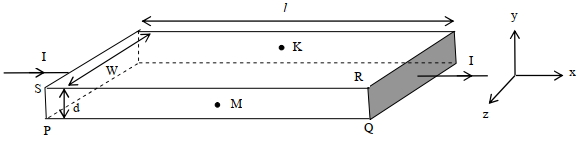
- 4In a thin rectangular metallic strip a constant current $I$ flows along the positive $x$-direction, as shown in the figure. The length, width and thickness of the strip are $\ell$, w and $d$, respectively. A uniform magnetic field $\vec{B}$ is applied on the strip along the positive $y$-direction. Due to this, the charge carriers experience a net deflection along the $z$ direction. This results in accumulation of charge carriers on the surface $P Q R S$ and appearance of equal and opposite charges on the face opposite to $PQRS$. A potential difference along the $z$-direction is thus developed. Charge accumulation continues until the magnetic force is balanced by the electric force. The current is assumed to be uniformly distributed on the cross section of the strip and carried by electrons.View Solution
$1.$ Consider two different metallic strips ($1$ and $2$) of the same material. Their lengths are the same, widths are $w_1$ and $w_2$ and thicknesses are $d_1$ and $d_2$, respectively. Two points $K$ and $M$ are symmetrically located on the opposite faces parallel to the $x$ - $y$ plane (see figure). $V _1$ and $V _2$ are the potential differences between $K$ and $M$ in strips $1$ and $2$ , respectively. Then, for a given current $I$ flowing through them in a given magnetic field strength $B$, the correct statement$(s)$ is(are)
$(A)$ If $w _1= w _2$ and $d _1=2 d _2$, then $V _2=2 V _1$
$(B)$ If $w_1=w_2$ and $d_1=2 d_2$, then $V_2=V_1$
$(C)$ If $w _1=2 w _2$ and $d _1= d _2$, then $V _2=2 V _1$
$(D)$ If $w _1=2 w _2$ and $d _1= d _2$, then $V _2= V _1$
$2.$ Consider two different metallic strips ($1$ and $2$) of same dimensions (lengths $\ell$, width w and thickness $d$ ) with carrier densities $n_1$ and $n_2$, respectively. Strip $1$ is placed in magnetic field $B_1$ and strip $2$ is placed in magnetic field $B_2$, both along positive $y$-directions. Then $V_1$ and $V_2$ are the potential differences developed between $K$ and $M$ in strips $1$ and $2$, respectively. Assuming that the current $I$ is the same for both the strips, the correct option$(s)$ is(are)
$(A)$ If $B_1=B_2$ and $n_1=2 n_2$, then $V_2=2 V_1$
$(B)$ If $B_1=B_2$ and $n_1=2 n_2$, then $V_2=V_1$
$(C)$ If $B _1=2 B _2$ and $n _1= n _2$, then $V _2=0.5 V _1$
$(D)$ If $B_1=2 B_2$ and $n_1=n_2$, then $V_2=V_1$
Give the answer question $1$ and $2.$
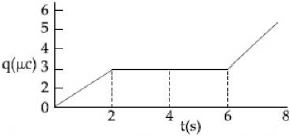
- 5The charge on a capacitor plate in a circuit, as a function of time, is shown in the figureView Solution
What is the value of current at $t = 4\,s$ ? ............... $\mu A$
- 6View SolutionGiven three equal resistors, how many different combination of all the three resistors can be made
- 7The length of a given cylindrical wire is increased to double of its original length. The percentage increase in the resistance of the wire will be..... $\%$.View Solution
- 8A cell having an emf $\varepsilon$ and internal resistance $r$ is connected across a variable external resistance $R.$ As the resistance $R$ is increased, the plot of potential difference $V$ across $R$ is given byView Solution
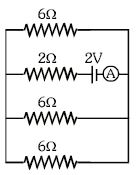
- 9The ammeter reading in the following circuit will be .............. $A$View Solution
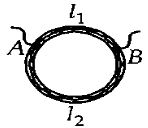
- 10A ring is made of a wire having a resistance $R_0 = 12 \,\,\Omega$. Find the points $A$ and $B,$ as shown in the figure, at which a current carrying conductor should be connected so that the resistance $R$ of the sub circuit between these points is equal to $\frac{8}{3}\,\Omega$.View Solution