To draw maximum current from a combination of cells, how should the cells be grouped
Easy
Download our app for free and get started
(d) Maximum current will be drawn from the circuit if resultant resistance of all internal resistances is equal to the value of external resistance if the arrangements mixed. In series, $R > > nr$ and in parallel, the external resistance is negligible.

Download our appand get started for free
Experience the future of education. Simply download our apps or reach out to us for more information. Let's shape the future of learning together!No signup needed.*
Similar Questions
- 1A current of $2\,A$ flows through a wire of crosssectional area $25.0\,mm ^2$. The number of free electrons in a cubic meter are $2.0 \times 10^{28}$. The drift velocity of the electrons is $...............\times 10^{-6}\,ms ^{-1}$ (given, charge on electron $=1.6 \times 10^{-19}\,C$ )View Solution
- 2The current density in a cylindrical wire of radius $r=4.0 \,mm$ is $1.0 \times 10^{6} \,A / m ^{2}$. The current through the outer portion of the wire between radial distances $r / 2$ and $r$ is $x \pi A$; where $x$ is ..........View Solution
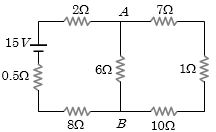
- 3The current from the battery in circuit diagram shown is .............. $A$View Solution
- 4If the current through a resistor in a circuit increases by $3 \%$, then the power dissipated by the resistorView Solution
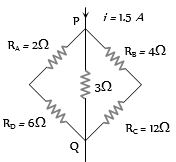
- 5Potential difference between the points $P$ and $Q$ in the electric circuit shown is ................. $V$View Solution
- 6Four wires $AB,\,\,BC,\,\,CD,\,\,DA$ of resistance $4\, \Omega$ each and a fifth wire $BD$ of resistance $8\, \Omega$ are joined to form a rectangle $ABCD$ of which $BD$ is a diagonal. The effective resistance between the points $A$ and $B$ isView Solution
- 7In $a$ wire of cross-section radius $r$, free electrons travel with drift velocity $v$ when a current $I$ flows through the wire. What is the current in another wire of half the radius and of the same material when the drift velocity is $2v$?View Solution
- 8In a Wheatstone’s bridge all the four arms have equal resistance $R$. If the resistance of the galvanometer arm is also $R$, the equivalent resistance of the combination as seen by the battery isView Solution
- 9It takes $12$ minutes to boil $1$ litre of water in an electric kettle. Due to some defect it becomes necessary to remove $20 \%$ turns of heating coil of the kettle. After repair, how much time will it take to boil $1$ litre of water.View Solution
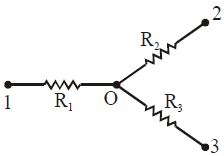
- 10.............. $A$ the current flowing through the resistance $R_2$ of the circuit shown in fig if the resistance are equal to $R_1 = 20\ \Omega, R_2 = 30 \ \Omega$ and $R_3 = 60 \ \Omega$ and potentials of points $1, 2$ and $3$ are equal to $V_1= 20\, V,$ $V_2 = 30\ V$ and $V_3 = 60\ V$View Solution