If in the experiment of Wheatstone's bridge, the positions of cells and galvanometer are interchanged, then balance points will
AIIMS 2017, Easy


Download our appand get started for free
Experience the future of education. Simply download our apps or reach out to us for more information. Let's shape the future of learning together!No signup needed.*
Similar Questions
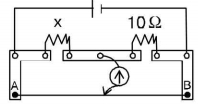
- 1A meter bridge is set up as shown, to determine an unknown resistance ' $X$ ' using a standard $10\,ohm$ resistor. The galvanometer shows null point when tapping-key is at $52\,cm$ mark. The endcorrections are $1\,cm$ and $2\,cm$ respectively for the ends $A$ and $B$. The determined value of ' $X$ ' is $..........\Omega$View Solution
- 2A current of $1\, mA$ is flowing through a copper wire. How many electrons will pass a given point in one secondView Solution
- 3A $5\,^oC$ rise in temperature is observed in a conductor by passing a current. When the current is doubled the rise in temperature will be approximately ........... $^oC$View Solution
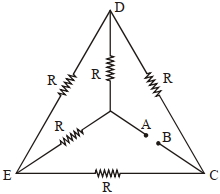
- 4Five equal resistances are connected in a network as shown in figure. The net resistance between the points $A$ and $B$ isView Solution
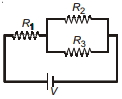
- 5Three identical resistors $R_1=R_2=R_3$ are connected as shown to a battery of constant e.m.f. The power dissipated is ...........View Solution
- 6Consider a block of conducting material ofresistivity '$\rho$' shown in the figure. Current '$I$' enters at '$A$' and leaves from '$D$'. We apply superp osition principle to find voltage '$\Delta V$ ' developed between '$B$' and '$C$'. The calculation is done in the following steps:View Solution
$(i)$ Take current '$I$' entering from '$A$' and assume it to spread over a hemispherical surface in the block.
$(ii)$ Calculatefield $E(r)$ at distance '$r$' from $A$ by using Ohm's law $E = \rho j$, where j is the current per unit area at '$r$'.
$(iii)$ From the '$r$' dependence of $E(r)$, obtain the potential $V(r)$ at $r$.
$(iv)$ Repeat $(i), (ii)$ and $(iii)$ for current '$I$' leaving '$D$' and superpose results for '$A$' and '$D$'.For current entering at $A$, the electric field at a distance '$r$'
from $A$ is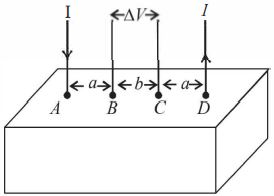
- 7For a wire $\frac{R}{l}=\frac{1}{2}$ and length of wire is $l=5\, cm .$ If potential difference $1\, V$ is applied across it, current through wire will be: $( R =$ Resistance $)$ (in $A$)View Solution
- 8Heater of electric kettle is made of a wire of length $L$ and diameter $d$. It takes $4$ minutes to raise the temperature of $0.5 \ kg$ water by $40\ K$. This heater is replaced by a new heater having two wires of the same material, each of length $L$ and diameter $2 d$. The way these wires are connected is given in the options. How much time in minutes will it take to raise the temperature of the same amount of water by $40K$ ?View Solution
$(A)$ $4$ if wires are in parallel
$(B)$ $2$ if wires are in series
$(C)$ $1$ if wires are in series
$(D)$ $0.5$ if wires are in parallel.
- 9A battery of $e.m.f.$ $10\, V$ and internal resistance $0.5\, ohm$ is connected across a variable resistance $R$. The value of $R$ for which the power delivered in it is maximum is given by ......... $ohm$View Solution
- 10The current in the primary circuit of a potentiometer is $0.2\, A$. The specific resistance and cross section of the potentiometer wire are $4\times10^{-7}\,ohm$ $metre$ and $8\times10^{-7}\, m^2$ respectively. The potential gradient will be equal to .............. $V/m$View Solution