Question
A projectile is fired at an angle with the horizontal.
  1. Show that its trajectory is a parabola.
  2. Obtain expression for:
  1. The maximum height attained.
  2. The time of its flight and
  3. The horizontal range.
  1. At what value of $\theta$ is the horizontal range maximum?
  2. Prove that, for a given velocity of projection, the horizontal range is same for $\theta$ and $(90^\circ-\theta).$
Answer

When a body is projected in the air in any direction, then the body is called a projectile.
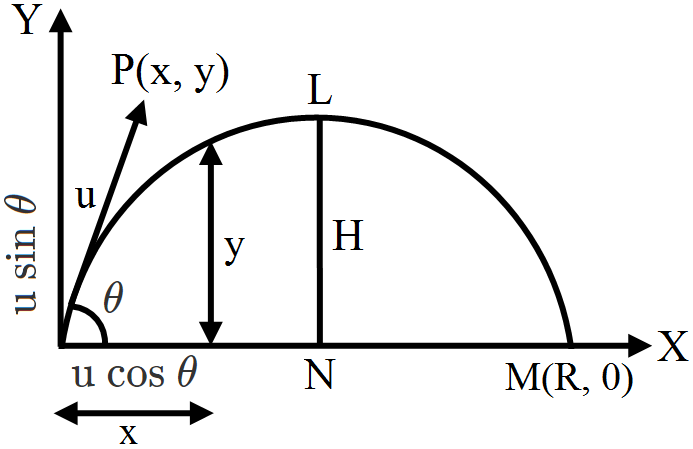
  1. Suppose a body is projected with velocity u at an angle $\theta$ with the horizontal, P(x, y) is any point on its trajectory at time t.

Horizontal component of velocity is unaffected by gravity, but the vertical component $(\text{u}\sin\theta)$ changes due to gravity
$\therefore\ \text{x}=(\text{u}\cos\theta)\text{t}.$
$\text{y}=(\text{u}\sin\theta)\text{t}-\frac{1}{2}\text{gt}^2$
$=\text{u}\sin\theta\times\frac{\text{x}}{\text{u}\cos\theta}-\frac{1}{2}\text{g}\Big(\frac{\text{x}}{\text{u}\cos\theta}\Big)^2$
$\text{y}=\text{x}\tan\theta-\frac{\text{gx}^2}{2\text{u}^2\cos^2\theta}\dots(\text{i})$
It represents the equation of a parabola, hence the path followed by a projectile is a parabola.
  1. The greatest vertical distance attained by the projectile above the horizontal plane from the point of projection is called maximum height.
Maximum height, LN = H
  1. At maximum height,
v = 0
$\therefore\ \text{v}^2-\text{u}_\text{y}^2=-2\text{gH},$ where
$\text{u}_\text{y}=\text{u}\sin\theta$
or $(\text{u}\sin\theta)^2=2\text{gH}$
or $\text{H}=\frac{\text{u}^2\sin^2\theta}{2\text{g}}$
  1. At maximum height,
​​​​​​​v = 0
$\therefore\ 0=\text{u}\sin\theta-\text{gt}$
or $\text{t}=\frac{\text{u}\sin\theta}{\text{g}}$
But time of flight,
$\text{T}=2\text{t}=\frac{2\text{u}\sin\theta}{\text{g}}$
  1. When the body returns to the same horizontal level y = 0
$\therefore\ 0=\text{x}\tan\theta-\frac{\text{gx}^2}{2\text{u}^2\cos^2\theta}$ [From (i)]
or $\text{x}\tan\theta=\frac{\text{gx}^2}{2\text{u}^2\cos^2\theta}$
or $\text{x}=\frac{2\text{u}^2\sin\theta\cos\theta}{\text{g}}=\frac{\text{u}^2\sin2\theta}{\text{g}}$
But coordinates of M are (R, 0). Putting x = R,
we have,
$\text{R}=\frac{\text{u}^2\sin2\theta}{\text{g}}.$
  1. $\theta=45^\circ$
  2. When an object is projected with velocity u making an angle $\theta$ with horizontal direction.
​​​​​​​$\text{R}_1=\frac{\text{u}^2\sin2\theta}{\text{g}}\dots(\text{i})$
When an object is projected with u making an angle $(90^\circ-\theta)$
$\text{R}_2=\frac{\text{u}^2\sin2(90^\circ-\theta)}{\text{g}}$
$=\frac{\text{u}^2}{\text{g}}\sin(180^\circ-2\theta)$
$=\frac{\text{u}^2}{\text{g}}\sin2\theta\dots(\text{ii})$
form (i) and (ii) $R_1 = R_2$​​​​​​​
$\therefore$ The horizontal range is same for two complementary angles.

Need a full question paper?

Generate a complete, print-ready paper with questions like this in minutes — across 16+ boards, with answer keys.

Start Generating Free

Similar questions

A motor car moving at a speed of 72km/h can not come to a stop in less than 3.0s while for a truck this time interval is 5.0s. On a higway the car is behind the truck both moving at 72km/h. The truck gives a signal that it is going to stop at emergency. At what distance the car should be from the truck so that it does not bump onto (collide with) the truck. Human response time is 0.5s.
Discuss how the principle of conservation of momentum is used in the launching of rockets. Deduce an expression for, (i) velocity at any instant and (ii) acceleration of the rocket and force experienced.
Separation of Motion of a system of particles into motion of the centre of mass and motion about the centre of mass: Show $\text{p}=\text{p}'_\text{i}+\text{m}_\text{i}\text{V}$ where $p_i$ is the momentum of the ith particle (of mass $m_i$ ) and $p′_i = m_iv′_i.$ Note: $v′_i$ is the velocity of the ith particle relative to the centre of mass. Also, prove using the definition of the centre of mass.
Describe Searl's method to determine Young's Modulus of elasticity and explain the behaviour of a stretched wire under increasing load.
A 5cm cube has its upper face displaced by 0.2cm by a tangential force of 8N. Calculate the shearing strain, shearing stress and modulus of rigidity of the material of cube.
Given below are some functions of x and t to represent the displacement of an elastic wave.
$​​​​\text{y}=100\cos(100\pi\text{t+0.5x})$
Two trains each having a speed of $30\ km/ hr$ are headed at each other on the same track. A bird that can fly at $60\ km/ hr$ flies off from one train, when they are $60\ km$ apart, and heads directly for the other train. On reaching the other train, it flies directly back to the first, and so forth.
  1. How many trips can the bird make from one train to the other before they crash?
  2. What is the total distance the bird travels?
Consider a one-dimensional motion of a particle with total energy E. There are four regions A, B, C and D in which the relation between potential energy V, kinetic energy (K) and total energy E is as given below: Region A : V > E Region B : V < E Region C : K > E Region D : V > K State with reason in each case whether a particle can be found in the given region or not.
A liquid cools from 70°C to 60°C in 5 minutes. Calculate the time taken by the liquid to cool from 60°C to 50°C, if the temperature of the surrounding is constant at 30°C.
A metre scale is made up of steel and measures correct length at $16^{\circ} \mathrm{C}$. What will be the percentage error if this scale is used:
a. On a summer day when the temperature is $46^{\circ} \mathrm{C}$.
b. On a winter day when the temperature is $6^{\circ} \mathrm{C}$ ? Coefficient of linear expansion of steel $=11 \times 10^{-60} \mathrm{C}^{-1}$.