Question
A projectile is projected horizontally with a velocity $u$. Show that its trajectory is parabolic. And obtain expressions for:
i. Time of flight
ii. Horizontal range
iii. Velocity at any instant $t$.
Answer

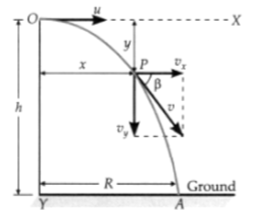
Projectile fired parallel to horizontal. As shown in figure, suppose a body is projected horizontally with velocity u from a point O at a certain height h above the ground level. The body is under the influence of two simultaneous independent motions:
i. Uniform horizontal velocity u.
ii. Vertically downward accelerated motion with constant acceleration g.
Under the combined effect of the above two motions, the body moves along the path OPA.
Image
Horizontal projection of a projectile.
Trajectory of the projectile. After the time t , suppose the body reaches the point $P ( x , y )$. The horizontal distance covered by the body in time $t$ is
$
x=ut . \therefore t=\frac{x}{u}
$
The vertical distance travelled by the body in time $t$ is given by
$
s=u t+\frac{1}{2} a t^2
$
or $y =0 \times t+\frac{1}{2} g t^2=\frac{1}{2} g t^2$ [For vertical motion, $u =0$ ]
or $y=\frac{1}{2} g\left(\frac{x}{u}\right)^2=\left(\frac{g}{2 u^2}\right) x^2\left[\because t=\frac{x}{u}\right]$
or $y = kx ^2$ [Here $k =\frac{g}{2 u^2}=$ a constant]
As y is a quadratic function of x , so the trajectory of the projectile is a parabola.
Time of flight. It is the total time for which the projectile remains in its flight (from O to A ). Let T be its time of flight.
For the vertical downward motion of the body, we use
$
s=u t+\frac{1}{2} a t^2 \text { or h }==0 \times T+\frac{1}{2} g T^2
$
or $T-\sqrt{\frac{2 h}{g}}$
Horizontal range. It is the horizontal distance covered by the projectile during its time of flight. It is equal to $O A=R$. Thus
$R =$ Horizontal velocity $\times$ time of flight $= u \times T$
or $R =u \sqrt{\frac{2 h}{g}}$
Velocity of the projectile at any instant. At the instant $t$ (when the body is at point P ), let the velocity of the projectile be v . The velocity v has two rectangular components:
Horizontal component of velocity, $v _{ x }= u$
Vertical component of velocity, $v _{ y }=0+ gt = gt$
$\therefore$ The resultant velocity at point P is
$
v=\sqrt{v_x^2+v_y^2}=\sqrt{u^2+g^2 t^2}
$
If the velocity v makes an angle p with the horizontal, then $\tan \beta=\frac{v_y}{v_x}=\frac{g t}{u}$
or $\beta=\tan ^{-1}\left(\frac{g t}{u}\right)$

Need a full question paper?

Generate a complete, print-ready paper with questions like this in minutes — across 16+ boards, with answer keys.

Start Generating Free

Similar questions

Find the centre of mass of a uniform:
  1. Half-disc.
  2. Quarter-disc.
Show that for a particle in linear SHM the average kinetic energy over a period of oscillation equals the average potential energy over the same period.
Name the physical quantity of the dimension given below:
  1. ML0T-3
  2. ML-1T-1
  3. M-1L3T-2
  4. ML2T-3
  5. ML0T-2
  6. T-1
A container of volume 50cc contains air (mean molecular weight = 28.8g) and is open to atmosphere where the pressure is 100kPa. The container is kept in a bath containing melting ice (0°C).
  1. Find the mass of the air in the container when thermal equilibrium is reached.
  2. The container is now placed in another bath containing boiling water (100°C). Find the mass of air in the container.
  3. The container is now closed and placed in the melting-ice bath. Find the pressure of the air when thermal equilibrium is reached.
A baloon filled with helium rises against gravity increasing its potential energy. The speed of the baloon also increases as it rises. How do you reconcile this with the law of conservation of mechanical energy? You can neglect viscous drag of air and assume that density of air is constant.
Two bodies of masses 10kg and 20kg respectively kept on a smooth, horizontal surface are tied to the ends of a light string. A horizontal force F = 600N is applied to (i) A, (ii) B along the direction of string. What is the tension in the string in each case?
An elastic spring of force constant K is compressed by an amount x. Show that its potential energy is $\frac{1}{2}\text{Kr}^2.$
A block of mass 15kg is placed on a long trolley. The coefficient of static friction between the block and the trolley is 0.18. The trolley accelerates from rest with 0.5ms-2 for 20s and then moves with uniform velocity. Discuss the motion of the block as viewed by (a) a stationary observer on the ground, (b) an observer moving with the trolley.
A voltmeter coil has resistance $50.0\Omega$ and a resistor of $1.15\text{k}\Omega$ is connected in series. It can read potential differences up to 12 volts. If this same coil is used to construct an ammeter that can measure currents up to 2.0A, what should be the resistance of the shunt used?
Calculate the moment of inertia of uniform circular disc of mass 500 g , radius 10 cm about
i. diameter of the disc
ii. the axis tangent to the disc and parallel to its diameter and
iii. the axis through the centre of the disc and perpendicular to its plane.