Questions

5 Marks Questions

Take a timed test

6 questions · self-marked practice — reveal the answer and mark yourself.

Question 15 Marks
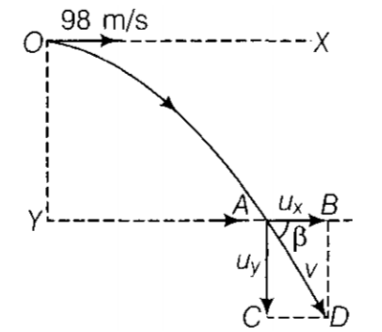
A projectile is fired horizontally with a velocity of $98 ms^{-1}$ from the hill 490 m high. Find
i. time taken to reach the ground
ii. the distance of the target from the hill and
iii. the velocity with which the projectile strikes the ground.
View full question & answer
Question 25 Marks
You are riding in an automobile of mass 3000 kg . Assuming that you are examining the oscillation characteristics of its suspension system. The suspension sags 15 cm when the entire automobile is placed on it. Also, the amplitude of oscillation decreases by $50 \%$ during one complete oscillation. Estimate the values of
a. the spring constant $k$ and
b. the damping constant b for the spring and shock absorber system of one wheel, assuming that each wheel supports 750 kg .
Answer
Mass of the automobile is given by, $m =3000 kg$
Displacement in the suspension system is given by, $x =15 cm=0.15 m$
There are 4 springs in parallel to the support of the mass of the automobile.
The equation for the restoring force for the system is given by:
$
F=-4 k x=m g
$
Where, k is the spring constant of the suspension system
Time period, $T=2 \pi \sqrt{\frac{m}{4 k}}$
And $k=\frac{m g}{4 x}=\frac{3000 \times 10}{4 \times 0.15}=5000=5 \times 10^4 N / m$
Spring constant, $k=5 \times 10^4 N / m$
a. Each wheel supports a mass is given by,$M=\frac{3000}{7}=750 kg$
For damping factor b, the equation for displacement is written as:
$
x=x_o e^{-b t / 2 M}
$
The amplitude of oscillation decreases by $50 \%$.
$
\begin{aligned}
& \therefore x=\frac{x_0}{2} \\
& \frac{x_0}{2}=x_0 e^{-b t / 2 M} \\
& \log _e 2=\frac{b t}{2 M} \\
& \therefore b=\frac{2 M \log _e 2}{t}
\end{aligned}
$
Where,
Time period is given by, $t=2 \pi \sqrt{\frac{m}{4 k}}=2 \pi \sqrt{\frac{3000}{4 \times 5 \times 10^4}}=0.7691 s$
$
\begin{aligned}
& \therefore b=\frac{2 \times 750 \times 0.693}{0.7691} \\
& =1351.58 kg / s
\end{aligned}
$
Therefore, the damping constant of the spring is given by $1351.58 kg / s$.
View full question & answer
Question 35 Marks
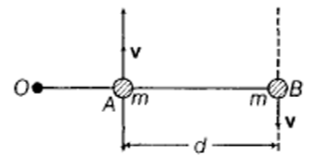
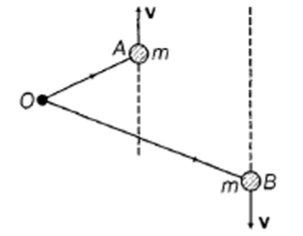
Two particles each of mass m and speed v travel in opposite direction along parallel lines, separated by a distance d. Show that vector angular momentum of the two particles system is same whatever be the point about which angular momentum is taken.
Answer
Suppose, O be the origin chosen. 
Image
Then, angular momentum of particle at A is
$
\begin{aligned}
& I_1=O A \times p=O A \times m v \\
& =m(O A \times v)
\end{aligned}
$
and angular momentum of particle at $B$ is
$
\begin{aligned}
& I_2=O B \times p=O B \times(-m v) \\
& =-m(O B \times v)
\end{aligned}
$
so, total angular momentum of the system of particles is
$
\begin{aligned}
& L=I_1+I_2 \\
& =m(O A \times v)-m(O B \times v) \\
& =m(O A-O B) \times v \\
& =m(B A) \times v
\end{aligned}
$
$
=m(B A) \times v
$
$\{ As , B A=$ position vector of $A -$ position vector of B $\}$
Above expression is independent of choice of origin.
Image
This is true even when particles are not in a straight line.
$
\begin{aligned}
& L_i\left(I_1+I_2=m(O A \times v-O B \times v)\right. \\
& =m(B A) \times v
\end{aligned}
$
Which is the same as a previous result. So, the angular momentum of the system is independent of the choice of origin.
View full question & answer
Question 45 Marks
Obtain an expression for the linear acceleration of a cylinder rolling down an inclined plane and hence find the condition for the cylinder to roll down without slipping.
Answer
Let $M \rightarrow$ mass of the solid cylinder $R \rightarrow$ Radius of the cylinder, $\theta \rightarrow$ Angle of inclination of the plane, $\omega$ -
Angular acceleration of the cylinder.
Various forces acting on the cylinder are:
$R - mg \cos \omega_r F=$ Frictional force acting upwards
$\omega=$ Net force in the downward directions $= f = ma = mg \sin \omega- F$
The torque required for the rolling motion of the cylinder is due to frictional forces, which acts tangential to the surface.
$
\begin{aligned}
& \tau=r \times F \text { Also } \tau=I \alpha=\frac{I a}{r}[\therefore a=r \alpha], \frac{I a}{r}=r F \therefore F=\frac{I a}{r^2} \\
& m a-m g \sin \theta-\frac{I a}{r^2} \rightarrow a\left(m+\frac{I}{r^2}\right)-mg \sin \theta \\
& \rightarrow a-\frac{m g \sin \theta}{m+\frac{I}{r^2}}
\end{aligned}
$
For a solid cylinder, M.I. about the axis $I=\frac{M r^2}{2} \therefore a=\frac{m g \sin \theta}{m+\frac{m r^2}{2} \times \frac{1}{r^2}}=\frac{2}{3} g \sin \theta$
Frictional force $=F=\frac{I a}{r^2}=\frac{I}{r^2} \cdot \frac{2}{3} g \sin \theta=\frac{1}{3} n g \sin \theta$
Coefficient of friction $=\frac{F}{R}=\frac{\frac{1}{3} m g \sin \theta}{m g \cos \theta} \Rightarrow \mu=\frac{1}{3} \tan \theta$
View full question & answer
Question 55 Marks
A projectile is projected horizontally with a velocity $u$. Show that its trajectory is parabolic. And obtain expressions for:
i. Time of flight
ii. Horizontal range
iii. Velocity at any instant $t$.
Answer
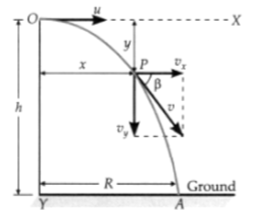
Projectile fired parallel to horizontal. As shown in figure, suppose a body is projected horizontally with velocity u from a point O at a certain height h above the ground level. The body is under the influence of two simultaneous independent motions:
i. Uniform horizontal velocity u.
ii. Vertically downward accelerated motion with constant acceleration g.
Under the combined effect of the above two motions, the body moves along the path OPA.
Image
Horizontal projection of a projectile.
Trajectory of the projectile. After the time t , suppose the body reaches the point $P ( x , y )$. The horizontal distance covered by the body in time $t$ is
$
x=ut . \therefore t=\frac{x}{u}
$
The vertical distance travelled by the body in time $t$ is given by
$
s=u t+\frac{1}{2} a t^2
$
or $y =0 \times t+\frac{1}{2} g t^2=\frac{1}{2} g t^2$ [For vertical motion, $u =0$ ]
or $y=\frac{1}{2} g\left(\frac{x}{u}\right)^2=\left(\frac{g}{2 u^2}\right) x^2\left[\because t=\frac{x}{u}\right]$
or $y = kx ^2$ [Here $k =\frac{g}{2 u^2}=$ a constant]
As y is a quadratic function of x , so the trajectory of the projectile is a parabola.
Time of flight. It is the total time for which the projectile remains in its flight (from O to A ). Let T be its time of flight.
For the vertical downward motion of the body, we use
$
s=u t+\frac{1}{2} a t^2 \text { or h }==0 \times T+\frac{1}{2} g T^2
$
or $T-\sqrt{\frac{2 h}{g}}$
Horizontal range. It is the horizontal distance covered by the projectile during its time of flight. It is equal to $O A=R$. Thus
$R =$ Horizontal velocity $\times$ time of flight $= u \times T$
or $R =u \sqrt{\frac{2 h}{g}}$
Velocity of the projectile at any instant. At the instant $t$ (when the body is at point P ), let the velocity of the projectile be v . The velocity v has two rectangular components:
Horizontal component of velocity, $v _{ x }= u$
Vertical component of velocity, $v _{ y }=0+ gt = gt$
$\therefore$ The resultant velocity at point P is
$
v=\sqrt{v_x^2+v_y^2}=\sqrt{u^2+g^2 t^2}
$
If the velocity v makes an angle p with the horizontal, then $\tan \beta=\frac{v_y}{v_x}=\frac{g t}{u}$
or $\beta=\tan ^{-1}\left(\frac{g t}{u}\right)$
View full question & answer
Question 65 Marks
Draw a graph to show the variation of P.E., K.E. and total energy of a simple harmonic oscillator with displacement.
Answer
The potential energy (PE) of a simple harmonic oscillator is
$
P E=\frac{1}{2} k \alpha^2=\frac{1}{2} m \omega^2 x^2\ldots(i)
$
When, PE is plotted against displacement $x$, we will obtain a parabola.
$
\begin{aligned}
& \text { When } x=0, PE=0 \\
& \text { When } x= \pm A, PE=\text { maximum } \\
& =\frac{1}{2} m \omega^2 A^2
\end{aligned}
$
The kinetic energy (KE) of a simple harmonic oscillator $KE =\frac{1}{2} m v^2$
But velocity of oscillator $v =\omega \sqrt{A^2-x^2}$
$
\Rightarrow \quad KE=\frac{1}{2} m\left[\omega \sqrt{A^2-x^2}\right]^2
$
or $KE =\frac{1}{2} m \omega^2\left(A^2-x^2\right)$ $\ldots(ii)$
This is also parabola, if we plot KE against displacement $x$
i.e. $KE =0$ at $x = \pm A$
and $KE =\frac{1}{2} m \omega^2 A^2$ at $x =0$
Now, total energy of the simple harmonic oscillator = PE + KE [using Eqs. (i) and (ii)]
$
\begin{aligned}
& =\frac{1}{2} m \omega^2 x^2+\frac{1}{2} m \omega^2\left(A^2-x^2\right) \\
& =\frac{1}{2} m \omega^2 x^2+\frac{1}{2} m \omega^2 A^2-\frac{1}{2} m \omega^2 x^2 \\
& TE=\frac{1}{2} m \omega^2 A^2=\text { constant }
\end{aligned}
$
which is a constant and independent of x .
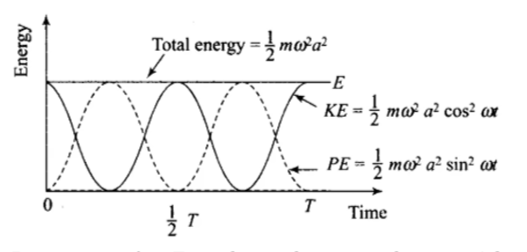
Plotting under the above guidelines KE, PE and TE versus displacement x-graph as follows:
Image
Important point: From the graph, we note that potential energy or kinetic energy completes two vibrations in a time during which S.H.M. completes one vibration.
Thus the frequency of potential energy or kinetic energy is double that of S.H.M.
View full question & answer