Question
A projectile is projected with velocity $u$ making an angle $\theta$ with horizontal direction, find:
  1. Time of flight.
  2. Horizontal range.

Answer

  1. At maximum height $v =0$
$\therefore\ 0=\text{u}\sin\theta-\text{gt};$
or $\text{t}=\frac{\text{u}\sin\theta}{\text{g}}$
But time of flight,
$\text{T}=\text{2t}=\frac{2\text{u}\sin\theta}{\text{g}}$
  1. When the body returns to the same horizontal level $y = 0$
$\therefore 0=\text{x}\tan\theta-\frac{\text{gx}^2}{2\text{u}^2\cos^2\theta} [$From $(i)]$
or $\text{x}\tan\theta=\frac{\text{gx}^2}{2\text{u}^2\cos^2\theta}$
or $\text{x}=\frac{2\text{u}^2\sin\theta\cos\theta}{\text{g}}=\frac{\text{u}^2\sin2\theta}{\text{g}}$
But coordinates of $M$ are $(R, 0).$
Putting $x = R$, we have $\text{R}=\frac{\text{u}^2\sin2\theta}{\text{g}}$

Need a full question paper?

Generate a complete, print-ready paper with questions like this in minutes — across 16+ boards, with answer keys.
Start Generating Free

Similar questions

A source emits light of wavelengths $555\ nm$ and $600\ nm$. The radiant flux of the $555\ nm$ part is $40W$ and of the $600\ nm$ part is $30W$. The relative luminosity at $600nm$ is $06$. Find:
  1. The total radiant flux.
  2. The total luminous flux.
  3. The luminous efficiency.
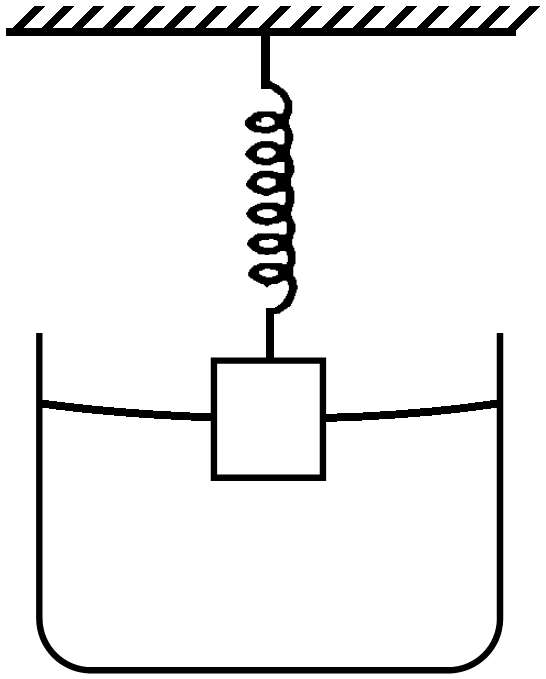
A cylindrical object of outer diameter $10\ cm$, height $20\ cm$ and density $8000\ kg/m^3$ is supported by a vertical spring and is half dipped in water as shown in.
  1. Find the elongation of the spring in equilibrium condition.
  2. If the object is slightly depressed and released, find the time period of resulting oscillations of the object. The spring constant $= 500N/m$.
A $660Hz$ tuning fork sets up vibration in a string clamped at both ends. The wave speed for a transverse wave on this string is $220m/s$ and the string vibrates in three loops.
  1. Find the length of the string.
  2. If the maximum amplitude of a particle is $0.5\ cm,$ write a suitable equation describing the motion.
The position of a particle is given by: $\vec{\text{r}}=3.0\text{t}\hat{\text{i}}-2.0\text{t}^2\hat{\text{j}}+4\hat{\text{k}}\text{ m}$ where $t$ is in seconds, $r$ is in metres and the coefficients have the proper units.
  1. Find the velocity $v$ and acceleration $a.$
  2. What is the magnitude of velocity of the particle at $t = 2s$?
Two rods of the same area of cross-section, but of lengths l, and l, and conductivities K, and K, are joined in series. Show that the combination is equivalent of a material of conductivity $\text{K}=\frac{\text{l}_1+\text{l}_2}{\Big(\frac{\text{l}_1}{\text{K}_1}\Big)+\Big(\frac{\text{l}_2}{\text{l}_2}\Big)}$
Discuss the variation of 'g' with depth. What happens to 'g' at the centre of earth?
The band gap for silicon is $1.1eV.$
  1. Find the ratio of the band gap to $kT$ for silicon at room temperature $300K.$
  2. At what temperature does this ratio become one tenth of the value at $300K?$
$($Silicon will not retain its structure at these high temperatures.$)$
Calculate the temperature at which r.m.s. velocity of a gas molecule is same as that of a molecule of another gas at $47°C$. Molecular weight of first and second gases are $64$ and $32$ respectively.
What is Simple Harmonic Motion? Show that in $\text{S.H.M}$., acceleration is directly proportional to its displacement at a given instant.
A circular loop of radius 20cm carries a current of 10A. An electron crosses the plane of the loop with a speed of $2.0 \times 10^6m/s$. The direction of motion makes an angle of 30° with the axis of the circle and passes through its centre. Find the magnitude of the magnetic force on the electron at the instant it crosses the plane.