A proton, a deuteron and an $\alpha$ particle are moving with same momentum in a uniform magnetic field. The ratio of magnetic forces acting on them is.......... and their speed is.................. in the ratio.
JEE MAIN 2021, Diffcult
Download our app for free and get started
$F=q(\vec{v} \times \vec{B})=\frac{q}{m}(\vec{P} \times \vec{B})$
$\Rightarrow F \propto \frac{ q }{ m }$
thus $F _{1}: F _{2}: F _{3}=\frac{ q _{1}}{ m _{1}}: \frac{ q _{2}}{ m _{2}}: \frac{ q _{3}}{ m _{3}}$
$=\frac{ e }{ m _{ p }}: \frac{ e }{2 m _{ p }}: \frac{2 e }{4 m _{ p }}$
$=\frac{1}{1}: \frac{1}{2}: \frac{2}{4}$
$=2: 1: 1$
Now for speed calculation
$P = constant \Rightarrow v \propto \frac{1}{ m }$
thus $v _{1}: v _{2}: v _{3}=\frac{1}{ m _{ p }}: \frac{1}{2 m _{ p }}: \frac{1}{4 m _{ p }}$
$=\frac{1}{1}: \frac{1}{2}: \frac{1}{4}$
$=4: 2: 1$

Download our appand get started for free
Experience the future of education. Simply download our apps or reach out to us for more information. Let's shape the future of learning together!No signup needed.*
Similar Questions
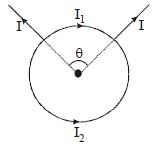
- 1Assertion : The magnetic field at the centre of the circular coil in the following figure due to the currents $I_1$ and $I_2$ is zero.View Solution
Reason : $I_1 = I_2$ implies that the fields due to the current $I_1$ and $I_2$ will be balanced.
- 2The current sensitivity of a galvanometer can be increased by:View Solution
$(A)$ decreasing the number of turns
$(B)$ increasing the magnetic field
$(C)$ decreasing the area of the coil
$(D)$ decreasing the torsional constant of the spring
Choose the most appropriate answer from the options given below.
- 3View SolutionA vertical wire carrying a current in the upward direction is placed in horizontal magnetic field directed towards north. The wire will experience a force directed towards
- 4In the hydrogen atom, the electron is making $6.6 \times {10^{15}}\,r.p.s.$ If the radius of the orbit is $0.53 \times {10^{ - 10}}\,metre,$ then magnetic field produced at the centre of the orbit is......$Tesla$View Solution
- 5View SolutionAssertion : Free electrons always keep on moving in a conductor even then no magnetic force act on them in magnetic field unless a current is passed through it.
Reason : The average velocity of free electron is zero.
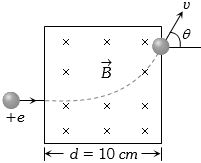
- 6A proton accelerated by a potential difference $500\;KV$ moves though a transverse magnetic field of $0.51\;T$ as shown in figure. The angle $\theta $through which the proton deviates from the initial direction of its motion is......$^o$View Solution
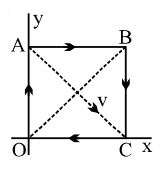
- 7$OABC$ is a current carrying square loop an electron is projected from the centre of loop along its diagonal $AC$ as shown. Unit vector in the direction of initial acceleration will beView Solution
- 8A circular loop of radius $r$ is carrying current I A. The ratio of magnetic field at the centre of circular loop and at a distance $r$ from the center of the loop on its axis is:View Solution
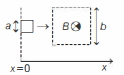
- 9A square-shaped conducting wire loop of dimension moving parallel to the $X$-axis approaches a square region of size $b(a < b)$, where a uniform magnetic field $B$ exists pointing into the plane of the paper (see figure). As the loop passes through this region, the plot correctly depicting its speed $v$ as a function of $x$ isView Solution
- 10When a charged particle moving with velocity $\vec v$ is subjected to a magnetic field of induction $\vec B$, the force on it is non-zero. This implies thatView Solution