Assertion : The magnetic field at the centre of the circular coil in the following figure due to the currents $I_1$ and $I_2$ is zero.
Reason : $I_1 = I_2$ implies that the fields due to the current $I_1$ and $I_2$ will be balanced.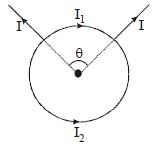
AIIMS 2013, Medium


Download our appand get started for free
Experience the future of education. Simply download our apps or reach out to us for more information. Let's shape the future of learning together!No signup needed.*
Similar Questions
- 1An electron (mass = $9.1 \times {10^{ - 31}}$ $kg$; charge = $1.6 \times {10^{ - 19}}$ $C$) experiences no deflection if subjected to an electric field of $3.2 \times {10^5}$ $V/m$, and a magnetic fields of $2.0 \times {10^{ - 3}} \,Wb/m^2$. Both the fields are normal to the path of electron and to each other. If the electric field is removed, then the electron will revolve in an orbit of radius.......$m$View Solution
- 2The magnetic moments associated with two closely wound circular coils $A$ and $B$ of radius $r_A=10 cm$ and $r_B=20 cm$ respectively are equal if: (Where $N _A, I _{ A }$ and $N _B, I _{ B }$ are number of turn and current of $A$ and $B$ respectively)View Solution
- 3A wire carrying current $I$ and other carrying $2I$ in the same direction produces a magnetic field $B$ at the mid point. What will be the field when $2I$ wire is switched offView Solution
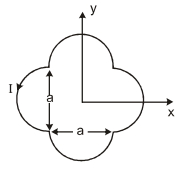
- 4A loop carrying current $I$ lies in the $x$-y plane as shown in the figure. the unit vector $\hat{ k }$ is coming out of the plane of the paper. the magnetic moment of the current loop is :View Solution
- 5In the following hexagons, made up of two different material $P$ and $Q,$ current enters and leaves from points $X$ and $Y$ respectively. In which case the magnetic field at its centre is not zero.View Solution
- 6What is the magnetic field at a distance $R$ from a coil of radius $r$ carrying current $I$ ?View Solution
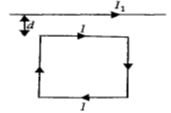
- 7A square loop, carrying a steady current $I,$ is placed in a horizontal plane near a long straight conductor carrying a steady current $I_1$ at a distance $d$ from the conductor as shown in figure. The loop will experienceView Solution
- 8A particle of specific charge (charge/mass) $\alpha$ starts moving from the origin under the action of an electric field $\vec E = {E_0}\hat i$ and magnetic field $\vec B = {B_0}\hat k$. Its velocity at $(x_0 , y_0 , 0)$ is ($(4\hat i + 3\hat j)$ . The value of $x_0$ is:View Solution
- 9A galvanmeter has a coil of resistance $200 \Omega$ with a full scale deflection at $20 \mu \mathrm{A}$. The value of resistance to be added to use it as an ammeter of range $(0-20) \mathrm{mA}$ is:View Solution
- 10A square loop of area $25\,cm ^2$ has a resistance of $10\,\Omega$. The loop is placed in uniform magnetic field of magnitude $40.0 T$. The plane of loop is perpendicular to the magnetic field. The work done in pulling the loop out of the magnetic field slowly and uniformly in $1.0 sec$, will be $..........\times 10^{-3}$View Solution