In the hydrogen atom, the electron is making $6.6 \times {10^{15}}\,r.p.s.$ If the radius of the orbit is $0.53 \times {10^{ - 10}}\,metre,$ then magnetic field produced at the centre of the orbit is......$Tesla$
Medium


Download our appand get started for free
Experience the future of education. Simply download our apps or reach out to us for more information. Let's shape the future of learning together!No signup needed.*
Similar Questions
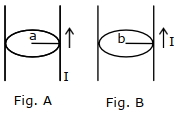
- 1Figure $A$ and $B$ shown two long straight wires of circular cross-section ($a$ and $b$ with $a$ $<$ $b$), carrying current $I$ which is uniformly distributed across the cross-section. The magnitude of magnetic field $B$ varies with radius $r$ and can be represented asView Solution
- 2If two protons are moving with speed $v=4.5 \times 10^{5} \,m / s$ parallel to each other then the ratio of electrostatic and magnetic force between themView Solution
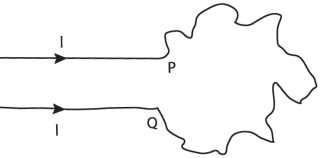
- 3Assertion $(A):$ A wire bent into an irregular shape with the points $P$ and $Q$ fixed. If a current $I$ passed through the wire, then the area enclosed by the irregular portion of the wire increases.View Solution
Reason $(R):$ Opposite currents carrying wires repel each other.
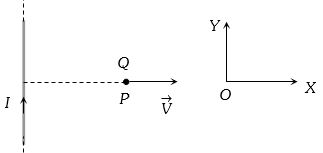
- 4A very long straight wire carries a current $I$. At the instant when a charge $ + Q$ at point $P$ has velocity $\overrightarrow V $, as shown, the force on the charge isView Solution
- 5Two straight parallel wires, both carrying $10$ $ampere$ in the same direction attract each other with a force of $1 \times {10^{ - 3}}\,N$. If both currents are doubled, the force of attraction will beView Solution
- 6View SolutionA cell is connected between two points of a uniformly thick circular conductor. The magnetic field at the centre of the loop will be
- 7The resistance of a galvanometer is $90\, ohms$. If only $10$ percent of the main current may flow through the galvanometer, in which way and of what value, a resistor is to be usedView Solution
- 8A circular loop is kept in that vertical plane which contains the north-south direction. It carries a current that is towards south at the topmost point. Let $A$ be a point on axis of the circle to the east of it and $B$ a point on this axis to the west of it. The magnetic field due to the loop :-View Solution
- 9One proton beam enters a magnetic field of ${10^{ - 4}}$ $T$ normally, Specific charge = ${10^{11}}\,C/kg.$ velocity = ${10^7}\,m/s$. What is the radius of the circle described by it....$m$View Solution
- 10The resistance of $1\, A$ ammeter is $0.018\,\Omega $. To convert it into $10\, A$ ammeter, the shunt resistance required will beView Solution