Question
A proton is about 1840 times heavier than an electron. When it is accelerated by a potential difference of 1 kV, its kinetic energy will be (a) 1840 keV(b) 1/1840 keV(c) 1 keV(d) 920 keV
       

Answer

(c) 1 keV

Need a full question paper?

Generate a complete, print-ready paper with questions like this in minutes — across 16+ boards, with answer keys.
Start Generating Free

Similar questions

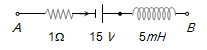
The network shown in the figure is a part of a complete circuit. If at a certain instant the current $i$ is $5 A$ and is decreasing at the rate of $10^3 A / s$  then $V_{A}-V_{B}$  is
A car moves up a plane road. The induced emf in the axle connecting the two wheels is maximum when it moves.
When a charged particle enters a uniform magnetic field its kinetic energy(a) Remains constant(b) Increases(c) Decreases(d) Becomes zero
       
A point charge $q$ is placed at a distance $a/2$ directly above the centre of a square of side $a$. The electric flux through the square is
An electron has a mass of $9.1 \times 10^{-31}\  kg.$ It revolves round the nucleus in a circular orbit of radius $0.529 \times 10^{-10}$ metre at a speed of $2.2 \times 10^6 m/s$ . The magnitude of its linear momentum in this motion is
When a radioactive substance emits an a -particle, its position in the periodic table is lowered by(a) One place(b) Two places(c) Three places(d) Four places
       
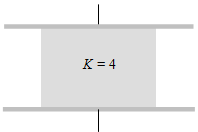
Consider a parallel plate capacitor of $10 \mu F\ ($micro$-$farad$)$ with air filled in the gap between the plates. Now one half of the space between the plates is filled with a dielectric of dielectric constant $4,$ as shown in the figure. The capacity of the capacitor changes to
The radius of a metallic sphere if its capacitance is $1/9 F,$ is
The magnetic moment of a circular coil carrying current is:
Consider a radioactive material of half$-$life $1.0$ minute. If one of the nuclei decays now, the next one will decay