A proton moving with a constant velocity passes through a region of space without any change in its velocity. If $\overrightarrow E $ and $\overrightarrow B $ represent the electric and magnetic fields respectively, then this region of space may have
IIT 1985, Medium


Download our appand get started for free
Experience the future of education. Simply download our apps or reach out to us for more information. Let's shape the future of learning together!No signup needed.*
Similar Questions
- 1A long solenoid is fabricated to closely winding wire of radius $0.5\,mm$ over a cylindrical frame so that the successive turns nearly touch each other, the magnetic field at the centre of solenoid if it carries a current of $5\,A$View Solution
- 2A circular loop of radius $r$ is carrying current I A. The ratio of magnetic field at the centre of circular loop and at a distance $r$ from the center of the loop on its axis is:View Solution
- 3View SolutionThe resistance of an ideal voltmeter is
- 4View SolutionThe magnetic field at the centre of current carrying coil is
- 5View SolutionThe radius of curvature of the path of a charged particle moving in a static uniform magnetic field is
- 6The earth's magnetic induction at a certain point is $7 \times {10^{ - 5}}\,Wb/{m^2}.$ This is to be annulled by the magnetic induction at the centre of a circular conducting loop of radius $5 \,cm$. The required current in the loop is......$A$View Solution
- 7Current $i$ is carried in a wire of length $L$. If the wire is turned into a circular coil, the maximum magnitude of torque in a given magnetic field $B$ will beView Solution
- 8A long straight wire carries an electric current of $2\,A$. The magnetic induction at a perpendicular distance of $5\,m$ from the wire isView Solution
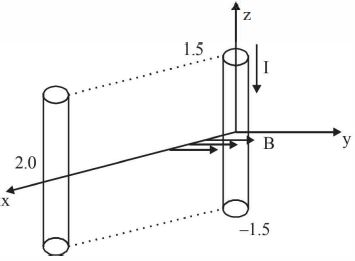
- 9A conductor lies along the $z-$axis $a$ $-1.5$$ \le Z < 1.5\,m$ carries a fixed current of $10.0\ A$ in $ - {\hat a_z}$ direction (see figure). For a field $\vec B$ $=$ $3.0 \times 10^{-4}$ $e^{-0.2x}$ ${\hat a_y}\,T$ find the power required to move the conductor at constant speed to $x = 2.0\ m, y = 0\ m$ in $5 \times 10^{-3}\ s$. Assume parallel motion along the $x-$axis........$ W$View Solution
- 10A galvanometer, having a resistance of $50 \,\Omega$ gives a full scale deflection for a current of $0.05\, A$. The length in meter of a resistance wire of area of cross-section $2.97× 10^{-2} \,cm^2$ that can be used to convert the galvanometer into an ammeter which can read a maximum of $5\, A$ current is (Specific resistance of the wire = $5 × {10^{ - 7}}\,\Omega m$)View Solution