The radius of curvature of the path of a charged particle moving in a static uniform magnetic field is
Easy
Download our app for free and get started
(d) $r = \frac{{mv}}{{qB}} = \frac{P}{{qB}}$

Download our appand get started for free
Experience the future of education. Simply download our apps or reach out to us for more information. Let's shape the future of learning together!No signup needed.*
Similar Questions
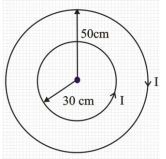
- 1Two concentric circular loops of radii $r _{1}=30\,cm$ and $r_{2}=50\,cm$ are placed in $X - Y$ plane as shown in the figure. $A$ current $I=7\,A$ is flowing through them in the direction as shown in figure. The net magnetic moment of this system of two circular loops is approximately.View Solution
- 2A charge moving with velocity $v$ in $X$-direction is subjected to a field of magnetic induction in the negative $X$-direction. As a result, the charge willView Solution
- 3A uniform conducting wire of length $12 \mathrm{a}$ and resistance $'R'$ is wound up as a current carrying coil in the shape of,View Solution
$(i)$ an equilateral triangle of side $'a'.$
$(ii)$ a square of side $'a'.$
The magnetic dipole moments of the coil in each case respectively are:
- 4View SolutionTwo parallel wires are carrying electric currents of equal magnitude and in the same direction. They exert
- 5A proton with a kinetic energy of $2.0\,eV$ moves into a region of uniform magnetic field of magnitude $\frac{\pi}{2} \times 10^{-3}\,T$. The angle between the direction of magnetic field and velocity of proton is $60^{\circ}$. The pitch of the helical path taken by the proton is $..........cm$ (Take, mass of proton $=1.6 \times 10^{-27}\,kg$ and Charge on proton $=1.6 \times 10^{-19}\,kg)$View Solution
- 6The relation between voltage sensitivity (${\sigma _V}$) and current sensitivity $({\sigma _i})$ of a moving coil galvanometer is (Resistance of Galvanometer = $G$)View Solution
- 7View SolutionAn electron is projected with uniform velocity along the axis inside a current carrying long solenoid. Then :
- 8A charged particle is moving in a uniform magnetic field in a circular path. Radius of circular path is $R$. When energy of particle is doubled, then new radius will beView Solution
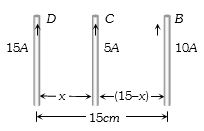
- 9Three long, straight and parallel wires carrying currents are arranged as shown in the figure. The wire $C$ which carries a current of $5.0\, amp$ is so placed that it experiences no force. The distance of wire $C$ from wire $D$ is thenView Solution
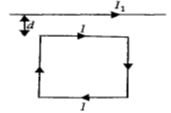
- 10A square loop, carrying a steady current $I,$ is placed in a horizontal plane near a long straight conductor carrying a steady current $I_1$ at a distance $d$ from the conductor as shown in figure. The loop will experienceView Solution