Question
A radioactive sample disintegrates via two independent decay processes having half lives $T _{1 / 2}^{(1)}$ and $T _{1 / 2}^{(2)}$ respectively. The effective half- life $T _{1 / 2}$ of the nuclei is

Answer

$\lambda_{ eq }=\lambda_{1}+\lambda_{2}$

$\frac{1}{ T _{1 / 2}}=\frac{1}{ T _{1 / 2}^{(1)}}+\frac{1}{ T _{1 / 2}^{(2)}}$

$T _{1 / 2}=\frac{ T _{1 / 2}^{(1)} T _{1 / 2}^{(2)}}{ T _{1 / 2}^{(1)}+ T _{1 / 2}^{(2)}}$

Need a full question paper?

Generate a complete, print-ready paper with questions like this in minutes — across 16+ boards, with answer keys.

Start Generating Free

Similar questions

A ball is dropped on the floor from a height of $10 \,m$. It rebounds to a height of $2.5 \,m$. If the ball is in contact with the floor for $0.01 \,sec$, the average acceleration during contact is 
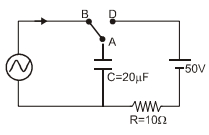
At time $t =0$, terminal $A$ in the circuit shown in the figure is connected to $B$ by a key and alternating current $I ( t )= I _0 \cos (\omega t$,$) , with I _0=1 A$ and $\omega=500 \ rad s ^{-1}$ starts flowing in it with the initial direction shown in the figure.

At $t=\frac{7 \pi}{6 \omega}$, the key is switched from $B$ to $D$. Now onwards on ly $A$ and $D$ are connected. $A$ total charge $Q$ flows from the battery to charge the capacitor fully. If $C =20 \mu, R =10 \Omega$ and the battery is ideal with emf of $50 \ V$, identify the correct statement $(s)$

$(A)$ Magnitude of the maximum charge on the capacitor before $t=\frac{7 \pi}{6 \omega}$ is $1 \times 10^{-3} C$.

$(B)$ The current in the left part of the circuit just before $t=\frac{7 \pi}{6 \omega}$ is clockwise

$(C)$ Immediately after $A$ is connected to $D$. the current in $R$ is $10 A$.

$(D)$ $Q =2 \times 10^{-3} C$.
A thin lens made of glass of refractive index $\mu  = 1.5$ has a focal length equal to $12 cm$ in air. It is now immersed in water $\left( {\mu \, = \,\frac{4}{3}} \right)$. Its new focal length is.......$cm$
In variable state, the rate of flow of heat is controlled by
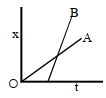
The position-time graphs for two students $A$ and $B$ returning from the school to their homes are shown in figure

$(A)$ $A$ lives closer to the school

$(B)$ $B$ lives closer to the school

$(C)$ $A$ takes lesser time to reach home

$(D)$ $A$ travels faster than $B$

$(E)$ $B$ travels faster than $A$

Choose the correct answer from the options given below :
A submarine has a window of area $30 \times 30 \,cm ^2$ on its ceiling and is at a depth of $100 \,m$ below sea level in a sea. If the pressure inside the submarine is maintained at the sea-level atmosphere pressure, then the force acting on the window is ............. $N$ (consider density of sea water $=1.03 \times 10^3 \,kg / m ^3$, acceleration due to gravity $=10 \,m / s ^2$ )
The thermal capacity of a body is $80\, cal$, then its water equivalent is
A system has basic dimensions as density $[D]$, velocity $[V]$ and area $[A]$. The dimensional representation of force in this system is 
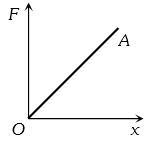
The force required to stretch a spring varies with the distance as shown in the figure. If the experiment is performed with the above spring of half length, the line $OA$ will
A lensmaker has to design an achromatic combination of effective power $- 0 .5D$.  The two types of glasses to be used  (say $A$. and $B$) has dispersive powers in the ratio ${\omega _A}:{\omega _B} = 3:5$ Then the lens made rom glass $A$ will have focal length.......$cm$