MCQ
A system has basic dimensions as density $[D]$, velocity $[V]$ and area $[A]$. The dimensional representation of force in this system is 
  • $[AV^2D]$
  • B
    $[A^2VD]$
  • C
    $[AVD^2]$
  • D
    $[A^0VD]$

Answer

Correct option: A.
$[AV^2D]$
a
$\mathrm{F}=\mathrm{Ma}=$ volume $\times$ density $\times\left(\frac{\mathrm{L}}{\mathrm{T}^{2}}\right)$

$=(\text { Area } \times \text { length }) \times$ density $\times \frac{\mathrm{L}}{\mathrm{T}^{2}}$

$\left[\text { velocity } \mathrm{v}^{2}=\frac{\mathrm{L}^{2}}{\mathrm{T}^{2}}\right]$

$=\left[\mathrm{Av}^{2} \mathrm{D}\right]$

Need a full question paper?

Generate a complete, print-ready paper with questions like this in minutes — across 16+ boards, with answer keys.
Start Generating Free

Similar questions

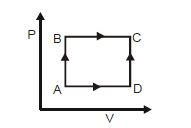
A shown in the figure, the amount of heat absorbed along the path $ABC$ is $90\,J$ and the amount of work done by the system is $30\,J$ . If the amount of work done along the path $ADC$ is $20\,J$ , the amount of heat absorbed will be  .... $J$
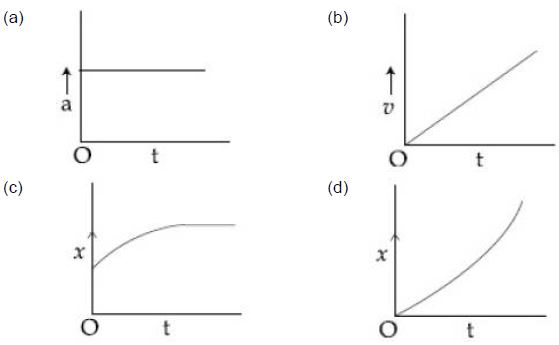
A particle starts from origin $O$ from rest and moves with a uniform acceleration along the positive $x -$ axis. Identify all figures that correctly represent the motion qualitatively. $(a =$ acceleration, $v =$ velocity, $x =$ displacement, $t =$ time$)$
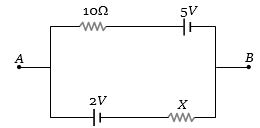
If ${V_{AB}} = 4\,V$ in the given figure, then resistance $X$ will be .............. $\Omega$
A dip needle lies initially in the magnetic meridian when it shows an angle of dip $\theta $ at a place. The dip circle is rotated through an angle $x$ in the horizontal plane and then it shows an angle of dip $\theta '$. Then $\frac{{\tan \theta '}}{{\tan \theta }}$ is
Assertion : In Young's double slit experiment the two slits are at distance $d$ apart. Interference pattern is observed on a screen at distance $D$ from the slits. At a point onthe screen when it is directly opposite to one of the slits, a dark fringe is observed. Then, the wavelength of wave is proportional to square of distance of two slits

Reason : For a dark fringe intensity is zero.
A sonometer wire, with a suspended mass of $M = 1\, kg$, is in resonance with a given tuning fork. The apparatus is taken to the moon where the acceleration due to gravity is $(1/6)$ that on earth. To obtain resonance on the moon, the value of $M$ should be ......... $kg$
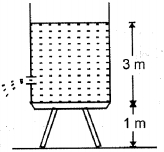
Water is filled in a tank upto $3 \,m$ height. The base of the tank is at height $1 \,m$ above the ground. What should be the height of a hole made in it, so that water can be sprayed upto maximum horizontal distance on ground?
This question contains statement$-1$ and statement$-2$. Of the four choices given after the statements, choose the one that best describes the two statements.

statement$-1$ : The temperature dependence of resistance is usually given as $R=R_{0}(1+\alpha \Delta t)$. The resistance of a wire changes from $100\; \Omega$ to $150\; \Omega$ when its temperature is increased from $27^{\circ} C$ to $227^{\circ} C$. This implies that $\alpha=2.5$ $\times 10^{-3} /{ }^{\circ} C$

statement$-2\;: R=R_{0}(1+\alpha \Delta t)$ is valid only when the change in the temperature $\Delta T$ is small and $\Delta R=\left(R-R_{0}\right) < < R_{0}$
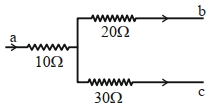
Figure shows a part of an electric circuit. The potentials at points $a , b$ and $c$ are $30\,V , 12\,V$ and $2\,V$ respectively. The current through the $20 \Omega$ resistor will be $........\,A$
A tuning fork of known frequency $256\,Hz$ makes $5$ beats per second with the vibrating string of a piano. The beat frequency decreases to $2$ beats per second when the tension in the piano string is slightly increased. The frequency of the piano string before increasing the tension was