MCQ
A radioactive substance emits
  • A
    $\alpha$- rays
  • B
    $\beta$- rays
  • C
    $\gamma$- rays
  • All of these

Answer

Correct option: D.
All of these
d
(d) Radiation is the energy that is released as particles or rays, during radioactive decay.

A radioactive substance emits $\alpha$ or $\beta$ rays.

Need a full question paper?

Generate a complete, print-ready paper with questions like this in minutes — across 16+ boards, with answer keys.
Start Generating Free

Similar questions

Which compound is soluble in ${H_2}O$
The angle between the two vectors $\vec A = 3\hat i + 4\hat j + 5\hat k$ and $\vec B = 3\hat i + 4\hat j - 5\hat k$ will be....... $^o$
One mole of an ideal monoatomic gas is compressed isothermally in a rigid vessel to double its pressure at room temperature, $27\,^oC$.The work done on the gas will be
In an experiment, the saturation in the plate current in a diode is observed at $240\,V$. But a student still wants to increase the plate current. It can be done, if
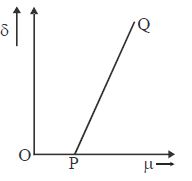
For a small angled prism, angle of prism $A$, the angle of minimum deviation $\left( \delta  \right)$ varies with the refractive index of the prism as shown in the graph.
Light of wavelength $6000\,\mathop A\limits^o$ is incident on a single slit of width $0.3\, mm$. The angular position of first minima will be
The correct value of ${0^o}C$ on the Kelvin scale is ........... $K$
Consider a uniform rod of mass $\mathrm{M}=4 \mathrm{m}$ and length $\ell$ pivoted about its centre. A mass $m$ moving with velocity $v$ making angle $\theta=\frac{\pi}{4}$ to the rod's long axis collides with one end of the rod and sticks to it. The angular speed of the rod-mass system just after the collision is
A convex mirror has a focal length$f.$ A real object is placed at a distance $f$ in front of it from the pole produces an image at
A body $A$ of mass $M$ while falling vertically downwards under gravity breaks into two parts; a body $B$ of mass $\frac{2}{3} M$. The centre of mass of bodies $B$ and $C$ taken together shifts compared to that of body $A$ towards