Question
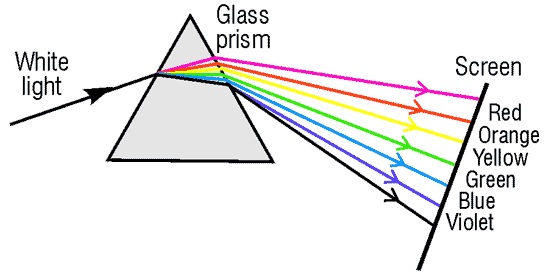
  1. A ray of white light breaks up into its components while passing through a glass prism. Draw a ray diagram to show the path of rays?
  2. Mark the least deviated colour in your diagram?
  3. Why do different coloured rays deviate differently in a prism?
Answer


Different coloured rays deviate differently in a prism because different colours travel at different speeds through the glass prism.

Need a full question paper?

Generate a complete, print-ready paper with questions like this in minutes — across 16+ boards, with answer keys.

Start Generating Free

Similar questions

Define Snell’s law of refraction. A ray of light is incident on a glass slab at an angle of incidence of 60°. If the angle of refraction be 32.7°, calculate the refractive index of glass.

$(\text{Given:}\ \sin60^\circ=0.866,\text{ and }\sin32.7^\circ=540)$ 

A 2.0cm tall object is place perpendicular to the principal axis of a concave lens of focal length 15cm. At what distance from the lens, should the object be placed so that it forms an image 10cm from the lens? Also find the nature and the size of image formed.
Describe the working of a hydrogen bomb.
State and explain the Clock face rule for determining the polarities of a circular wire carrying current.
 The calorific value and ignition temperature of fuel A are 55kJ/ g and 80°C, respectively. These values for fuel B are 80kJ/ g and 10°C, respectively. On burning, the fuel A produces CO2 and H2O while the fuel B produces CO2 , CO and SO2. Give three points of relative and disadvantages of these two fuels.
Explain why, a stick half immersed in water appears to be bent at the surface. Draw a labelled diagram to illustrate your answer.
Draw circuit symbols for:
  1. Fixed resistance.
  2. Variable resistance.
  3. A cell.
  4. A battery of three cells.
  5. An open switch.
  6. A closed switch.
The magnification of an image formed by a lens is – 1. If the distance of the image from the optical centre of the lens is 35 cm, where is the object placed ? What is the nature and focal length of the lens? If the object is displaced 20 cm towards the optical centre of the lens, where would the image be formed and what will be its nature? Draw a ray diagram to justify your answer.
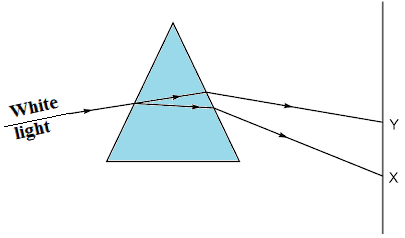
In the figure given alongside, a narrow beam of white light is shown to pass through a triangular glass prism. After passing through the prism, it produces a spectrum YX on the screen:
State the colour seen.
  1. At X, and
  2. At Y​​​​​​​​​​​​


​​​​​​​​​​​​
  1. violet.
  2. Red
  1. ​​​​​​​Why do different colours of white light bend through different angles with respect to the incident beam of light?
A student uses a lens of focal length -50cm. What is the nature of the lens and its power?