MCQ
A real image is formed by:
  • Actual intersection of the refracting or reflecting rays.
  • B
    Imaginary intersection of the refracting or reflecting rays produced backwards.
  • C
    Either actual or imaginary intersection of the reflecting or refracting rays.
  • D
    Neither actual nor imaginary intersection of the reflecting or refracting rays.

Answer

Correct option: A.
Actual intersection of the refracting or reflecting rays.

When the refracting or reflecting rays actually intersect, rather than pretending to be meeting at a point, a real image is formed. A real image hence can be obtained on a screen.

Need a full question paper?

Generate a complete, print-ready paper with questions like this in minutes — across 16+ boards, with answer keys.

Start Generating Free

Similar questions

Two identical metal balls of radius $r$ are at a distance $a (a >> r)$ from each other and are charged, one with potential $V_1$ and other with potential $V_2$. The charges $q_1$ and $q_2$ on these balls in $CGS$ esu are
Which experiment seemed to make it clear that light propogates as a wave?
A telescope has an objective lens of focal length $144\, cm$ and an eye piece of focal length $6\, cm$. Find magnifying power of telescope for normal adjustment
A nucleus of mass $M + \Delta m$ is at rest and decays into two daughter nuclei of mass $ \frac {M}{4}$&$\frac{3M}{4}$ each. Speed of light is $c.$ The speed of daughter nucleus of mass $\frac{M}{4}$ is
An ammeter of $100$ $\Omega$ resistance gives full deflection for the current of $10^{-5} \,amp$. Now the shunt resistance required to convert it into ammeter of $1\, amp$. range, will be
The frequency and intensity of a light source are both doubled. Consider the following statements.
  1. The saturation photocurrent remains almost the same.
  2. The maximum kinetic energy of the photoelectrons is doubled.
An isolated solid metallic sphere is given +Q charge. The charge will be distributed on the sphere
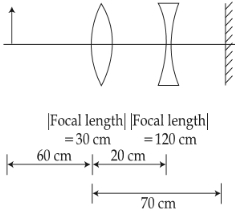
A convex lens, of focal length $30\,cm,$  a concave lens of focal length $120\,cm,$ and a plane mirror are arranged as shown. For an object kept at a distance of $60\,cm$  from the convex lens, the final image, formed by the combination, is a real image, at a distance of
Mean life of a radioactive sample is $100$ seconds. Then its half life (in minutes) is
Which of the following cannot be polarized?