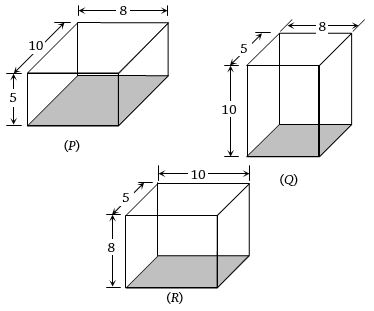
A rectangular block of size $10\,cm \times 8\,cm \times 5\,cm$ is kept in three different positions $P, Q$ and $R$ in turn as shown in the figure. In each case, the shaded area is rigidly fixed and a definite force $F$ is applied tangentially to the opposite face to deform the block. The displacement of the upper face will be
Medium


Download our appand get started for free
Experience the future of education. Simply download our apps or reach out to us for more information. Let's shape the future of learning together!No signup needed.*
Similar Questions
- 1A steel wire $1.5\,m$ long and of radius $1\,mm$ is attached with a load $3\,kg$ at one end the other end of the wire is fixed it is whirled in a vertical circle with a frequency $2\,Hz$ . Find the elongation of the wire when the weight is at the lowest position $(Y = 2 \times 10^{11}\,N/m^2$ and $g = 10\,m/s^2)$View Solution
- 2View SolutionHook's law defines
- 3A steel rod of length $\ell$, cross sectional area $A$, young's modulus of elasticity $Y$, and thermal coefficient of linear expansion $'a'$ is heated so that its temperature increases by $t\,^oC$. Work that can be done by rod on heating will beView Solution
- 4Stress required in a wire to produce $0.1\%$ strain is $4 \times10^8\, N/m^2$. Its yound modulus is $Y_1$. If stress required in other wire to produce $0.3\%$ strain is $6 \times 10^8\, N/m^2$. Its young modulus is $Y_2$. Which relation is correctView Solution
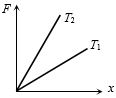
- 5The diagram shows the change $x$ in the length of a thin uniform wire caused by the application of stress $F$ at two different temperatures $T_1$ and $T_2$. The variations shown suggest thatView Solution
- 6A wire of length $L$ is hanging from a fixed support. The length changes to $L _{1}$ and $L _{2}$ when masses $1 \,kg$ and $2 \,kg$ are suspended respectively from its free end. Then the value of $L$ is equal to ..................View Solution
- 7The work done in increasing the length of a metre long wire of cross-sectional area ........ $J.$ $1\,mm^2$ through $1\,mm$ will be $(Y = 2 \times 10^{11}\,Nm^{-2})$View Solution
- 8Two exactly similar wires of steel and copper are stretched by equal forces. If the total elongation is $2 \ cm$, then how much is the elongation in steel and copper wire respectively? Given, $Y_{\text {steel }}=20 \times 10^{11} dyne / \ cm ^2, Y_{\text {copper }}=12 \times 10^{11} dyne / \ cm ^2$View Solution
- 9$A$ and $B$ are two wires. The radius of $A$ is twice that of $B.$ They are stretched by the some load. Then the stress on $B$ isView Solution
- 10The proportional limit of steel is $8 \times 10^8 \,N / m ^2$ and its Young's modulus is $2 \times 10^{11} \,N / m ^2$. The maximum elongation, a one metre long steel wire can be given without exceeding the elastic limit is $......mm$View Solution