The proportional limit of steel is $8 \times 10^8 \,N / m ^2$ and its Young's modulus is $2 \times 10^{11} \,N / m ^2$. The maximum elongation, a one metre long steel wire can be given without exceeding the elastic limit is $......mm$
Medium
Download our app for free and get started
At proportional limit
Stress $\propto$ strain
Stress $=Y \times$ strain $\{Y=$ Young's Modulus $\}$
Stress $=Y \times \frac{\Delta L}{L} $
Stress $=8 \times 10^8 \,N / m ^2 Y$
$=2 \times 10^{11} \,N / m ^2L=1 \,m $
Substituting values
$\frac{8 \times 10^8 \times 1}{2 \times 10^{11}}=\Delta L$
$4 \,mm=\Delta L$
Stress $\propto$ strain
Stress $=Y \times$ strain $\{Y=$ Young's Modulus $\}$
Stress $=Y \times \frac{\Delta L}{L} $
Stress $=8 \times 10^8 \,N / m ^2 Y$
$=2 \times 10^{11} \,N / m ^2L=1 \,m $
Substituting values
$\frac{8 \times 10^8 \times 1}{2 \times 10^{11}}=\Delta L$
$4 \,mm=\Delta L$

Download our appand get started for free
Experience the future of education. Simply download our apps or reach out to us for more information. Let's shape the future of learning together!No signup needed.*
Similar Questions
- 1Two wires $‘A’$ and $‘B’$ of the same material have radii in the ratio $2 : 1$ and lengths in the ratio $4 : 1$. The ratio of the normal forces required to produce the same change in the lengths of these two wires isView Solution
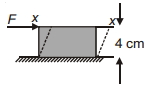
- 2A steel plate of face area $1 \,cm ^2$ and thickness $4 \,cm$ is fixed rigidly at the lower surface. A tangential force $F=10 \,kN$ is applied on the upper surface as shown in the figure. The lateral displacement $x$ of upper surface w.r.t. the lower surface is .............. $m$ (Modulus of rigidity for steel is $8 \times 10^{11} \,N / m ^2$ )View Solution
- 3The increase in length on stretching a wire is $0.05\%$. If its Poisson's ratio is $0.4$, then its diameterView Solution
- 4How much force is required to produce an increase of $0.2\%$ in the length of a brass wire of diameter $0.6\, mm$ (Young’s modulus for brass = $0.9 \times {10^{11}}N/{m^2}$)View Solution
- 5The length of a wire is $1.0\, m$ and the area of cross-section is $1.0 \times {10^{ - 2}}\,c{m^2}$. If the work done for increase in length by $0.2\, cm$ is $0.4\, joule$, then Young's modulus of the material of the wire isView Solution
- 6A $2 \,m$ long rod of radius $1 \,cm$ which is fixed from one end is given a twist of $0.8$ radians. The shear strain developed will beView Solution
- 7Three bars having length $l, 2l$ and $3l$ and area of cross-section $A, 2 A$ and $3 A$ are joined rigidly end to end. Compound rod is subjected to a stretching force $F$. The increase in length of rod is (Young's modulus of material is $Y$ and bars are massless)View Solution
- 8A uniform metal rod of $2\,\,mm^2$ cross section fixed between two walls is heated from $0\,^oC$ to $20\,^oC$ . The coefficient of linear expansion of rod is $12\,\,\times\,\,10^{-6}\,/^oC$ . Its Young's modulus of elasticity is $10^{11}\,\,N/m^2$ . The energy stored per unit volume of rod will be ....... $J/m^3$View Solution
- 9View SolutionShear modulus is zero for
- 10A boy’s catapult is made of rubber cord which is $42\, cm$ long, with $6\, mm$ diameter of cross -section and of negligible mass. The boy keeps a stone weighing $0.02\, kg$ on it and stretches the cord by $20\, cm$ by applying a constant force. When released, the stone flies off with a velocity of $20\, ms^{-1}$. Neglect the change in the area of cross section of the cord while stretched. The Young’s modulus of rubber is closest toView Solution