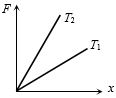
The diagram shows the change $x$ in the length of a thin uniform wire caused by the application of stress $F$ at two different temperatures $T_1$ and $T_2$. The variations shown suggest that
Easy


Download our appand get started for free
Experience the future of education. Simply download our apps or reach out to us for more information. Let's shape the future of learning together!No signup needed.*
Similar Questions
- 1The bulk moduli of ethanol, mercury and water are given as $0.9, 25$ and $2 .2$ respectively in units of $10^9\, Nm^{-2}$ . For a given value of pressure, the fractional compression in volume is $\frac{{\Delta V}}{V}$. Which of the following statements about $\frac{{\Delta V}}{V}$ for these three liquids is correct ?View Solution
- 2Join the relation of physical quantities in Column$-I$ to the details given in Column$-II$ appropriately :View Solution
Column $-I$ Column $-II$ $(a)$ Stress $\propto $ Strain $(i)$ $M^1\,L^{-1}\,T^{-2}$ $(b)$ Dimensional formula for compressibility $(ii)$ $M^{-1}\,L^{1}\,T^{-2}$ $(iii)$ Poisson’s ratio $(iv)$ Hooke’s law - 3A solid sphere of radius $r$ made of a soft material of bulk modulus $K$ is surrounded by a liquid in a cylindrical container. A massless piston of area $a$ floats on the surface of the liquid, covering entire crosssection of cylindrical container. When a mass $m$ is placed on the surface of the piston to compress the liquid, the fractional decrement in the radius of the sphere, $\left( {\frac{{dr}}{r}} \right)$ isView Solution
- 4View SolutionThe material which practically does not show elastic after effect is
- 5A wire of diameter $1mm$ breaks under a tension of $1000\, N.$ Another wire, of same material as that of the first one, but of diameter $2\, mm$ breaks under a tension of ...... $N$View Solution
- 6A rod of length $l$ and radius $r$ is joined to a rod of length $l/2$ and radius $r/2$ of same material. The free end of small rod is fixed to a rigid base and the free end of larger rod is given a twist of $\theta°$, the twist angle at the joint will beView Solution
- 7An elastic material of Young's modulus $Y$ is subjected to a stress $S$. The elastic energy stored per unit volume of the material isView Solution
- 8If the volume of the given mass of a gas is increased four times, the temperature is raised from $27°C$ to $127°C.$ The elasticity will becomeView Solution
- 9View SolutionFour identical rods are stretched by same force. Maximum extension is produced in
- 10A sphere contracts in volume by $0.01 \%$ when taken to the bottom of sea $1 \,km$ deep. Find Bulk modulus of the material of sphere ........... $N / m ^2$View Solution