Question
A rectangular courtyard is $18m, 72\ cm$ long and $13m, 20\ cm$ board. It is to be paved with square tiles of the same size. Find the least possibele number of such tiles.
Answer

Length of the courtyard $= 18m, 72\ cm = 1872\ cm$
Breadth of the courtyard $= 13m, 20\ cm = 1320\ cm$
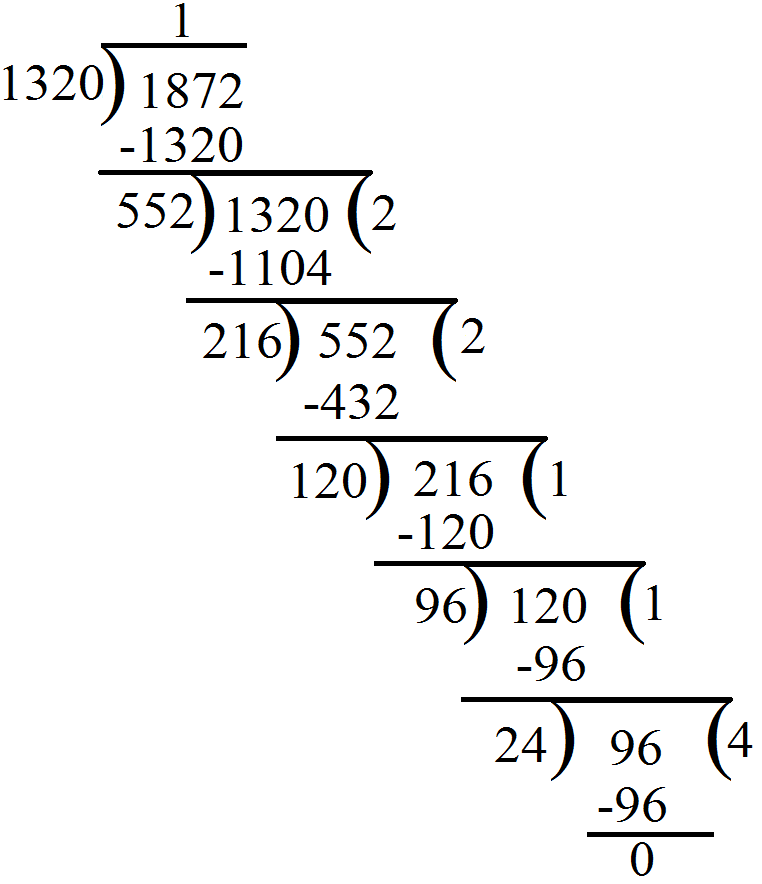
Now, maximum edge of the square tile is given by the $HCF$ of $1872\ cm$ and $1320\ cm.$​​​​​​​

$HCF$ of $1872$ and $1320 = 24$
$\therefore$ maximum edge of the squre tile $= 24\ cm$
Required number of tiles $=\frac{\text{area of courtyard}}{\text{area of each square tile}}$
$=\frac{1872\times1320}{24\times24}$
$=4290$

Need a full question paper?

Generate a complete, print-ready paper with questions like this in minutes — across 16+ boards, with answer keys.

Start Generating Free

Similar questions

Refer to question $39.$ Prepare a pictograph of the data by taking a suitable symbol to represent $200$ kilometers.
Find the largest number which divides $630$ and $940$ leaving remainders $6$ and $4$ respectively.
Mother wants to divide $₹36$ among her daughters Shreya and Bhoomika in the ratio of their ages. If age of Shreya is $15$ years and age of Bhoomika is $12$ years, find how much Shreya and Bhoomika will get$?$
The production of saleable steel in some of the steel plants of our country during $1999$ is given below:
Plant
Bhilai
Durgapur
Rourkela
Bokaro
Production (in thousand tonnes)
$160$
$80$
$200$
$150$
Construct a bar graph to represent the above data on a graph paper by using the scale $1$ big divisions $= 20$ thousand tonnes.
What part of a revolution have you turned through if you stand facing west and turn clockwise to face east?
Construct the ‘Falling Squares” figure shown below:
Image
Make sure that the squares are aligned the way they are shown. Now, try this.
Image
Draw a number line and answer the given statement:
Which number will we reach if we move $4$ numbers to the right of $– 2.$
Match the items of Column $I$ with that of Column $II:$
S.No.
Column $I$
S.No.
Column $II$
$i.$
The additive inverse of $+2$
$A.$
$0$
$ii.$
The greatest negative integer
$B.$
$-2$
$iii.$
The greatest negative even integer
$C.$
$2$
$iv.$
The smallest integer greater than every negative integer
$D.$
$1$
$v.$
Sum of predecessor and successor of $-1$
$E.$
$-1$
Draw a square, each of whose sides is $5\ cm.$ Use a pair of compasses and a ruler in your constribuction.
Copy Figure on your notebook and draw a perpendicular to l through $P,$ using $(i)$ set squares $(ii)$ Protractor $(iii)$ ruler and compasses. How many such perpendiculars are you able to draw?