Question
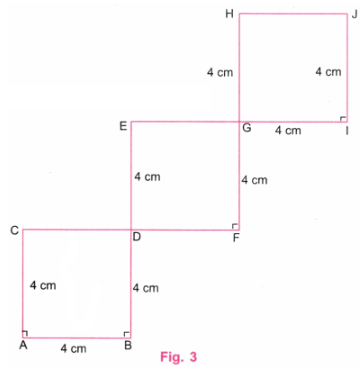
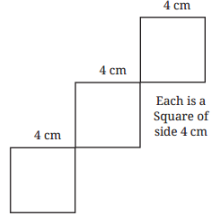
Construct the ‘Falling Squares” figure shown below:
Image
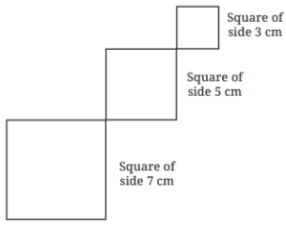
Make sure that the squares are aligned the way they are shown. Now, try this.
Image

Answer

In the given figure, there are three falling squares and the side of each square is 4 cm.
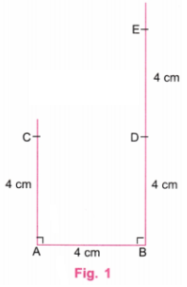
Step 1. Using a ruler, draw a line AB equal to 4 cm. Using a protractor, draw perpendicular lines at A and B.
Using a ruler, mark point C on a perpendicular line at A such that AC = 4 cm.
Using a ruler, mark points D and E on a perpendicular line at B such that BD = 4 cm and DE = 4 cm. (Fig. 1)
Image
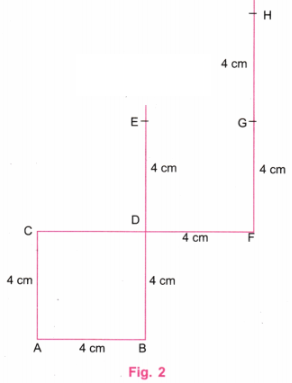
Step 2. Join C and D. Produce CD to F such that DF = 4 cm. Using a protractor, draw a perpendicular line at F. Using a ruler, mark points G and H on a perpendicular line at F such that FG = 4 cm and GH = 4 cm. (Fig. 2).
Image
Step 3. Join E and G. Produce EG to I such that GE = 4 cm. Using a protractor, draw a perpendicular line at I. Using a ruler, mark point J on the perpendicular line at I such that IJ = 4 cm. Join H and J. Erase extra lines in the figure. (Fig. 3).
Image
Step 4. Fig. 3 is the required figure of three “falling squares” each of side 4 cm.

Need a full question paper?

Generate a complete, print-ready paper with questions like this in minutes — across 16+ boards, with answer keys.

Start Generating Free

Similar questions

The area of a rectangular ground is $120m^2$ and its length is $12m$. Find the cost of fencing the ground at the rate of $Rs.125$ per metre.
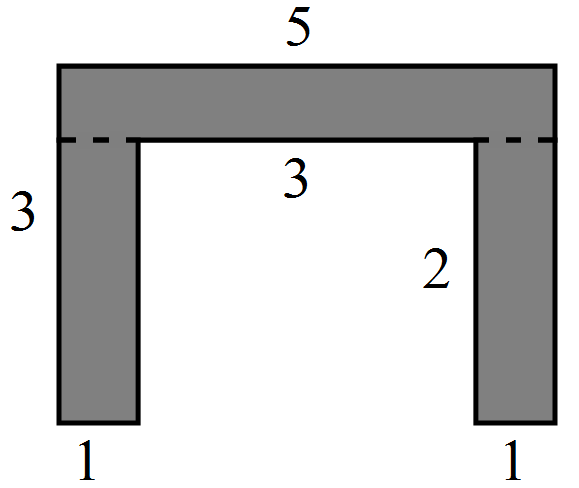
Calculate the area one of the shaded region given below (all measures are in cm):
See the figure and find the ratio of number of circles to all the figures inside the rectangle.
8
The following data gives the production of food grains (in thousand tones) for some years:
Years
$1995$
$1996$
$1997$
$1998$
$1999$
$2000$
Production (in thousand tonnes)
$120$
$150$
$140$
$180$
$170$
$190$
Represent the above data with the help of a bar graph.
Draw an angle of $50^\circ $ with the help of protractor. Draw a ray bisecting this angle.
The following fractions represent just three different numbers. Separate them into three groups of equivalent fractions, by changing each one to its simplest form.
$(a.)\frac{2}{12}$ $(b.)\frac{3}{15}$ $(c.)\frac{8}{50}$ $(d.)\frac{16}{100}$ $(e.)\frac{10}{60}$ $(f.)\frac{15}{75}$ $(g.)\frac{12}{60}$ $(h.)\frac{16}{96}$ $(i.)\frac{12}{75}$ $(j.)\frac{12}{72}$ $(k.)\frac{3}{18}$ $(l.)\frac{4}{25}$
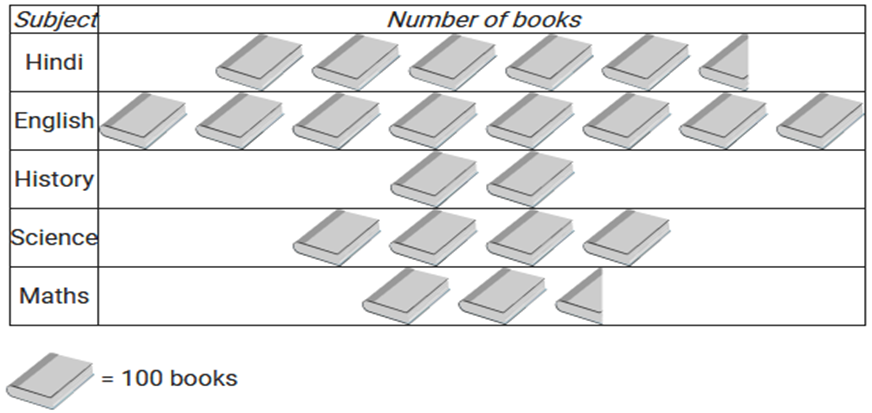
The pictograph shown different subject books which are kept in a library.

$i.\ $How many English books are there in the library?
$ii.\ $How many maths books are there?
$iii.\ $Which books are maxmimum in number?
$iv.\ $Which books are minimum in number?
Arrange the following numbers in descending order: $63521047, 7354206, 63514759, 7355014, 102345680$
Draw a line segment of length $10\ cm.$ Divide it into four equal parts. Measure each of these parts.
Identify and name the line segments and rays in the following figure: