Question
A rectangular current carrying loop is placed 1cm away from a long straight current-carrying conductor as shown.
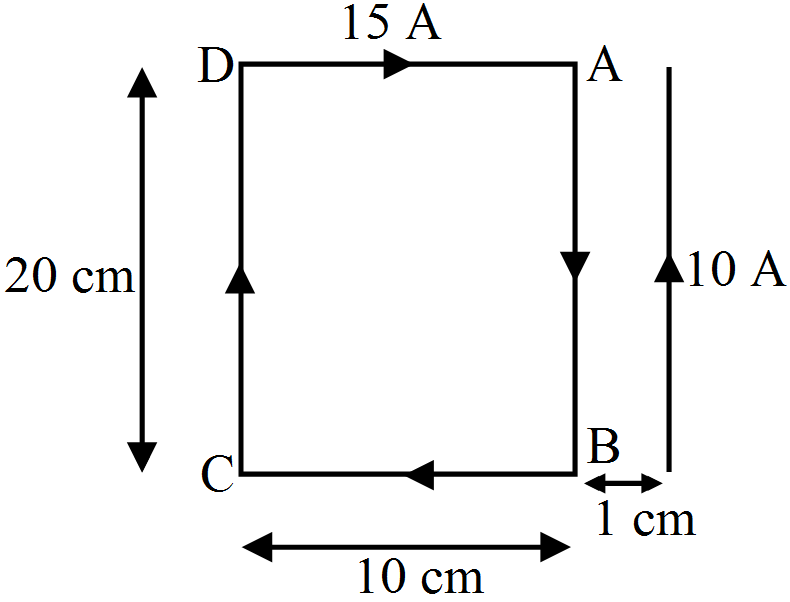
  1. Will the net force acting on the loop due to straight conductor be attractive or repulsive in nature? Justify your answer. Calculate the magnitude of this force.
Answer

The net force acting on the loop will be repulsive in nature.
Justification:
Part AB of the loop will experience a force of repulsion whereas part CD will experience attraction. Parts BC and AD will not experience any force. Thus, the overall force will be a force of repulsion because AB is closer to the straight conductor than CD and the force between two current carrying conductors is inversely proportional to the distance between them.
$\text{F}=\frac{\mu_0}{2\pi}\frac{\text{I}_1\text{I}_2}{\text{r}}\text{l}$
Net Force
Force $F_1 $ on AB due to current in the straight conductor.
$\text{F}_1=\frac{\mu_0}{2\pi}\times\frac{2\times10\times15}{1\times10^{-2}}\times20\times10^{-2}$
$= 3 \times 10^{-4}N$ towards left $\Big(\frac{\mu_0}{2\pi}=10^{-7}\Big)$
Force $F_2$ on CD due to current in thw straight conductor.
$\text{F}_2=\frac{\mu_0}{2\pi}\times\frac{2\times10\times15}{11\times10^{-2}}\times20\times10^{-2}$
$= 0.2725 \times 10^{-4}N$ towards right.
Hence, net force on the loop $= 2.72N$ towards left.

Need a full question paper?

Generate a complete, print-ready paper with questions like this in minutes — across 16+ boards, with answer keys.

Start Generating Free

Similar questions

How does the sign of the phase angle $\phi$, by which the supply voltage leads the current in an LCR series circuit, change as the supply frequency is gradually increased from very low to very high values.
Describe the potential energy of an electric dipole in an external field in different positions also draw the diagram.
Total charge -Q is uniformly spread along length of a ring of radius R. A. small test charge +q of mass m is kept at the centre of the ring and is given a gentle push along the axis of the ring.
  1. Show that the particle executes a simple harmonic oscillation.
  2. Obtain its time period.
Suppose the space between the two inner shells of the previous problem is filled with a dielectric of dielectric coastant K. Find the capacitance of the system between A and B.
Shiv had a high tension tower erected on his farm land. He kept complaining to the authorities to remove it since it occupied a large portion of his land. His uncle, who was a teacher, explained to him the need for erecting these towers for efficient transmission of power. As Shiv got convinced and realised significance, he stopped complaining.
Based on the above paragraph, answer the following questions:
  1. Why is it necessary to transport power at high voltages?
  2. ‘A low power factor implies large power loss'. Explain.
  3. Write the two values displayed by Shiv and his Uncle.
Write characteristics of different components of electromagnetic waves and describe them.
A cubical metal block of edge 12cm floats in mercury with one fifth of the height inside the mercury. Water is poured till the surface of the block is just immersed in it. Find the height of the water column to be poured. Specific gravity of mercury = 13.6.
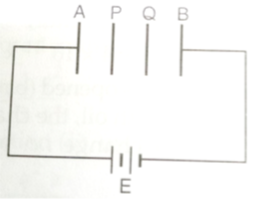
Two parallel metal plates P and Q are inserted at equal distances into a plane capacitor as shown in fig. Plates A and B of the capacitor are connected to a battery of e.m.f. V.
a. What are the potentials of the four plates?
Image
a. What are the potentials of the four plates?
b. How will the potentials of plates P and Q and the intensities of the fields in each of the three spaces change after plates P and Q have been connected by a wire?
c..What will happen to the charges on plates A and B, when plates P and Q are connected with a wire?
d. Will there be charges on the plates P and Q after connecting them with a wire?
When a metal plate is exposed to a monochromatic beam of light of wavelength 400nm, a negative potential of 1.1V is needed to stop the photocurrent. Find the threshold wavelength for the metal.
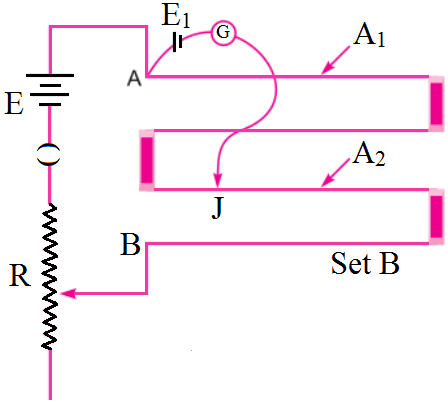
You are given two sets of potentiometer circuits to measure the emf $E_1 $ of a cell. Set A: consists of a potentiometer wire of a material of resistivity $\rho_1$, area of cross-section $A_1$ and length l. Set B: consists of a potentiometer of two composite wire of equal lengths $\frac{\text{l}}2{}$ each, of resistivity $\rho_1,\rho_2$ and area of cross-section $A _1,A_2$ respectively.

Find the relation between resistivity of the two wires with respect to their area of cross section, if the current flowing in the two sets is same. Compare the balancing length obtained in the two sets.