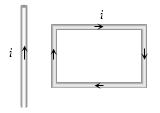
A rectangular loop carrying a current $i$ is situated near a long straight wire such that the wire is parallel to the one of the sides of the loop and is in the plane of the loop. If a steady current $I$ is established in wire as shown in figure, the loop will
AIIMS 2003,IIT 1985, Medium
Download our app for free and get started
(c)$\,{r_1} < {r_2}$
So $F_1 > F_2$
$ \Rightarrow {F_{net}} = ({F_1} - {F_2})$
towards the wire.
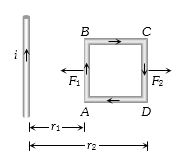
So $F_1 > F_2$
$ \Rightarrow {F_{net}} = ({F_1} - {F_2})$
towards the wire.

Download our appand get started for free
Experience the future of education. Simply download our apps or reach out to us for more information. Let's shape the future of learning together!No signup needed.*
Similar Questions
- 1A proton, an electron, and a Helium nucleus, have the same energy. They are in circular orbitals in a plane due to magnetic field perpendicular to the plane. Let $r_p, r_e$ and $r_{He}$ be their respective radii, thenView Solution
- 2View SolutionIf an electron enters a magnetic field with its velocity pointing in the same direction as the magnetic field, then
- 3An element $\Delta l=\Delta \mathrm{xi}$ is placed at the origin and carries a large current $\mathrm{I}=10 \mathrm{~A}$. The magnetic field on the $y$-axis at a distance of $0.5 \mathrm{~m}$ from the elements $\Delta \mathrm{x}$ of $1 \mathrm{~cm}$ length is:View Solution
- 4In given figure, $X$ and $Y$ are two long straight parallel conductors each carrying a current of $2\,\, A.$ The force on each conductor is $F$ newtons. When the current in each is changed to $1\, A $ and reversed in direction, the force on each is nowView Solution

- 5Two parallel wires of length $9\, m$ each are separated by a distance $0.15\, m$. If they carry equal currents in the same direction and exerts a total force of $30 \times 10^{-7} \,N$ on each other, then the value of current must be........$amp$View Solution
- 6An $\alpha$-particle (mass $4 amu$ ) and a singly charged sulfur ion (mass $32 amu$ ) are initially at rest. They are accelerated through a potential $V$ and then allowed to pass into a region of uniform magnetic field which is normal to the velocities of the particles. Within this region, the $\alpha$-particle and the sulfur ion move in circular orbits of radii $r_\alpha$ and $r_5$, respectively. The ratio $\left(r_s / r_\alpha\right)$ is. . . . .$(4)$View Solution
- 7To know the resistance $G$ of a galvanometer by half deflection method, a battery of $emf\, V_E$ and resistance $R$ is used to deflect the galvanometer by angle $\theta $. If a shunt of resistance $S$ is needed to get half deflection then $G, R$ and $S$ related by the equationView Solution
- 8View SolutionWhich is a vector quantity
- 9A charge particle of $2\,\mu\,C$ accelerated by a potential difference of $100\,V$ enters a region of uniform magnetic field of magnitude $4\,m\,T$ at right angle to the direction of field. The charge particle completes semicircle of radius $3\,cm$ inside magnetic field. The mass of the charge particle is $........\times 10^{-18}\,kg$.View Solution
- 10View SolutionTesla is the unit of