In given figure, $X$ and $Y$ are two long straight parallel conductors each carrying a current of $2\,\, A.$ The force on each conductor is $F$ newtons. When the current in each is changed to $1\, A $ and reversed in direction, the force on each is now

Medium
Download our app for free and get started
$F=\frac{\mu_{0}}{4 \pi} \frac{2 I_{1} I_{2}}{d}$
$F=\frac{\mu_{0}}{4 \pi} \frac{2 \times 2 \times 2}{d} \times l$
$F^{\prime}=\frac{\mu_{0}}{4 \pi} \frac{2 \times 1 \times 1}{d} \times l=\frac{F}{4}$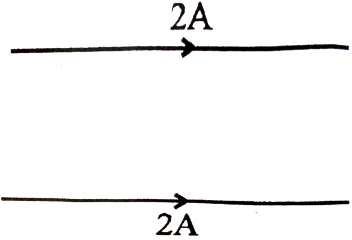

Download our appand get started for free
Experience the future of education. Simply download our apps or reach out to us for more information. Let's shape the future of learning together!No signup needed.*
Similar Questions
- 1In a hydrogen atom, an electron moves in a circular orbit of radius $5.2 \times {10^{ - 11}}\,m$ and produces a magnetic induction of $12.56\, T$ at its nucleus. The current produced by the motion of the electron will be (Given ${\mu _0} = 4\pi \times {10^{ - 7}}\,Wb/A - m)$View Solution
- 2Current $I$ is flowing in conductor shaped as shown in the figure. The radius of the curved part is $r$ and the length of straight portion is very large. The value of the magnetic field at the centre $O$ will beView Solution
- 3The magnetic field at the centre of a wire loop formed by two semicircular wires of radii $R_1=2 \pi\ \mathrm{m}$ and $R_2=4 \pi\ \mathrm{m}$ carrying current $I=4 \mathrm{~A}$ as per figure given below is $\alpha \times 10^{-7} \mathrm{~T}$. The value of $\alpha$ is___________ (Centre $\mathrm{O}$ is common for all segments)View Solution
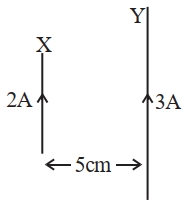
- 4A wire $X$ of length $50\; cm$ carrying a current of $2\,A$ is placed parallel to a long wire $Y$ of length $5\,m$. The wire $Y$ carries a current of $3\,A$. The distance between two wires is $5\,cm$ and currents flow in the same direction. The force acting on the wire $Y$ is.View Solution
- 5A loop is moulded by a constant length current carrying wire and placed in external magnetic field, then torque acts on it does not depends uponView Solution
$(a)$ Shape of loop
$(b)$ Area of loop.
$(c)$ Current in loop
$(d)$ External magnetic field.
- 6A galvanometer with its coil resistance $25\,\Omega $ requires a current of $1\,mA$ for its full deflection. In order to construct an ammeter to read up to a current of $2\,A,$ the approximate value of the shunt resistance should beView Solution
- 7View SolutionA metallic ring with a small cut is held horizontally and a magnet is allowed to fall vertically through the ring then the acceleration of the metallic ring is :
- 8View SolutionTwo infinitely long parallel wires carry equal current in same direction. The magnetic field at a mid point in between the two wires is
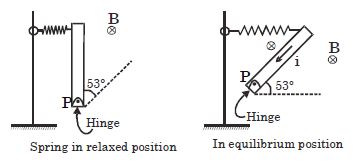
- 9A thin uniform rod with negligible mass and length $l$ is attached to the floor by a frictionless hinge at point $P$ . A horizontal spring with force constant $k$ connects the other end to wall. The rod is in a uniform magnetic field $B$ directed into the plane of paper. What is extension in spring in equilibrium when a current $i$ is passed through the rod in direction shown. Assuming spring to be in natural length initially.View Solution
- 10A small block of mass $m$, having charge $q$ is placed on frictionless inclined plane making an angle $\theta$ with the horizontal. There exists a uniform magnetic field $B$ parallel to the inclined plane but perpendicular to the length of spring. If $m$ is slightly pulled on the inclined in downward direction and released, the time period of oscillation will be (assume that the block does not leave contact with the plane)View Solution