To know the resistance $G$ of a galvanometer by half deflection method, a battery of $emf\, V_E$ and resistance $R$ is used to deflect the galvanometer by angle $\theta $. If a shunt of resistance $S$ is needed to get half deflection then $G, R$ and $S$ related by the equation
JEE MAIN 2016, Diffcult
Download our app for free and get started
According to Ohm's Law, $I$ $=\frac{V}{R}$
$\mathrm{I}_{\mathrm{g}}=\frac{\mathrm{V}}{\mathrm{R}+\mathrm{G}}$
where, $I $$_{g}$ - Galvanometer current, $G-$Galvonometer resistance
When shunt of resistance $S$ is connected parallel to the Galvanometer then
$\mathrm{G}=\frac{\mathrm{GS}}{\mathrm{G}+\mathrm{S}}$
$\therefore I=\frac{V}{R+\frac{G S}{G+S}}$
Equal potential difference is given by
$\mathrm{I}_{\mathrm{g}}^{\prime} \mathrm{G}=\left(\mathrm{I}-\mathrm{I}_{\mathrm{B}}^{\prime}\right) \mathrm{S}$
$\mathrm{I}_{\mathrm{g}}^{\prime}(\mathrm{G}+\mathrm{S})=\mathrm{IS}$
$\Rightarrow \frac{\mathrm{I}_{\mathrm{g}}}{2}=\frac{\mathrm{IS}}{\mathrm{G}+\mathrm{S}}$
$\Rightarrow \frac{\mathrm{v}}{2(\mathrm{R}+\mathrm{G})}=\frac{\mathrm{v}}{\mathrm{R}+\frac{\mathrm{GS}}{\mathrm{G}+\mathrm{S}}} \times \frac{\mathrm{S}}{\mathrm{G}+\mathrm{S}}$
$ \Rightarrow \frac{1}{{2(R + G)}} = \frac{S}{{R(G + S) + GS}}$
$\Rightarrow R(G+S)+G S=2 S(R+G)$
$\Rightarrow \mathrm{RG}+\mathrm{RS}+\mathrm{GS}=2 \mathrm{S}(\mathrm{R}+\mathrm{G})$
$\Rightarrow \mathrm{RG}=2 \mathrm{S}(\mathrm{R}+\mathrm{G})-\mathrm{S}(\mathrm{R}+\mathrm{G})$
$\therefore \mathrm{RG}=\mathrm{S}(\mathrm{R}+\mathrm{G})$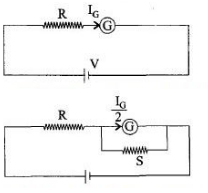

Download our appand get started for free
Experience the future of education. Simply download our apps or reach out to us for more information. Let's shape the future of learning together!No signup needed.*
Similar Questions
- 1A small square loop of wire of side $l$ is placed inside a large square loop of wire of side $L(L >> l)$. The loops are coplaner and their centres coincide. The mutual inductance of the system is propotional toView Solution
- 2A conductor of length $l$ and mass $m$ is placed along the east-west line on a table. Suddenly a certain amount of charge is passed through it and it is found to jump to a height $h$. The earth’s magnetic induction is $B$. The charge passed through the conductor is:View Solution
- 3When a resistance of $5\,\Omega$ is shunted with a moving coil galvanometer, it shows a full scale deflection for a current of $250\,mA$, however when $1050\,\Omega$ resistance is connected with it in series, it gives full scale deflection for $25$ volt. The resistance of galvanometer is $......\,\Omega$.View Solution
- 4View SolutionThe radius of curvature of the path of the charged particle in a uniform magnetic field is directly proportional to
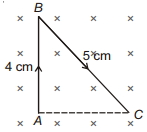
- 5A uniform conducting wire $A B C$ has a mass of $10 \,g$. A current of $2 \,A$ flows through it. The wire is kept in a uniform magnetic field $B=2 T$. The acceleration of the wire will be ............. $ms ^{-2}$View Solution
- 6A battery is connected between two points $A$ and $B$ on the circumference of a uniform conducting ring of radius $r$ and resistance $R$. One of the arcs $AB$ of the ring subtends an angle $\theta $ at the centre. The value of the magnetic induction at the centre due to the current in the ring isView Solution
- 7A coil in the shape of an equilateral triangle of side $10\, {cm}$ lies in a vertical plane between the pole pieces of permanent magnet producing a horizontal magnetic field $20\, {mT}$. The torque acting on the coil when a current of $0.2\, {A}$ is passed through it and its plane becomes parallel to the magnetic field will be $\sqrt{{x}} \times 10^{-5} \,{Nm}$. The value of ${x}$ is ..... .View Solution
- 8A beam of protons with speed $4 \times 10^{5}\, ms ^{-1}$ enters a uniform magnetic field of $0.3\, T$ at an angle of $60^{\circ}$ to the magnetic field. The pitch of the resulting helical path of protons is close to....$cm$View Solution
(Mass of the proton $=1.67 \times 10^{-27}\, kg$, charge of the proton $=1.69 \times 10^{-19}\,C$)
- 9Which of the following graphs shows the variation of magnetic induction $B$ with distance $r$ from a long wire carrying currentView Solution
- 10A particle having some charge is projected in $x-y$ plane with a speed of $5\ m/s$ in a region having uniform magnetic field along $z-$ axis. Which of the following cannot be the possible value of velocity at any time ?View Solution