Question
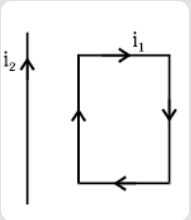
A rectangular loop carrying a current $i_1​,$ is situated near a long straight wire carrying a steady current $i_2​.$ The wire is parallel to one of the sides of the loop and is in the plane of the loop as shown in the figure. Then the current loop will:
Answer

The magnetic field due to the straight current current carrying wire decreases with increasing distance from the wire.
Thus the magnetic field is stronger at the side closer to wire and weaker at the other.
Force on each segment of wire is $\text{BIL}$
Hence force acting on nearer side towards the wire is greater than the force acting on farther side away from wire. Hence the net force on loop is towards the wire.

Need a full question paper?

Generate a complete, print-ready paper with questions like this in minutes — across 16+ boards, with answer keys.

Start Generating Free

Similar questions

In an A.C. circuit the voltage is V, and current is I, then power loss will be :
Suppose the medium in the previous question is water. Select the correct option$(s)$ from the list given in that question.
The number of photons of frequency $ 10^{14} $ Hz in radiation of 6.62 J will be :
Two light beams superimposed each other constructively this results in$:$
Weber $/ \mathrm{m}^2$ is equal to
To an observer on the earth the stars appear to twinkle. This can be ascribed to(a) The fact that stars do not emit light continuously(b) Frequent absorption of star light by their own atmosphere(c) Frequent absorption of star light by the earth's atmosphere(d) The refractive index fluctuations in the earth's atmosphere


A moving charge produces:
The amount of substance liberated on electrodes during electrolysis when 1 coulomb of electricity is passed, is(a) Chemical equivalent(b) Electrochemical equivalent(c) Equivalent weight(d) One mol
   
   
In Young's double slit experiment, 62 fringes are seen in visible region for sodium light of wavelength 5893 Å. If violet light of wavelength 4358 Å is used in place of sodium light, then number of fringes seen will be(a) 54(b) 64(c) 74       (d) 84
       
$X-$rays of wavelength $0.1 \mathring A$ allowed to fall on a metal get scattered. The wavelength of scattered radiation is $0.111 \mathring A $. If $h = 6.624 \times 10^{–34}\ J-s$ and $m_0 = 9 \times 10^{–31}\ kg,$ then the direction of the scattered photons will be