Question
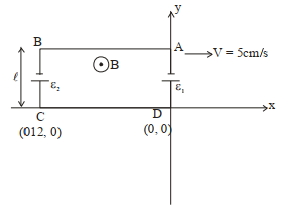
A rectangular loop of sides $12 \mathrm{~cm}$ and $5 \mathrm{~cm}$, with its sides parallel to the $x$-axis and $y$-axis respectively moves with a velocity of $5 \mathrm{~cm} / \mathrm{s}$ in the positive $\mathrm{x}$ axis direction, in a space containing a variable magnetic field in the positive $z$ direction. The field has a gradient of $10^{-3} \mathrm{~T} / \mathrm{cm}$ along the negative $\mathrm{x}$ direction and it is decreasing with time at the rate of $10^{-5} \mathrm{~T} / \mathrm{s}$. If the resistance of the loop is $6 \mathrm{~m} \Omega$, the power dissipated by the loop as heat is______ $\times 10^{-9} \mathrm{~W}$.
Answer

$\mathrm{B}_0$ is the magnetic field at origin

$\frac{d B}{d x}=-\frac{10^{-3}}{10^{-2}}$

$\int_{B_0}^B d B=-\int_0^x 10^{-1} d x$

$B-B_0=-10^{-1} x$

$B=\left(B_0-\frac{x}{10}\right)$

Motional emf in $\mathrm{AB}=0$

Motional emf in $\mathrm{CD}=0$

Motional emf in $\mathrm{AD}=\varepsilon_1=\mathrm{B}_0 / \mathrm{v}$

Magnetic field on $\operatorname{rod} B C B$

$=\left(\mathrm{B}_0-\frac{\left(-12 \times 10^{-2}\right)}{10}\right)$

Motional emf in $\mathrm{BC}=\varepsilon_2=\left(\mathrm{B}_0+\frac{12 \times 10^{-2}}{10}\right) \ell \times \mathrm{v}$

$\varepsilon_{\text {eq }}=\varepsilon_2-\varepsilon_1=300 \times 10^{-7} \mathrm{~V}$

For time variation

$\left(\varepsilon_{\text {eq }}\right)^{\prime}=\mathrm{A} \frac{\mathrm{dB}}{\mathrm{dt}}=60 \times 10^{-7} \mathrm{~V}$

$\left(\varepsilon_{\text {eq }}\right)_{\text {net }}=\varepsilon_{\text {eq }}+\left(\varepsilon_{\text {eq }}\right)^{\prime}=360 \times 10^{-7} \mathrm{~V}$

$\text { Power }=\frac{\left(\varepsilon_{\text {eq }}\right)_{\text {net }}^2}{\mathrm{R}}=216 \times 10^{-9} \mathrm{~W}$

Need a full question paper?

Generate a complete, print-ready paper with questions like this in minutes — across 16+ boards, with answer keys.

Start Generating Free

Similar questions

A photodetector is made from a semiconductor In$ 0.53$ $Ga$  $0.47$ As with $E_g = 0.73 \,eV$. What is the maximum wavelength, which it can detect.........$nm$
Select wrong statement about simple,harmonic motion
Consider a hydrogen-like ionized atom with atomic number $Z$ with a single electron. In the emission spectrum of this atom, the photon emitted in the $n =2$ to $n =1$ transition has energy $74.8 eV$ higher than the photon emitted in the $n =3$ to $n =2$ transition. The ionization energy of the hydrogen atom is $13.6 eV$. The value of $Z$ is. . . . . .
A $dc$ source of $emf \,E_1 = 100\,V$ and internal resistance $r = 0.5\,\Omega ,$ a storage battery of emf $E_2 = 90\,V$ and an external resistance $R$ are connected as shown in figure. For what value of $R$ no current will pass through the battery ? ................ $\Omega$
All surfaces shown in figure are assumed to be frictionless and the pulleys and the string are light. The acceleration of the block of mass $2 \mathrm{~kg}$ is :
A nucleus is bombarded with a high speed neutron so that resulting nucleus is a radioactive one. This phenomenon is called
The angular speed of a fly wheel moving with uniform angular acceleration changes from $1200\,rpm$ to $3120\,rpm$ in $16$ seconds. The angular acceleration in $rad/s^{2}$ is :
If the source of light used in a Young's Double Slit Experiment is changed from red to blue, then
A man is slipping on a frictionless inclined plane and a bag falls down from the same height. Then the velocity of both is related as
Two particles of equal mass are connected to a rope $AB$ of negligible mass such that one is at end $A$ and other dividing the length of rope in the ratio $1:2$ from $B$. The rope is rotated about end $B$ in a horizontal plane. Ratio of tensions in the smaller part to the other is (ignore effect of gravity)