Question
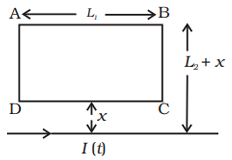
A rectangular loop of wire $\text {ABCD}$ is kept close to an infinitely long wire carrying a current $I ( t )= l _0\left(1-\frac{t}{T}\right)$ for $0 \leq t \leq T$ and $I (0)=0$ for $t > T \ ($Figure$)$. Find the total charge passing through a given point in the loop, in time $T$ .
The resistance of the loop is $R$.
Image

Answer

To find the charge that passes through the circuit first we have to find the relation between instantaneous current and instantaneous magnetic flux linked with it.
The emf induced can be obtained by differentiating the expression of magnetic flux linked $\text {w.r.t. t}$ and then applying Ohm's law, we get $A$ rectangular loop of wire $\text {ABCD}$ is kept close to an infinitely long wire carrying a current
$I=\frac{E}{R}=\frac{1}{R} \frac{d \phi}{d t}$
According to the problem electric current is given as a function of time.
$I(t)=\frac{d Q}{d t}$ or $\frac{d Q}{d t}=\frac{1}{R} \frac{d \phi}{d t}$
Integrating the variable separately in the form of the differential equation for finding the charge $Q$ that passed in time $t,$ we have
$Q\left(t_1\right)-Q\left(t_2\right)=\frac{1}{R}\left[\phi\left(t_1\right)-\phi\left(t_2\right)\right]$
$\phi\left(t_1\right)=L_1 \frac{\mu_0}{2 \pi} \int_x^{L_2+x} \frac{d x^2}{x^{\prime}} I\left(t_1\right)\left[\phi_m=\vec{B} \cdot \vec{A}=\frac{\mu_0 I}{2 \pi} l \int_{x_0}^x \frac{d r}{r}=\frac{\mu_0 I l}{2 \pi} \ln \frac{x}{x_0}\right]$
$=\frac{\mu_0 L_1}{2 \pi} I\left(t_1\right) \ln \frac{L_2+x}{x}$
Therefore the magnitude of charge is
$Q=\frac{1}{R}\left[\phi\left(T^{\prime}\right)-\phi(0)\right]$
$Q=\frac{\mu_0 L_1}{2 \pi} \ln \frac{L_2+x}{x}\left[I\left(T^{\prime}\right)-I(0)\right]$
Now $I(T)=I_1$ and $I(0)=0$
$\therefore Q=\frac{\mu_0 L_1}{2 \pi} I_1 \ln \left(\frac{L_2+x}{x}\right)$
This is the required expression.

Need a full question paper?

Generate a complete, print-ready paper with questions like this in minutes — across 16+ boards, with answer keys.

Start Generating Free

Similar questions

Draw a plot showing the variation of power of a lens with the wavelength of the incident light.
The figure shows three infinitely long straight parallel current carrying conductors. Find the
  1. magnitude and direction of the net magnetic field at point A lying on conductor 1,
  2. magnetic force on conductor 2.
Explain the process of thermonuclear fusion with example.
  1. Using Bohr's second postulate of quantization of orbital angular momentum show that the circumference of the electron in the $n^{th}$ orbital state in hydrogen atom is n times the de Broglie wavelength associated with it.
  2. The electron in hydrogen atom is initially in the third excited state.What is the maximum number of spectral lines which can be emitted when it finally moves to the ground state?
The force of surface tension acts tangentially to the surface whereas the force due to air pressure acts perpendicularly on the surface. How is then the force due to excess pressure inside a bubble balanced by the force due to the surface tension?
A light ray is incident at an angle of 45° with the normal to a $\sqrt{2}\text{cm}$ thick plate $(\mu = 2.0)$. Find the shift in the path of the light as it emerges out from the plate.
Derive the equation of the missing term in the Ampere circuital law $OR$ Derive the equation of displacement current and write its unit and definition.
A beam of light consisting of two wavelengths $, 650 nm$ and $520 nm,$ are used to obtain interference fringes in a Young's double slit experiment.
$a$. Find the distance of the third bright fringe on the screen from the central maximum for wavelength $650 nm.$
$b$. What is the least distance from the central maximum where the bright fringes due to both the wavelengths coincide?
A person sitting on the top of a tall building is dropping balls at regular intervals of one second. Find the positions of the $3^{rd}, 4^{th}$ and $5^{th}$ ball when the $6^{th}$ ball is being dropped.
What will be the effect on placing a metal foil between the plates of a parallel plate capacitor on its capacitance?