Questions

3 Marks Question

Take a timed test

8 questions · self-marked practice — reveal the answer and mark yourself.

Question 13 Marks
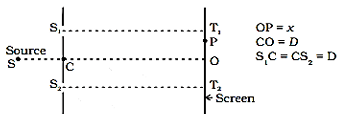
Consider a two $-$ slit interference arrangements $($Figure$)$ such that the distance of the screen from the slits is half the distance between the slits. Obtain the value of $D$ in terms of $\lambda$ such that the first minima on the screen fall at a distance $D$ from the center $O$.
Image
Answer
According to  $\theta$
$ d = D \text { (Given) ...(i) }$
$\ D=\frac{1}{2} d \text { (Given) ...(ii) }$
$d=2D$
Path difference at $P = S _2 P - S _1 P$
Path difference $p=\sqrt{D^2+\left(x+\frac{d}{2}\right)^2}-\sqrt{D^2+\left(x-\frac{d}{2}\right)^2}$
Substitute the value of $d$ and $x$ from $(i)$ and $(ii)$
$=\sqrt{\left.D^2+(D)+D\right)^2}-\sqrt{D^2+(D-D)^2}$
$=\sqrt{5 D^2}-\sqrt{D^2}$
$p=D(\sqrt{5}-1)$
The path difference for $n$ the dark fringe from central maxima $O$ is $(2 n-1) \frac{\lambda}{2}$
$\therefore$ For $1^{st}$ minima $p=\frac{\lambda}{2}$
Put the value of $p$ in $(iii)$
$\frac{\lambda}{2}=D(\sqrt{5}-1)$
$D=\frac{\lambda}{2(\sqrt{5}-1)}$
Rationalizing the denominator, we get,
$D=\frac{\lambda}{2(\sqrt{5}-1)} \times \frac{(\sqrt{5}+1)}{(\sqrt{5}+1)}$
$=\frac{(2.236+1)}{2 \times(5-1)} \lambda=\frac{3.236}{2 \times 4} \lambda$
$=\frac{3.236}{8} \lambda=0.404 \lambda$
View full question & answer
Question 23 Marks
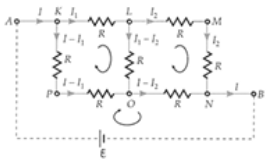
Find the equivalent resistance between the terminals $A$ and $B$ in the network shown in Figure. Given each resistor $R$ is $10 \Omega$.
Image
Answer
Imagine a battery of $emf ,$ having no internal resistance, connected between the points $A$ and $B$. The distribution of current through various branches is as shown in Figure.
Image

Applying Kirchhoff's second law to loop $\text{KLOPK},$ we get
$ I _1 R +\left( I _1- I _2\right) R -2\left( I - I _1\right) R =0$
$\text { or } 4 I _1- I _2=2 I \ldots \text { (i) }$
Similarly, from the loop $\text{LMNOL},$ we have
$2 I _2 R -\left( I - I _2\right) R -\left( I _1- I _2\right) R =0$
$\text { or }- I _1+4 I _1= I \ldots \text { (ii) }$
From the loop $\text{AKPONBEA},$ we have
$2\left( I - I _1\right) R +\left( I - I _2\right) R =\varepsilon \ldots(iii)$
Solving equations $(i)$ and $(ii),$ we get
$I_1=\frac{3}{5} I$ and $I_2=\frac{2}{5} I$
Substituting these values in equation $(iii),$ we get
$2\left(I-\frac{3}{5} I\right) R+\left(I-\frac{2}{5} I\right) R=\varepsilon$
$\text { or } \frac{7}{5} I R=\varepsilon \ldots \text { (iv) }$
If $R^{\prime}$ is the equivalent resistance between $A$ and $B ,$ then
$I R^{\prime}=\varepsilon \ldots( v )$
From $(iv)$ and $(v), I R^{\prime}=\frac{7}{5} I R$
or $R^{\prime}=\frac{7}{5} R=\frac{7}{5} \times 10=14 \Omega$
View full question & answer
Question 33 Marks
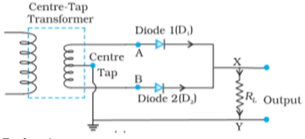
With the help of a circuit diagram, explain how two p-n junction diodes along with a centre tapped transformer can be used as a full wave rectifier.
Answer
Image

Explanation
The circuit diagram is as shown above.
During positive half of the AC input, diode D1 gets forward biased and conducts and diode D2 gets reverse biased. During negative half of the AC input, diode D2 gets forward biased and conducts; and diode D1 gets reverse biased. So, output is obtained during both positive and negative half of the cycle in the same direction.
View full question & answer
Question 43 Marks
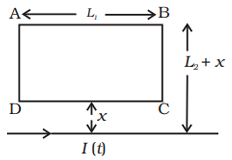
A rectangular loop of wire $\text {ABCD}$ is kept close to an infinitely long wire carrying a current $I ( t )= l _0\left(1-\frac{t}{T}\right)$ for $0 \leq t \leq T$ and $I (0)=0$ for $t > T \ ($Figure$)$. Find the total charge passing through a given point in the loop, in time $T$ .
The resistance of the loop is $R$.
Image
Answer
To find the charge that passes through the circuit first we have to find the relation between instantaneous current and instantaneous magnetic flux linked with it.
The emf induced can be obtained by differentiating the expression of magnetic flux linked $\text {w.r.t. t}$ and then applying Ohm's law, we get $A$ rectangular loop of wire $\text {ABCD}$ is kept close to an infinitely long wire carrying a current
$I=\frac{E}{R}=\frac{1}{R} \frac{d \phi}{d t}$
According to the problem electric current is given as a function of time.
$I(t)=\frac{d Q}{d t}$ or $\frac{d Q}{d t}=\frac{1}{R} \frac{d \phi}{d t}$
Integrating the variable separately in the form of the differential equation for finding the charge $Q$ that passed in time $t,$ we have
$Q\left(t_1\right)-Q\left(t_2\right)=\frac{1}{R}\left[\phi\left(t_1\right)-\phi\left(t_2\right)\right]$
$\phi\left(t_1\right)=L_1 \frac{\mu_0}{2 \pi} \int_x^{L_2+x} \frac{d x^2}{x^{\prime}} I\left(t_1\right)\left[\phi_m=\vec{B} \cdot \vec{A}=\frac{\mu_0 I}{2 \pi} l \int_{x_0}^x \frac{d r}{r}=\frac{\mu_0 I l}{2 \pi} \ln \frac{x}{x_0}\right]$
$=\frac{\mu_0 L_1}{2 \pi} I\left(t_1\right) \ln \frac{L_2+x}{x}$
Therefore the magnitude of charge is
$Q=\frac{1}{R}\left[\phi\left(T^{\prime}\right)-\phi(0)\right]$
$Q=\frac{\mu_0 L_1}{2 \pi} \ln \frac{L_2+x}{x}\left[I\left(T^{\prime}\right)-I(0)\right]$
Now $I(T)=I_1$ and $I(0)=0$
$\therefore Q=\frac{\mu_0 L_1}{2 \pi} I_1 \ln \left(\frac{L_2+x}{x}\right)$
This is the required expression.
View full question & answer
Question 53 Marks
$a$. A toroidal solenoid with an air core has an average radius of $0.15\ m,$ area of cross section $12 \times 10^{-4} m^2$ and $1200$ turns. Obtain the self inductance of the toroid. Ignore field variation across the cross section of the toroid.
$b$. A second coil of $300$ turns is wound closely on the toroid above. If the current in the primary coil is increased from zero to $2.0 A$ in $0.05\ s,$ obtain the induced emf in the secondary coil.
Answer
$a. B=\mu_0 n_1 I=\frac{\mu_0 N_1 I}{l}=\frac{\mu_0 N_1 I}{2 \pi r}$
Total magnetic flux, $\phi_B=N_1 B A=\frac{\mu_0 N_1^2 I A}{2 \pi r}$
$\text { But } \phi_B=L I$
$\therefore L=\frac{\mu_0 N_1^2 A}{2 \pi r}$
Or $ L=\frac{4 \pi \times 10^{-7} \times 1200 \times 1200 \times 12 \times 10^{-4}}{2 \pi \times 0.15}$
$=2.3 \times 10^{-3} H=2.3 mH$
$|E|=\frac{d}{d t}\left(\phi_2\right)$ where $ \phi_2$ is the total magnetic flux linked with the second coil. 
$|E|=\frac{d}{d t}\left(N_2 B A\right)$
$=\frac{d}{d t}\left[N_2 \frac{\mu_0 N_1 I}{2 \pi r} A\right]$
$|E|=\frac{\mu_0 N_1 N_2 A}{2 \pi r} \frac{d I}{d t}$
$|E|=\frac{4 \pi \times 10^{-7} \times 1200 \times 300 \times 12 \times 10^{-4} \times 2}{2 \pi \times 0.15 \times 0.05}$
$=0.023 V$
View full question & answer
Question 63 Marks
It is found experimentally that $13.6 eV$ energy is required to separate a hydrogen atom into a proton and an electron. Compute the orbital radius and the velocity of the electron in a hydrogen atom.
Answer
Total energy of the electron in hydrogen atom is $-13.6 eV =-13.6 \times 1.6 \times 10^{-19} J$
$=-2.2 \times 10^{-18} J$
Thus from Eq., we have
$-\frac{e^2}{8 \pi \varepsilon_0 r}= E$
This gives the orbital radius
$r=-\frac{e^2}{8 \pi \varepsilon_0 E}$
$=-\frac{\left(9 \times 10^9 Nm ^2 / C ^2\right)\left(1.6 \times 10^{-19} C \right)^2}{(2)\left(-2.2 \times 10^{-18} J\right)}$
$=5.3 \times 10^{-11} m$
The velocity of the revolving electron can be computed from Eq. with $m =9.1 \times 10^{-31} \ kg$,
$\frac{1}{2} m v^2=\frac{e^2}{4 \pi \epsilon_0 r^2}$ thus velocity of electron is given by : $-$
$v=\frac{e}{\sqrt{4 \pi \varepsilon_0 m r^2}}$
$=2.2 \times 10^6 m / s$
View full question & answer
Question 73 Marks
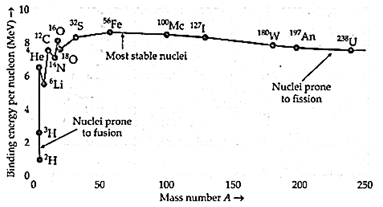
Draw a plot showing the variation of binding energy per nucleon with mass number A. Write two important conclusions which you can draw from this plot. Explain with the help of this plot, the release in energy in the processes of nuclear fusion and fission.
Answer
Image

Binding energy per nucleon as a function of mass number A.
Two important conclusions from this graph are:
i. Nuclear forces non-central and short ranged force.
ii. Nuclear forces between proton-neutron and neutron-neutron are strong and attractive in nature.
Explanation of Nuclear Fission: When a heavy nucleus (A ≥ 235 say) breaks into two lighter nuclei (nuclear fission), the binding energy per nucleon increases i.e, nucleons get more tightly bound. This implies that energy would be released in nuclear fission. 
Explanation of Nuclear Fusion: When two very light nuclei (A  ≤ 10) join to form a heavy nucleus, the binding is energy per nucleon of fused heavier nucleus more than the binding energy per nucleon of lighter nuclei, so again energy would be released in nuclear fusion.
View full question & answer
Question 83 Marks
An alpha particle is accelerated through a potential difference of $100 \ V.$ Calculate:
$i.$ The speed acquired by the alpha particle, and
$ii.$ The de$-$Broglie wavelength associated with it. 
$($Take mass of alpha particle $=6.4 \times 10^{-27} kg )$
Answer
$i. \frac{1}{2} m v^2=q V$
$\frac{1}{2} m v^2=2 e \times 100$
$\text { or, } \frac{1}{2} m v^2=2 e \times 100$
$\text { or, } m v^2=400 eV $
$\text { or, } v =\sqrt{\frac{400 eV }{m}}$
$\text { or, } v =\sqrt{\frac{400 \times 1.6 \times 10^{-19}}{6.4 \times 10^{-27}}}$
$\therefore v =10^5 m / s $
$ii.$ de$-$Broglie wavelength $=\lambda=\frac{h}{\sqrt{2 m q V}}$
$\text { Or, } \lambda=\frac{6.6 \times 10^{-34}}{\sqrt{2 \times 6.4 \times 10^{-27} \times 2 \times 1.6 \times 10^{-19} \times 100}}$
$\therefore \lambda=1.03 \times 10^{-12} m$
View full question & answer
3 Marks Question - Physics STD 12 Science Questions - Vidyadip