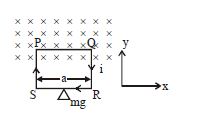
A rectangular loop of wire, supporting a  mass $m$, hangs with one end in a uniform magnetic field $\vec B$  pointing into the plane of the paper. $A$ clockwise current is set up such that  $i> mg/Ba,$ where $a$ is the width of the loop. Then
  • A
    The weight decends due to a vertical force caused by the magnetic field
  • B
    The weight moves towards rightward
  • C
    The weight rises due to a vertical force caused by the magnetic field
  • D
    None of these
Medium
art

Download our app
and get started for free

Experience the future of education. Simply download our apps or reach out to us for more information. Let's shape the future of learning together!No signup needed.*

Similar Questions

  • 1
    A particle having the same charge as of electron moves in a circular path of radius $0.5
    \,cm$ under the influence of a magnetic field of $0.5\,T.$ If an electric field of $100\,V/m$ makes it to move in a straight path, then the mass of the particle is (given charge of electron $= 1.6 \times 10^{-19}\, C$ )
    View Solution
  • 2
    Equal currents are flowing in three infinitely long wires along positive $x, y$ and $z$ direction. The magnetic field at a point $(0, 0, -a)$ would be ( $i =$ current in each wire)
    View Solution
  • 3
    A particle of mass $m$ and charge $q$ moves with a constant velocity $v$ along the positive $x$ direction. It enters a region containing a uniform magnetic field $B$ directed along the negative $z$ direction, extending from $x = a$ to $x = b$. The minimum value of $v$ required so that the particle can just enter the region $x > b$ is
    View Solution
  • 4
    Two moving coil meters $M_1$ and $M_2$ having the following particulars :-
    $R_1 = 10\,\Omega , N_1 = 30, A_1 = 3.6\times10^{-3}\, m^2, B_1 = 0.25\, T$
    $R_2 = 14\,\Omega , N_2 = 42, A_2 = 1.8\times10^{-3}\, m^2, B_2 = 0.50\, T$
    (The spring constants are identical for the two meters). Determine the ratio of voltage sensitivity of $M_2$ and $M_1$
    View Solution
  • 5
    Electrons moving with different speeds enter a uniform magnetic field in a direction perpendicular to the field. They will move along circular paths.
    View Solution
  • 6
    A wire carrying current $I$ is tied between points $P$ and $Q$ and is in the shape of a circular arc of radius $R$ due to a uniform magnetic field $B$ (perpendicular to the plane of the paper, shown by $\times \times \times $) in the vicinity of the wire. If the wire subtends an angle $2\theta_0$ at the centre of the circle (of which it forms an arc) then the tension in the wire is
    View Solution
  • 7
    A current of $0.1\, A$ circulates around a coil of $100$ $turns$ and having a radius equal to $5\,cm$. The magnetic field set up at the centre of the coil is ($\mu_0 = 4\pi \times 10^{-7} weber/amp-metre$)
    View Solution
  • 8
    A straight rod of mass $m$ and length $L$ is suspended from the identical spring as shown in the figure. The spring stretched by a distance of $x_0$ due to the weight of the wire. The circuit has total resistance $R\Omega$ . When the magnetic field perpendicular to the plane of the paper is switched on, springs are observed to extend further by the same distance. The magnetic field strength is 
    View Solution
  • 9
    The expression for the torque acting on a coil having area of cross-section $A$, number of turns $n$, placed in a magnetic field of strength $B$, making an angle $\theta $ with the normal to the plane of the coil, when a current $i$ is flowing in it, will be
    View Solution
  • 10
    Two identical moving coil galvanometer have $10 \Omega$ resistance and full scale deflection at $2 \mu A$ current. One of them is converted into a voltmeter of $100 mV$ full scale reading and the other into an Ammeter of $1 mA$ full scale current using appropriate resistors. These are then used to measure the voltage and current in the Ohm's law experiment with $R =1000 \Omega$ resistor by using an ideal cell. Which of the following statement( $s$ ) is/are correct?

    $(1)$ The measured value of $R$ will be $978 \Omega$

    $(2)$ The resistance of the Voltmeter will be $100 k \Omega$.

    $(3)$ The resistance of the Ammeter will be $0.02 \Omega$ (round off to $2^{\text {nd }}$ decimal place)

    $(4)$ If the ideal cell is replaced by a cell having internal resistance of $5 \Omega$ then the measured value of $R$ will be more than $1000 \Omega$.

    View Solution