Question
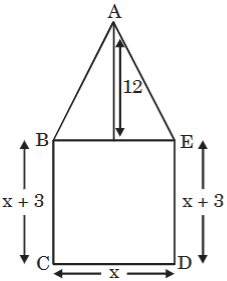
A rectangular park is to be designed whose breadth is 3 m less than its length. Its area is to be 4 square metres more than the area of a park that has already been made in the shape of an isosceles triangle with its base as the breadth of the rectangular park and of altitude 12 m. Find the length and breadth of the park.
Need a full question paper?

Generate a complete, print-ready paper with questions like this in minutes — across 16+ boards, with answer keys.

Start Generating Free

Similar questions

Abdul travelled 300km by train and 200km by taxi taking 5 hours 30 minutes. But, if he travels 260km by train and 240km by taxi, he takes 6 minutes longer. Find the speed of the train and that of the taxi.
The following table shows the cumulative frequency distribution of marks of 800 students in an examination:
Marks Number of students
Below 10 10
Below 20 50
Below 30 130
Below 40 270
Below 50 440
Below 60 570
Below 70 670
Below 80 740
Below 90 780
Below 100 800
Construct a frequency distribution table for the data above.
If $\cos\theta=\frac{3}{5},$ find the value of $\frac{\sin\theta-\frac{1}{\tan\theta}}{2\tan\theta}.$
A square ABCD is inscribed in a circle of radius r. Find the area of the square.
A solid is in the shape of a right$-$circular cone surmounted on a hemisphere, the radius of each of them being $7 \ cm$ and the height of the cone is equal to its diameter. Find the volume of the solid.
Find the value of x for which (x + 2), 2x, (2x + 3) are three consecutive terms of an AP.
Solve the following quadratic equations by factorization:
$3\Big(\frac{7\text{x}+1}{5\text{x}-3}\Big)-4\Big(\frac{5\text{x}-3}{7\text{x}+1}\Big)=11,$ $\text{x}\neq\frac{3}{5},-\frac{1}{7}$
Two dice are rolled once. Find the probability of getting such numbers on two dice whose product is a perfect square.
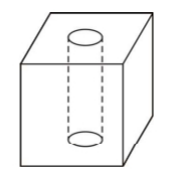
In Figure, from a solid cube of side 7 cm , a cylinder of radius 2.1 cm and height 7 cm is scooped out. Find the total surface area of the remaining solid.
Image
A straight highway leads to the foot of a tower. A man standing at the top of the tower observes a car at an angle of depression of $30^{\circ},$ which is approaching the foot of the tower with a uniform speed. Six seconds later, the angle of depression of the car is found to be $60^{\circ}$. Find the further time taken by the car to reach the foot of the tower from this point.