Question
A reference frame attached to the earth:
  1. Is an inertial frame by definition.
  2. Cannot be an inertial frame because the earth is revolving around the sun.
  3. Is an inertial frame because Newton's laws are applicable in this frame.
  4. Cannot be an inertial frame because the earth is rotating about its axis.
Answer

  1. Cannot be an inertial frame because the earth is revolving around the sun.
  1. Cannot be an inertial frame because the earth is rotating about its axis.
Explanation:
A reference frame attached to the earth cannot be an inertial frame because the earth is revolving around the sun and also rotating about its axis.

Need a full question paper?

Generate a complete, print-ready paper with questions like this in minutes — across 16+ boards, with answer keys.

Start Generating Free

Similar questions

It is required to construct a $10\mu\text{F}$ capacitor which can be connected across a 200V battery. Capacitors of capacitance $10\mu\text{F}$ are available but they can withstand only 50V. Design a combination which can yield the desired result.
Two masses $M_1$ and $M_2$ are connected by a light rod and the system is slipping down a rough incline of angle $\theta$ with the horizontal. The friction coefficient at both the contacts is $\mu.$ Find the acceleration of the system and the force by the rod on one of the blocks.
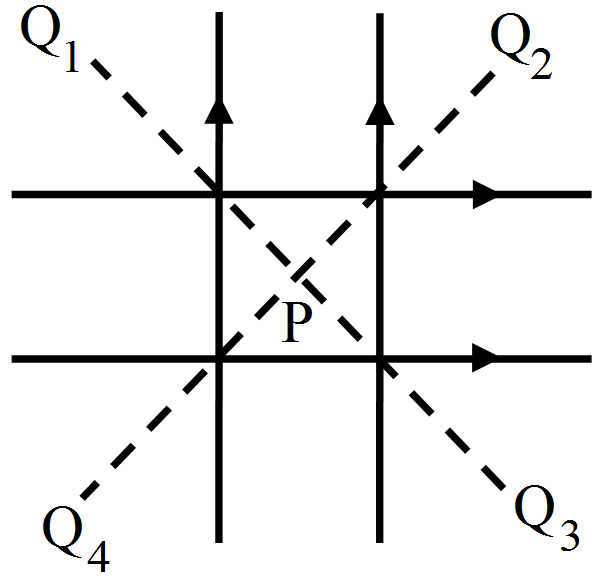
Four long, straight wires, each carrying a current of $5.0A,$ are placed in a plane as shown in figure. The points of intersection form a square of side $5.0\ cm$.
  1. Find the magnetic field at the centre $P$ of the square.
  2. $Q_1, Q_2, Q_3,$ and $Q_4$ are points situated on the diagonals of the liquare and at a distance from $P$ that is equal to the length of the diagonal of the square. Find the magnetic fields at these points.
What is a transformer? It is of how many types? Explain the principle, construction and working of any transformer.
A long, straight wire carries a current i. Let $B_1,$ be the magnetic field at a point Pat a distance d from the wire. Consider a section of length l of this wire such that the point $P$ lies on a perpendicular bisector of the section. Let $B_2$ be the magnetic field at this point due to this section only. Find the value of $\frac{\text{d}}{\text{l}}$ so that $B_2$ differs from $B_1,$ by $1\%.$
Two waves, each having a frequency of $100Hz$ and a wavelength of $2.0\ cm,$ are travelling in the same direction on a string. What is the phase difference between the waves,
  1. If the second wave was produced $0.015s$ later than the first one at the same place.
  2. If the two waves were produced at the same instant but the first one was produced a distance $4.0\ cm$ behind the second one?
  3. If each of the waves has an amplitude of $2.0\ mm,$ what would be the amplitudes of the resultant waves in part $(a)$ and $(b)$?
Describe the procedure for obtaining V-I characteristic curve in forward bias of P-N junction diode. Make a circuit diagram of the experimental arrangement.
Find the speed of an electron with kinetic energy:
  1.  1eV
  2. 10keV
  3. 10MeV
What are the values of the self-induced emf in the circuit of the previous problem at the times indicated therein?
A heavy but uniform rope of length L is suspended from a ceiling.
  1. Write the velocity of a transverse wave travelling on the string as a function of the distance from the lower.
  2. If the rope is given a sudden sideways jerk at the bottom, how long will it take for the pulse to reach the ceiling?
  3. A particle is dropped from the ceiling at the instant the bottom end is given the jerk. Where will the particle meet the pulse ?