Question
What is a transformer? It is of how many types? Explain the principle, construction and working of any transformer.
Answer

SELF

Need a full question paper?

Generate a complete, print-ready paper with questions like this in minutes — across 16+ boards, with answer keys.

Start Generating Free

Similar questions

The difference in the frequencies of series limit of Lyman series and Balmer series is equal to the frequency of the first line of the Lyman series. Explain.
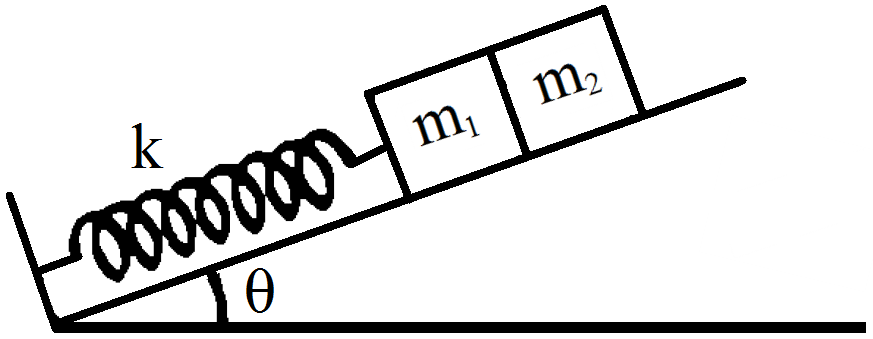
The block of mass $m_1$ shown in figure is fastened to the spring and the block of mass $m_2$ is placed against it.
  1. Find the compression of the spring in the equilibrium position.
  2. The blocks are pushed a further distance $\big(\frac{2}{\text{k}}\big)(\text{m}_1+\text{m}_2)\text{g}\sin\theta$ sine against the spring and released. Find the position where the two blocks separate.
  3. What is the common speed of blocks at the time of separation?
Answer the following questions:
(a) Are the equations of nuclear reactions (such as those given in Section 13.7) 'balanced' in the sense a chemical equation (e.g., $2 H _2+ O _2 \rightarrow 2 H _2 O$ ) is? If not, in what sense are they balanced on both sides?
(b) If both the number of protons and the number of neutrons are conserved in each nuclear reaction, in what way is mass converted into energy (or vice-versa) in a nuclear reaction?
(c) A general impression exists that mass-energy interconversion takes place only in nuclear reaction and never in chemical reaction. This is strictly speaking, incorrect. Explain.
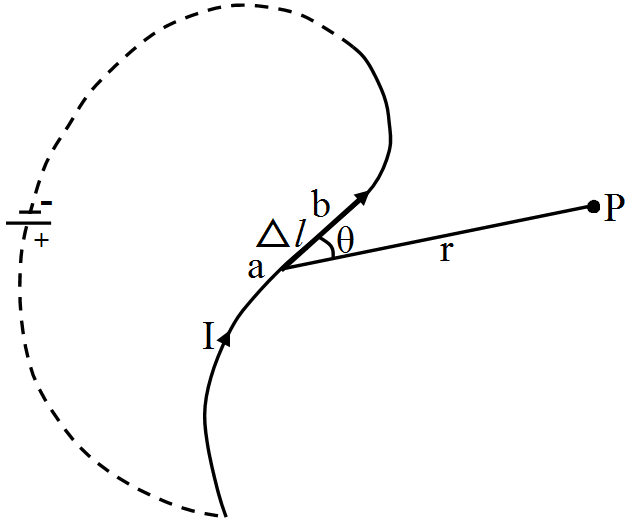
State and explain Biot$-$Savart law. Use it to derive an expression for the magnetic field produced at a point near a long current carrying wire.
A group of students while coming from the school noticed a box marked "Danger H.T. 2200 V" at a substation in the main street. They did not understand the utility of such a high voltage, while they argued, the supply was only 220 V.They asked their teacher this question the next day. The teacher thought it to be an important question and therefore explained to the whole class.
Answer the following questions:
  1. What device is used to bring the high voltage down to low voltage of a.c. Current and what is the principle of its working?
  2. Is it possible to use this device for bringing down the high d.c. Voltage to the low voltage? Explain.
  3. Write the values displayed by the students and the teacher.
What is meant by electric potential? Calculate the electric potential generated by a point charge. Draw the equipotential surfaces resulting from this.
A steel frame $(\text{K}=45\text{Wm}^{-1}{^{\circ}}\text{C}^{-1})$of total length $60\ cm$ and cross sectional area $0.20\ cm^2,$ forms three sides of a square. The free ends are maintained at $20^\circ C$ and $40^\circ C.$ Find the rate of heat flow through a cross section of the frame.
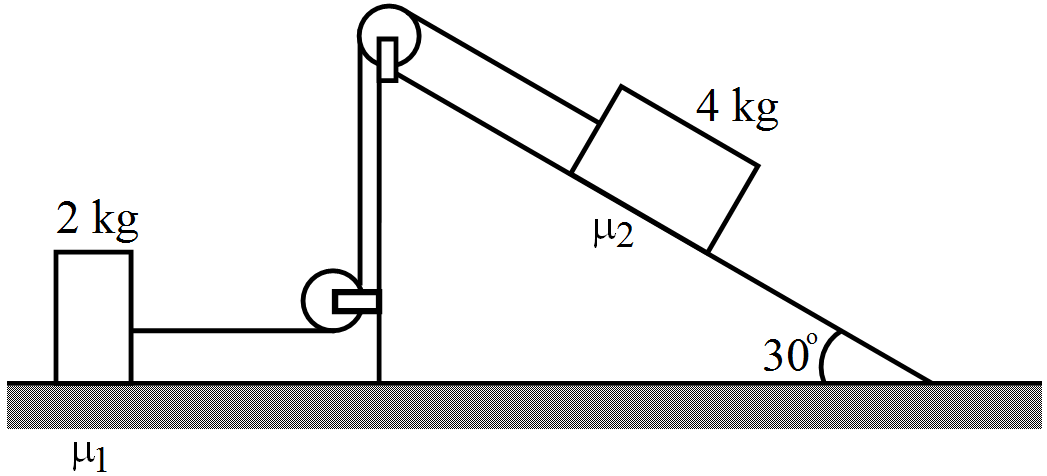
If the tension in the string in figure is $16N$ and the acceleration of each block is $0.5\ m/s^2,$ find the friction coefficients at the two contacts with the blocks.
$(I)$ Explain briefly, with the help of a labelled diagram, the basic principle of the working of an $a.c.$ generator. In an a.c. generator, coil of $N$ turns and area $A$ is rotated at an angular velocity $ω$ in a uniform magnetic field $B$. Derive an expression for the instantaneous value of the emf induced in coil. What is the source of energy generation in this device?
The bob of a stationary pendulum is given a sharp hit to impart it a horizontal speed of $\sqrt{3\text{gl}}.$ Find the angle rotated by the string before it becomes slack.