Question
A reference frame attached to the earth:
  1. Is an inertial frame by definition.
  2. Cannot be an inertial frame because the earth is revolving around the sun.
  3. Is an inertial frame because Newton's laws are applicable in this frame.
  4. Cannot be an inertial frame because the earth is rotating about its axis.
Answer

  1. Cannot be an inertial frame because the earth is revolving around the sun.
  1. Cannot be an inertial frame because the earth is rotating about its axis.
Explanation:

A reference frame attached to the earth cannot be an inertial frame because the earth is revolving around the sun and also rotating about its axis.

Need a full question paper?

Generate a complete, print-ready paper with questions like this in minutes — across 16+ boards, with answer keys.

Start Generating Free

Similar questions

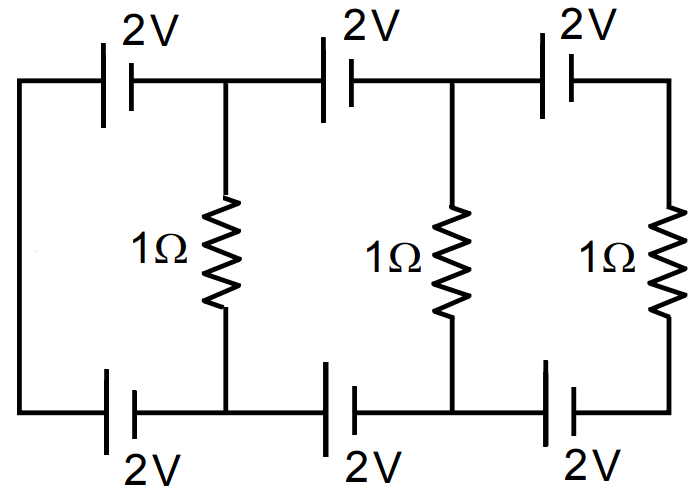
Find the circuit in the three resistors shown in the figure.

The teachers of Geeta’s school took the students on a study trip to a power generating station, located nearly 200km away from the city. The teacher explained that electrical energy is transmitted over such a long distance to their city, in the form of alternating current (ac) raised to a high voltage. At the receiving end in the city, the voltage is reduced to operate the devices. As a result, the power loss is reduced. Geeta listened to the teacher and asked questions about how the ac is converted to a higher or lower voltage.
  1. Name the device used to change the alternating voltage to a higher or lower value. State one cause for power dissipation in this device.
  2. Explain with an example, how power loss is reduced if the energy is transmitted over long distances as an alternating current rather than a direct current.
  3. Write two values each shown by the teachers and Geeta.
The half-life of 199Au is 2.7 days.
  1. Find the activity of a sample containing $1.00\mu\text{g}$ of 198Au.
  2. What will be the activity after 7 days? Take the atomic weight of 198Au to be 198g/mol.
A series L-C-R circuit is connected to an AC source. Using the phasor diagram, derive the expression for the impedance of the circuit. Plot a graph to show the variation of current with frequency of the source, explaining the nature of its variation.
  1. Obtain lens makers formula using the expression

 $\frac{\text{n}_{2}}{\text{v}} - \frac{\text{n}_{1}}{\text{u}} = \frac{(\text{n}_{2} - \text{n}_{1})}{\text{R}}$ 

Here the ray of light propagating from a rare medium of refractive index (n1) to a denser medium of refractive index (n2) is incident on the convex side of spherical refracting surface of radius of curvature R.

  1. Draw a ray diagram to show the image formation by a concave mirror when the object is kept between its focus and the pole. Using this diagram, derive the magnification formula for the image formed.
Establish an expression for induced electromotive force due to rotational motion of a conducting rod in a uniform magnetic field.
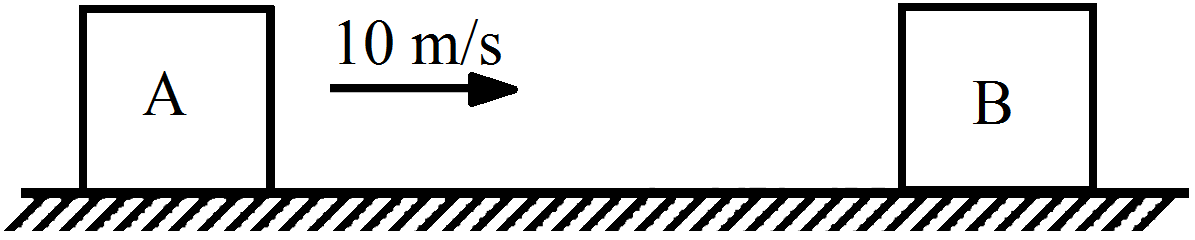
The blocks shown in figure have equal masses. blocks in the process. The surface of A is smooth but that of B has a friction coefficient of 0.10 with the floor. Block A is moving at a speed of 10m/s towards B which is kept at rest. Find the distance travelled by B if
  1. The collision is perfectly elastic
  2. The collision is perfectly inelastic. (Take g = 10m/s2)

For the $\beta^{+}$ (positron) emission from a nucleus, there is another competing process known as electron capture (electron from an inner orbit, say, the K–shell, is captured by the nucleus and a neutrino is emitted).
$\text{e}^{+}+^{\text{A}}_{\text{Z}}\text{X}\rightarrow\ ^{\text{A}}_{\text{Z}-1}\text{Y}+\text{v}$
Show that if $\beta^{+}$ emission is energetically allowed, electron capture is necessarily allowed but not vice–versa.
A particle of mass m and charge q is released from the origin in a region in which the electric field and magnetic field are given by
$\overrightarrow{\text{B}}=-\text{B}_0\overrightarrow{\text{j}}$ and $\overrightarrow{\text{E}}=\text{E}_0\overrightarrow{\text{k}}.$ Find the speed of the particle as a function of its z-coordinate.
i. With the help of a diagram, explain the principle and working of a device which produces current that reverses its direction after regular intervals of time.
ii. If a charged capacitor C is short-circuited through an inductor L, the charge and current in the circuit oscillate simple harmonically. a. In what form the capacitor and the inductor store energy? b. Write two reasons due to which the oscillations become damped.