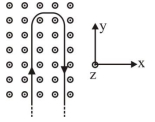
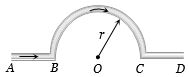
A rigid wire consists of a semicircular portion of radius $R$ and two straight sections. The wire is partially immerged in a perpendicular magnetic field $B=B_0\ {j}$ as shown in figure. The magnetic force on the wire if it has a current $i$ is :
JEE MAIN 2024, Diffcult
Download our app for free and get started
Note : $Direction of magnetic field is in$ $+\hat{k}$
$\vec{F}=i \vec{\ell} \times \vec{B}$
$\ell=2 \mathrm{R}$
$\vec{F}=-2 i R B \hat{j}$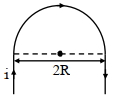

Download our appand get started for free
Experience the future of education. Simply download our apps or reach out to us for more information. Let's shape the future of learning together!No signup needed.*
Similar Questions
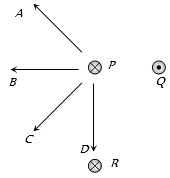
- 1In figure shows three long straight wires $P, Q$ and $R$ carrying currents normal to the plane of the paper. All three currents have the same magnitude. Which arrow best shows the direction of the resultant force on the wire $P$View Solution
- 2Two circular coils $P$ and $Q$of $100$ turns each have same radius of $\pi \mathrm{cm}$. The currents in $\mathrm{P}$ and $\mathrm{R}$ are $1 \mathrm{~A}$ and $2 \mathrm{~A}$ respectively. $\mathrm{P}$ and $\mathrm{Q}$ are placed with their planes mutually perpendicular with their centers coincide. The resultant magnetic field induction at the center of the coils is $\sqrt{\mathrm{x}} \mathrm{mT}$, where X=___.View Solution
$\left[\text { Use } \mu_0=4 \pi \times 10^{-7} \mathrm{TmA}^{-1}\right]$
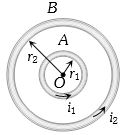
- 3$A$ and $B$ are two concentric circular conductors of centre $O$ and carrying currents ${i_1}$ and ${i_2}$ as shown in the adjacent figure. If ratio of their radii is $1 : 2$ and ratio of the flux densities at $O$ due to $A$ and $B$ is $1 : 3$, then the value of ${i_1}/{i_2}$ isView Solution
- 4A homogeneous electric field $E$ and a uniform magnetic field $\mathop B\limits^ \to $ are pointing in the same direction. A proton is projected with its velocity parallel to $\mathop E\limits^ \to $. It willView Solution
- 5the magnetic induction at $O$ due to the whole length of the conductor isView Solution
- 6A current of $0.1\, A$ circulates around a coil of $100$ $turns$ and having a radius equal to $5\, cm$. The magnetic field set up at the centre of the coil is $({\mu _0} = 4\pi \times {10^{ - 7}}\,weber/ampere - metre)$View Solution
- 7A galvanometer gives full scale deflection with $0.006$ A current. By connecting it to a $4990 \ \Omega$ resistance, it can be converted into a voltmeter of range $0-30 \ V$. If connected to a $\frac{2 n }{249} \Omega$ resistance, it becomes an ammeter of range $0-1.5 \ A$. The value of $n$ is:View Solution
- 8A moving coil galvanometer has a coil with $175\, turns$ and area $1\, cm^2$ It uses a torsion band of torsion constant $10^{-6}\, N\, -m/rad$. The coil is placed in a magnetic field $B$ parallel to its plane. The coil deflects by $10$ for a current of $1\, mA$. The value of $B$ (in Tesla) is approximatelyView Solution
- 9The resistance of a galvanometer is $90\, ohms$. If only $10$ percent of the main current may flow through the galvanometer, in which way and of what value, a resistor is to be usedView Solution
- 10Two identical moving coil galvanometer have $10 \Omega$ resistance and full scale deflection at $2 \mu A$ current. One of them is converted into a voltmeter of $100 mV$ full scale reading and the other into an Ammeter of $1 mA$ full scale current using appropriate resistors. These are then used to measure the voltage and current in the Ohm's law experiment with $R =1000 \Omega$ resistor by using an ideal cell. Which of the following statement( $s$ ) is/are correct?View Solution
$(1)$ The measured value of $R$ will be $978 \Omega$
$(2)$ The resistance of the Voltmeter will be $100 k \Omega$.
$(3)$ The resistance of the Ammeter will be $0.02 \Omega$ (round off to $2^{\text {nd }}$ decimal place)
$(4)$ If the ideal cell is replaced by a cell having internal resistance of $5 \Omega$ then the measured value of $R$ will be more than $1000 \Omega$.