MCQ
A rod is placed on a smooth horizontal surface. The stress developed when temperature is increased by $40\,^oC$

$[\alpha = 5\, \times\, 10^{-5}\,^oC^{-1},\,\, \gamma = 5\, \times\, 10^{11}\,\, N/m^2]$

  • A
    $10^9\,\,N/m^2$
  • B
    $2\,\,\times\,\,10^9\,\,N/m^2$
  • C
    $10^{11}\,\,N/m^2$
  • Zero

Answer

Correct option: D.
Zero
d
No stress will develop as both ends of rod are free and rod is placed on smooth floor

Need a full question paper?

Generate a complete, print-ready paper with questions like this in minutes — across 16+ boards, with answer keys.

Start Generating Free

Similar questions

A transverse wave is described by the equation $Y = {Y_0}\sin 2\pi \left( {ft - \frac{x}{\lambda }} \right)$. The maximum particle velocity is four times the wave velocity if
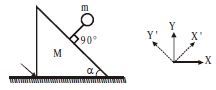
A ball of mass $m$ strikes the inclined face of the wedge normally with speed $v_0$. The wedge is at rest on a rough horizontal surface before collision. The conservation of momentum is applicable for the event of collision for

$(i)$ $m$ as system, along $Y'$
$(ii) $ $M$ as system, along $Y'$
$(iii)$ $(M + m)$ as system, along $X$
$(iv)$  $(M + m)$ as system, along $Y$
Which of the following is correct?

Critical angle of incidence for a pair of optical media is $45^{\circ}$. The refractive indices of first and second media are in the ratio:
A potential barrier of $ 0.50 $ $V $ exists across a $P-N$ junction. If the depletion region is $5.0 \times {10^{ - 7}}$m wide, the intensity of the electric field in this region is
Two charges $ + 5\,\mu C$ and $ + 10\,\mu C$ are placed $20\, cm$ apart. The net electric field at the mid-Point between the two charges is
It is possible for a substance to coexist in all three phases in equilibrium, when the substance is at
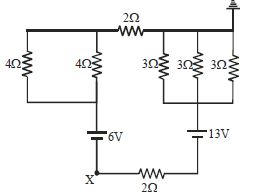
Find potential at point $'x'$ in given circuit ............... $V$
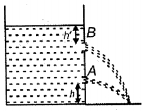
A tank is filled with water and two holes $A$ and $B$ are made in it. For getting same range, ratio of $h^{\prime} T h$ is ..........
While working on a physics project at school physics lab, you require a $4 \,\mu F$ capacitor in a circuit across a potential difference of $1 \,kV$. Unfortunately, $4 \,\mu F$ capacitors are out of stock in your lab but $2 \,\mu F$ capacitors which can withstand a potential difference of $400 \,V$ are available in plenty. If you decide to use the $2 \,\mu F$ capacitors in place of $4 \,\mu F$ capacitor, minimum number of capacitors required are
The vibration of a string fixed at both ends are described by $Y= 2 \,\,sin(\pi x) \,\,sin\,\,(100\pi t)$ where $Y$ is in $mm$,$x$ is in $cm$,$t$ in $sec$ then