MCQ
A rod is placed on a smooth horizontal surface. The stress developed when temperature is increased by $40\,^oC$

$[\alpha = 5\, \times\, 10^{-5}\,^oC^{-1},\,\, \gamma = 5\, \times\, 10^{11}\,\, N/m^2]$

  • A
    $10^9\,\,N/m^2$
  • B
    $2\,\,\times\,\,10^9\,\,N/m^2$
  • C
    $10^{11}\,\,N/m^2$
  • Zero

Answer

Correct option: D.
Zero
d
No stress will develop as both ends of rod are free and rod is placed on smooth floor

Need a full question paper?

Generate a complete, print-ready paper with questions like this in minutes — across 16+ boards, with answer keys.

Start Generating Free

Similar questions

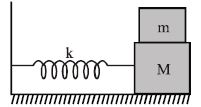
In the arrangement, spring constant $k$ has value $2\,N\,m^{-1}$ , mass $M = 3\,kg$ and mass $m = 1\,kg$ . Mass $M$ is in contact with a smooth surface. The coefficient of friction between two blocks is $0.1$ . The time period of $SHM$ executed by the system is
The correct increasing order for modulus of elasticity for copper, steel, glass and rubber is
An ideal gas is expanding such that ${PT}^{3}=$ constant. The coefficient of volume expansion of the gas is:
Which of the following is not a vector quantity?
A car of mass 1000 kg passes on inclined curve of radius 90 m on a frictionless road. If the inclination of turn is $45^{\circ}$ then the speed of car is
A vertical closed cylinder is separated into two parts by a frictionless piston of mass $m$ and of negligible thickness. The piston is free to move along the length of the cylinder .The length of the cylinder above the piston is $l_1,$ and that below the piston is $l_2,$ such that $l_1 > l_2.$ Each part of the cylinder contains $n$ moles of an ideal gas at equal temperature $T.$ If the piston is stationary, its mass, $m,$ will be given by: ( $R$ is universal gas constant and $g$ is the acceleration due to gravity)
A bomb of mass $30\,kg$at rest explodes into two pieces of masses $18\,kg$ and $12\,kg$. The velocity of $18\,kg$ mass is $6\,m{s^{ - 1}}$. The kinetic energy of the other mass is ....... $J$
Consider a uniform rod of mass $\mathrm{M}=4 \mathrm{m}$ and length $\ell$ pivoted about its centre. A mass $m$ moving with velocity $v$ making angle $\theta=\frac{\pi}{4}$ to the rod's long axis collides with one end of the rod and sticks to it. The angular speed of the rod-mass system just after the collision is
The minimum orbital angular momentum of the electron in a hydrogen atom is:

  1. $\text{h}$

  2. $\frac{\text{h}}{2}$

  3. $\frac{\text{h}}{2\pi}$

  4. $\frac{\text{h}}{\lambda}$

Doppler's effect holds good for: