A rod of length $l$ and area of cross-section $A$ is heated from $0°C$ to $100°C$. The rod is so placed that it is not allowed to increase in length, then the force developed is proportional to
Easy
Download our app for free and get started
(c) $F = YA\alpha \Delta \theta \,\,\,\therefore F \propto A$

Download our appand get started for free
Experience the future of education. Simply download our apps or reach out to us for more information. Let's shape the future of learning together!No signup needed.*
Similar Questions
- 1The extension of a wire by the application of load is $3$ $mm.$ The extension in a wire of the same material and length but half the radius by the same load is..... $mm$View Solution
- 2If $\rho $ is the density of the material of a wire and $\sigma $ is breaking stress, the greatest length of the wire that can hang freely without breaking isView Solution
- 3View SolutionCorrect pair is ..........
- 4View SolutionCorrect pair is ..........
- 5View SolutionThe shear strain is possible in .............
- 6If the Bulk modulus of lead is $8.0 \times 10^9 \,N / m ^2$ and the initial density of the lead is $11.4 \,g / cc$, then under the pressure of $2.0 \times 10^8 \,N / m ^2$, the density of the lead is $............. g / cc$View Solution
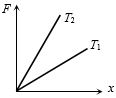
- 7The diagram shows the change $x$ in the length of a thin uniform wire caused by the application of stress $F$ at two different temperatures $T_1$ and $T_2$. The variations shown suggest thatView Solution
- 8The area of cross section of a steel wire $(Y = 2.0 \times {10^{11}}N/{m^2})$ is $0.1\;c{m^2}$. The force required to double its length will beView Solution
- 9Which of the following curve represents the correctly distribution of elongation $(y)$ along heavy rod under its own weight $L \rightarrow$ length of rod, $x \rightarrow$ distance of point from lower end?View Solution
- 10A bob of mass $10\, kg$ is attached to wire $0.3\, m$ long. Its breaking stress is $4.8 \times 10^7 N/m^2$. The area of cross section of the wire is $10^{-6} m^2$. The maximum angular velocity with which it can be rotated in a horizontal circle ....... $rad/sec$View Solution